Meaning
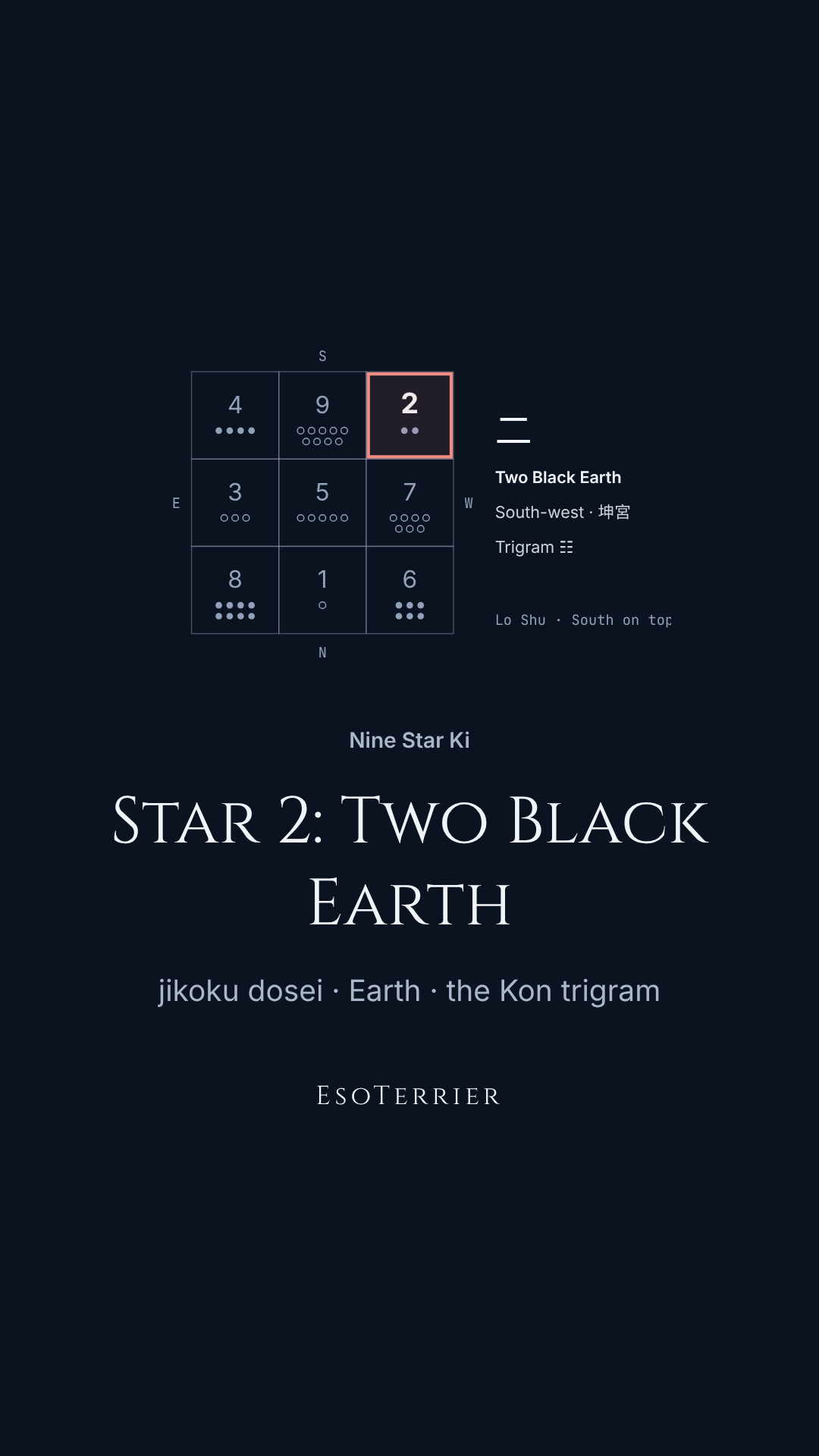
Two Black Earth belongs to the south-west palace, the place of the 坤 trigram. In the Shuogua's circuit of the year this is where the great work of feeding is done: "致役乎坤", service is rendered in 坤, for 坤 is the earth, from which all things receive their nourishment. The trigram's family role is the mother, and it sits on the turn from summer to autumn.
Japanese practitioners read a person whose year star is 二黒 as steady, plain-spoken and patient: someone who serves, supports and builds slowly, and who is often described with the proverb 大器晩成, a great vessel takes long to finish. Our own text calls it the field that feeds: nurturing, patient and methodical, a natural supporter who works steadily behind the scenes and stays loyal, with worry, indecision and stubbornness as the shadow side. The Kushi line calls the number 2 Soil and gives it late summer and the early afternoon, with themes of listening, conserving and strengthening.
On the boards
二黒 is the star of the solar years 1989, 1998, 2007, 2016 and 2025, each from 立春. In a 二黒 year the first solar month opens with 二黒 itself, so a 二黒 person born between 立春 and 啓蟄, early February to early March, or in the 亥 month between 立冬 and 大雪, has the same month star: the centre case, 中宮傾斜, which the schools read differently.
With any other month star in the centre, a 二黒 year star lands in 乾宮 (month star 1), 巽宮 (3), 震宮 (4), 坤宮 (5), 坎宮 (6), 離宮 (7), 艮宮 (8) or 兌宮 (9), and that palace is the inclination.
The south-west palace is the second house of the nine-step rhythm the boards trace. A person whose year star stands there on a year, month or day board is in what the tradition reads as the groundwork phase, a time for steady effort, service and patience.
The tradition counts a direction auspicious for a 二黒 person where 九紫 stands, since Fire generates Earth (生気); where 八白 stands, the other Earth star (比和); or where 六白 or 七赤 stands, the Metal that Earth generates (退気). 五黄 shares the phase but is never counted auspicious. We show these as the tradition's readings and advise no journey.
The trigram's classical correspondences
The Shuogua's lists for 坤:
- Family member: the mother (母).
- Part of the body: the belly (坤為腹).
- Image: the earth (坤為地); Legge's translation adds cloth, a cauldron, a large wagon and a multitude among its images.
- Polarity of the trigram: yin, as the mother.
These are the trigram's symbols in a classical text. They say nothing about any person's body or wellbeing, and the star itself has no yin or yang in the sources we found.
Names
The Japanese name reads jikoku dosei: 二 two, 黒 black, 土 earth, 星 star. In Traditional Chinese the colour is written 黑, so the name is 二黑土星; our own engine had the Japanese shape in its Chinese field until October 2026. Chinese feng shui also calls it 二黑巨門星, after 巨門, the Great Gate, the second star of the Northern Dipper in the Sui-dynasty 五行大義. The trigram is read Kon in Japanese and Kūn in Chinese, and its doubled form is hexagram 2 of the I Ching. Zheng Xuan's Han commentary sends the spirit Taiyi from 坎 to 坤 as the second step of its round.
Correspondences
Each item with how it stands: “sourced” is in the work cited, “our construction” is EsoTerrier’s own, and “disputed” means the sources disagree.
- Place in the Later Heaven circuit
- The south-west, where the Shuogua says all things receive their fullest nourishment; between summer and autumn sourced
- The Kushi line's season and hour
- Late summer and early afternoon, under the name 2 Soil; a modern Western reading sourced
- Character taught in Japan
- Steady and unshowy; a late achiever, the kind the proverb calls a great vessel slow to finish (大器晩成) sourced
- Chinese Dipper name
- 巨門 (Great Gate), the second star of the Northern Dipper; a name only here sourced
- Our one-line image
- The field that feeds our construction
- Our reading of its house
- The groundwork phase, read as a time for steady effort, service and patience our construction
- Yin or yang of the star itself
- No source gives one; the 坤 trigram is the mother and yin disputed
How the schools read it
- Japanese 気学
- Steady, plain and patient; a supporter who builds slowly and comes into their own late.
- The Kushi line
- "2 Soil": late summer, early afternoon, a time for listening and conserving strength.
- Chinese feng shui (Xuan Kong)
- Names the number 二黑巨門星 and reads it for the sectors of a building over time; that reading is not about people and is not shown here.
- Eight Mansions feng shui
- A Kua number of 2 is the 坤 life trigram; men whose formula gives 5 are also given 2. A different number from the year star.
- EsoTerrier
- The field that feeds: nurturing, patient and methodical, a loyal supporter behind the scenes, with worry, indecision and stubbornness as the shadow side.
Claims about it
-
The Traditional Chinese name of star 2 is 二黒土星.
falseWhat the record shows: 黒 is the Japanese shape of the character; the Traditional Chinese form is 二黑土星. Our own engine had the Japanese shape in its Chinese field until October 2026.
-
The Chinese flying-star reading of 二黑 describes the people born under it.
disputedWhat the record shows: In Xuan Kong feng shui that reading belongs to the number when it flies into a sector of a building for a period. Japanese kigaku reads the birth star as character, and we never show the period reading.
-
Two Black Earth rules a part of the body and shows what its people must guard against.
unverifiedWhat the record shows: The Shuogua gives the 坤 trigram a body part as a symbol; the stars' body lists are the Western books' extension of it. We give the symbol only in the trigram's block.
-
Two Black Earth is a star in the sky.
falseWhat the record shows: It is the number 2 of the Lo Shu with its colour and phase; "star" is a counting name.