Meaning
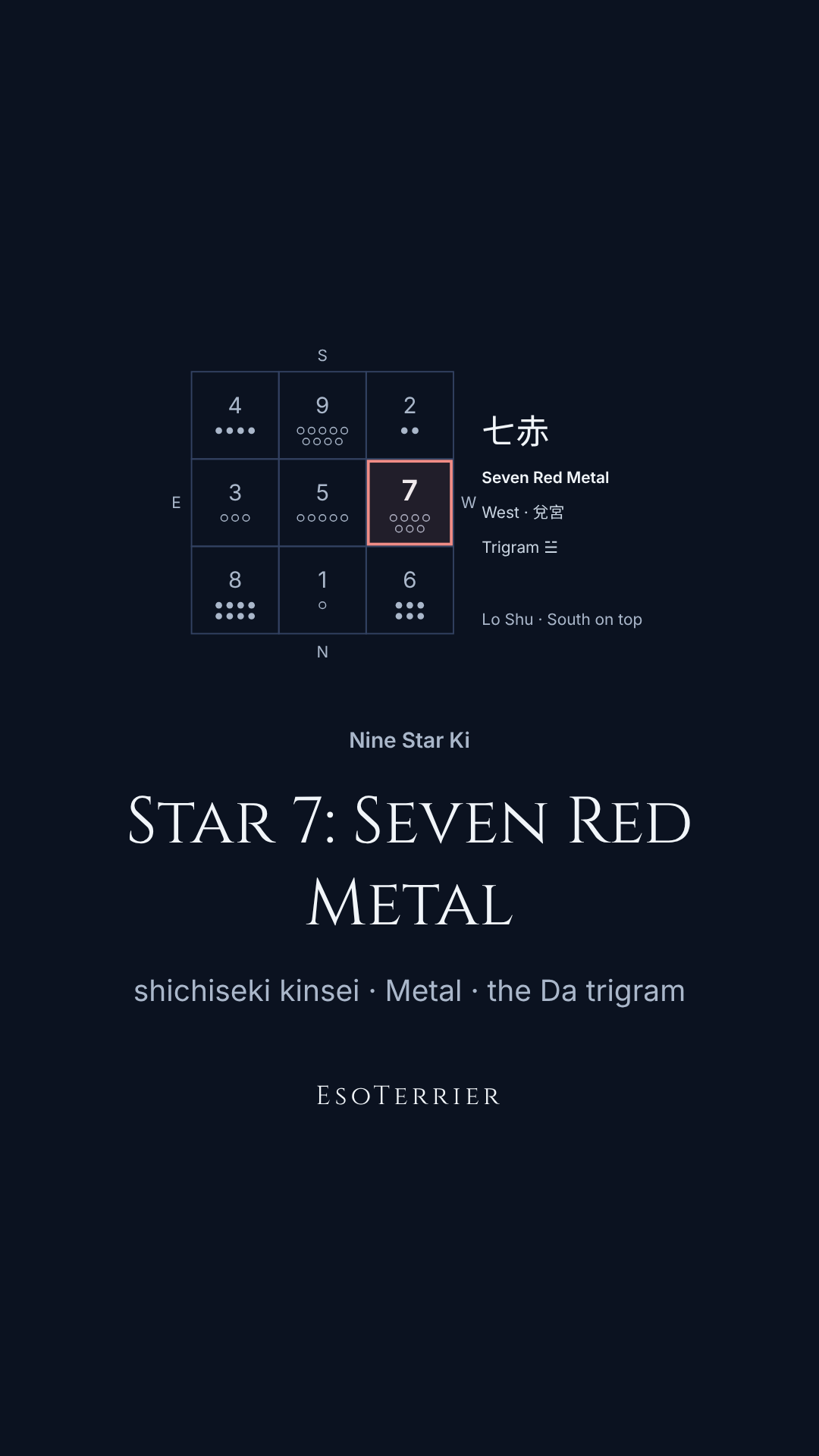
Seven Red Metal is the west palace, the place of the 兌 trigram, the lake or marsh. The Shuogua gives it the full autumn: "說言乎兌", there is gladness in 兌, for it is the season in which all things rejoice. The trigram's family role is the youngest daughter.
Japanese practitioners read a person whose year star is 七赤 as bright, charming and deft, someone who is liked and who talks well; some add that the type comes into its own from the forties. Our own text calls it the lake at evening: charming, sociable and persuasive, someone who enjoys conversation and company and knows how to be liked, with indulgence, vanity and moodiness as the shadow side. The Kushi line calls the number 7 Metal and gives it early autumn, sunset and the themes of joy and fruition.
On the boards
七赤 is the star of the solar years 1984, 1993, 2002, 2011 and 2020, each from 立春. 1984 was also a 甲子 year, the first of a sixty-year cycle, and the almanacs take it as the start of the last of three such cycles in their 180-year round, the 下元; the round began with 一白 in 1864 and will begin again in 2044. In a 七赤 year the first solar month has the star 八白, so a 七赤 person born in the 卯 month, from 啓蟄 in early March to 清明 in early April, or in the 子 month, from 大雪 in early December to 小寒 in early January, has 七赤 as their month star too, and the inclination falls on the centre.
With any other month star in the centre, a 七赤 year star lands in 坤宮 (month star 1), 坎宮 (2), 離宮 (3), 艮宮 (4), 兌宮 (5), 乾宮 (6), 巽宮 (8) or 震宮 (9).
The west palace is the seventh house of the nine-step rhythm, which the tradition reads as the harvest phase, a time of enjoyment, company and the fruits of earlier effort. The tradition counts a direction auspicious for a 七赤 person where 二黒 or 八白 stands, the Earth that generates Metal (生気; never 五黄); where 六白 stands, the other Metal star (比和); or where 一白 stands, the Water that Metal generates (退気). We show these as the tradition's readings and advise no journey.
七赤 has a part in the day chart too. When a winter leap falls, the almanacs run the descending count thirty days longer, and 七赤 is the star that falls on two days running before the ascending run starts on a 甲午 day. Sonoda's pamphlet of 1930 sets out the rule; the schools still differ.
The trigram's classical correspondences
The Shuogua's lists for 兌:
- Family member: the youngest daughter (少女).
- Part of the body: the mouth (兌為口).
- Image: the lake or marsh (兌為澤); Legge's translation adds a sorceress, the tongue and a sheep among its images.
- Polarity of the trigram: yin, as one of the three daughters.
These are the trigram's symbols in a classical text. They do not describe anyone's body, and the star itself has no yin or yang in the sources we found.
Names
The Japanese name reads shichiseki kinsei: 七 seven, 赤 red, 金 metal, 星 star. The Traditional Chinese form is the same; Chinese feng shui also calls it 七赤破軍星, after 破軍, the seventh star of the Northern Dipper in the 五行大義, whose name means army breaker. The trigram is read Da in Japanese and Duì in Chinese; Zheng Xuan's commentary sends the spirit Taiyi from 乾 to 兌, the seventh step of its round. Its doubled form is hexagram 58 of the I Ching.
Correspondences
Each item with how it stands: “sourced” is in the work cited, “our construction” is EsoTerrier’s own, and “disputed” means the sources disagree.
- Season in the Later Heaven circuit
- Autumn: the Shuogua names the west and the full autumn for 兌, the season in which all things rejoice sourced
- The Kushi line's season and hour
- Early autumn and sunset, under the name 7 Metal; a modern Western reading sourced
- Character taught in Japan
- Bright, charming and deft; often said to come into their own from the forties sourced
- Place in the 180-year cycle
- The star of 1984, the 甲子 year the almanacs take as the start of the last sixty-year cycle (下元) sourced
- Chinese Dipper name
- 破軍, the seventh star of the Northern Dipper; a name only here sourced
- Our one-line image
- The lake at evening our construction
- Our reading of its house
- The harvest phase, read as a time of enjoyment, company and the fruits of earlier effort our construction
How the schools read it
- Japanese 気学
- Bright, charming and deft with people and words; easily liked.
- The Kushi line
- "7 Metal": early autumn and sunset, joy and fruition.
- Chinese feng shui (Xuan Kong)
- Names the number 七赤破軍星 and reads it for the sectors of a building over time; that reading is not a trait of people and is not shown here.
- Eight Mansions feng shui
- A Kua number of 7 is the 兌 life trigram, from a formula that differs for men and women: a different number from the year star.
- EsoTerrier
- The lake at evening: charming, sociable and persuasive, someone who enjoys conversation and company, with indulgence, vanity and moodiness as the shadow side.
Claims about it
-
There is one fixed rule for the leap of the day chart.
disputedWhat the record shows: Three methods circulate. In the common printed one, which is also Sonoda's, 七赤 is the star repeated on two days running when a winter leap falls. We follow it and mark births inside a leap window.
-
The Chinese flying-star reading of 七赤 describes the people born under it.
disputedWhat the record shows: In Xuan Kong that reading belongs to the number in a sector of a building for a period. We show only the Chinese name, never the period reading.
-
Seven Red Metal rules a part of the body.
unverifiedWhat the record shows: The Shuogua gives the 兌 trigram a part of the body as a symbol. We give it only in the trigram's block.
-
Seven Red Metal is a star in the sky.
falseWhat the record shows: It is the number 7 of the Lo Shu with its colour and phase; "star" is a counting name.