Meaning
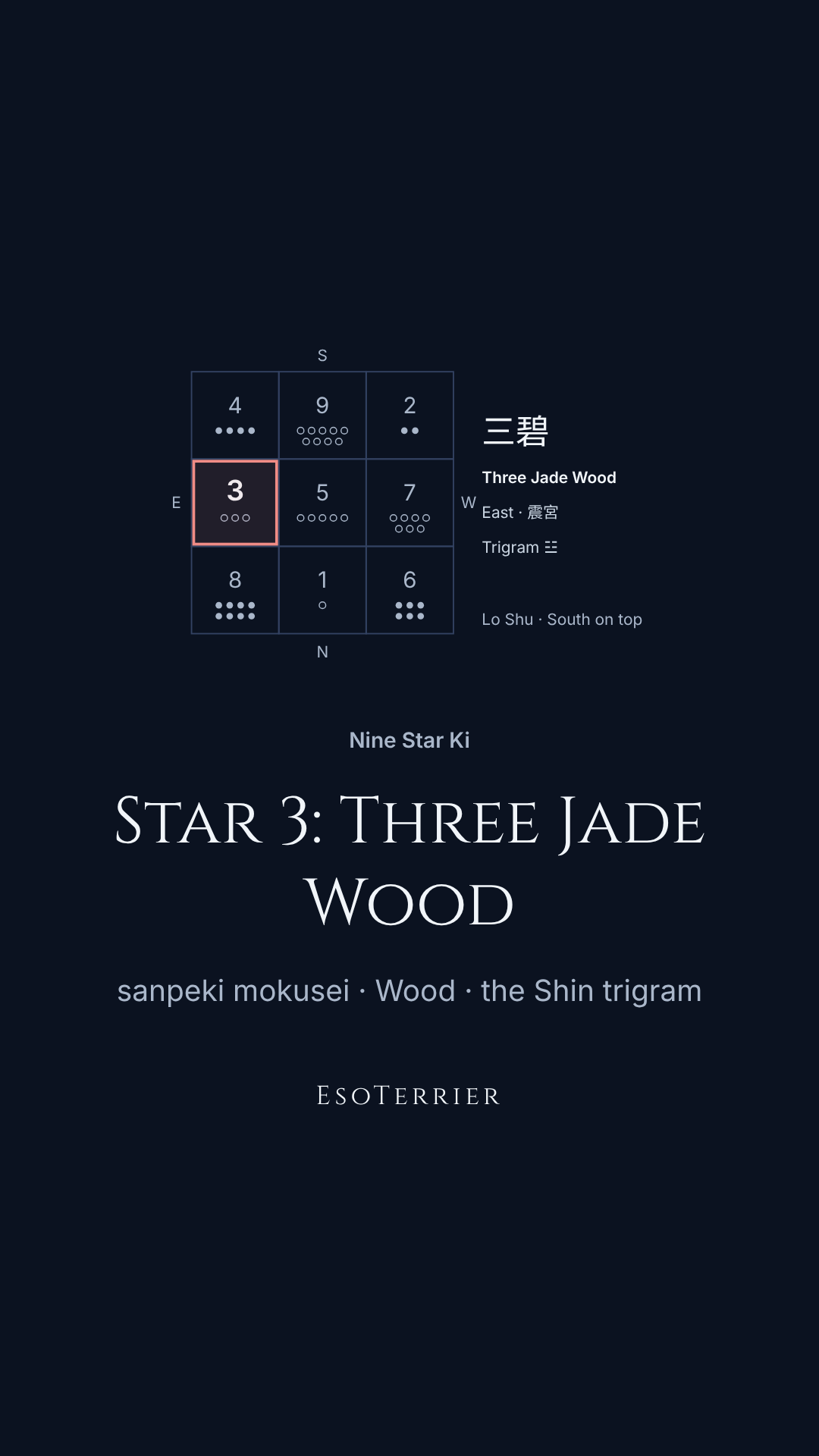
Three Jade Wood is the east palace, the place of the 震 trigram, thunder. The Shuogua opens its circuit of the year here: "帝出乎震", the Lord comes forth in 震, and all things come forth with him, which makes the east the beginning of the round and spring its season. The trigram's family role is the eldest son.
Japanese practitioners read a person whose year star is 三碧 as curious, energetic and active, a starter who likes to be first and is quick off the mark. Our own text calls it thunder in spring: energetic, optimistic and quick, someone who loves movement, novelty and the new thing before anyone else, with impatience, bluntness and scatter as the shadow side. The Kushi line calls the number 3 Tree and gives it early spring, sunrise and the theme of beginnings; the English Wikipedia glosses its blue-green as the livelier Wood beside the gentler green of 4.
The colour matters for the name. 碧 is jade, a blue-green, and 緑 in the fourth star is plain green; calling this star plain green makes it collide with Four Green Wood, so we write Three Jade Wood.
On the boards
三碧 is the star of the solar years 1988, 1997, 2006, 2015 and 2024, each from 立春. In a 三碧 year the first solar month has the star 五黄, so a 三碧 person born in the 辰 month, from 清明 in early April to 立夏 in early May, or in the 丑 month, from 小寒 in early January to the next 立春, has 三碧 as their month star as well and an inclination in the centre. The sample person on the system page is one of them: born on 19 January 1989, before that year's 立春, in the 丑 month of the solar year 1988.
With any other month star in the centre, a 三碧 year star lands in 兌宮 (month star 1), 乾宮 (2), 巽宮 (4), 震宮 (5), 坤宮 (6), 坎宮 (7), 離宮 (8) or 艮宮 (9).
The east palace is the third house of the nine-step rhythm, which the tradition reads as the starting phase, a time when energy returns and new things begin. The tradition counts a direction auspicious for a 三碧 person where 一白 stands, the Water that generates Wood (生気); where 四緑 stands, the other Wood star (比和); or where 九紫 stands, the Fire that Wood generates (退気). These are the tradition's readings; we show them and advise no journey or move.
三碧 also has a small part in the day chart. When a summer leap falls, the almanacs run the old direction thirty days longer, and 三碧 is the star that comes twice: in 2020, 19 and 20 June were both 三碧 days. Sonoda's pamphlet of 1930 sets out the rule, and the schools still differ over it.
The trigram's classical correspondences
The Shuogua's lists for 震:
- Family member: the eldest son (長男).
- Part of the body: the feet (震為足).
- Image: thunder (震為雷); Legge's translation adds the dragon, a great highway and bamboo shoots among its images.
- Polarity of the trigram: yang, as one of the three sons.
These are the trigram's symbols in a classical text, nothing more. They are not statements about a person's body, and no source we found gives the star itself a yin or yang.
Names
The Japanese name reads sanpeki mokusei: 三 three, 碧 jade, 木 wood, 星 star. The Traditional Chinese form is the same, and Chinese feng shui also calls it 三碧祿存星, after 祿存, the third star of the Northern Dipper in the 五行大義. The trigram is read Shin in Japanese and Zhèn in Chinese; Zheng Xuan's Han commentary sends the spirit Taiyi to 震 as the third step of its round of the palaces. Its doubled form is hexagram 51 of the I Ching.
Correspondences
Each item with how it stands: “sourced” is in the work cited, “our construction” is EsoTerrier’s own, and “disputed” means the sources disagree.
- Season in the Later Heaven circuit
- Spring: the east, where the Shuogua says all things come forth sourced
- The Kushi line's season and hour
- Early spring and sunrise, under the name 3 Tree; a modern Western reading sourced
- Character taught in Japan
- Curious, energetic and active; makes an early start sourced
- Colour name
- Jade or blue-green, the sense of 碧; lists that give star 3 a plain or light green collide with star 4 disputed
- Chinese Dipper name
- 祿存, the third star of the Northern Dipper; a name only here sourced
- Our one-line image
- Thunder in spring our construction
- Our reading of its house
- The starting phase, read as a time when energy returns and new things begin our construction
How the schools read it
- Japanese 気学
- Curious, lively and active; a starter who likes to be first and is quick off the mark.
- The Kushi line
- "3 Tree": early spring and sunrise, beginnings and forward movement.
- Chinese feng shui (Xuan Kong)
- Names the number 三碧祿存星 and reads it for the sectors of a building over time; that reading is not a trait of people and is not shown here.
- Eight Mansions feng shui
- A Kua number of 3 is the 震 life trigram, from a formula that differs for men and women: a different number from the year star.
- EsoTerrier
- Thunder in spring: energetic, optimistic and quick, a starter who loves novelty, with impatience, bluntness and scatter as the shadow side.
Claims about it
-
Stars 3 and 4 are two shades of one green, and either colour name will do.
disputedWhat the record shows: 碧 means jade or blue-green and 緑 means green. We call star 3 Three Jade Wood and star 4 Four Green Wood, as the characters say.
-
There is one fixed rule for the leap of the day chart.
disputedWhat the record shows: Three methods circulate. In the common printed one, which is also Sonoda's, 三碧 is the star repeated on two days running when a summer leap falls. We follow it and mark births inside a leap window.
-
The Chinese flying-star reading of 三碧 describes the people born under it.
disputedWhat the record shows: In Xuan Kong that reading belongs to the number in a sector of a building for a period. We show only the Chinese name, never the period reading.
-
Three Jade Wood is a star in the sky.
falseWhat the record shows: It is the number 3 of the Lo Shu with its colour and phase; "star" is a counting name.