Meaning
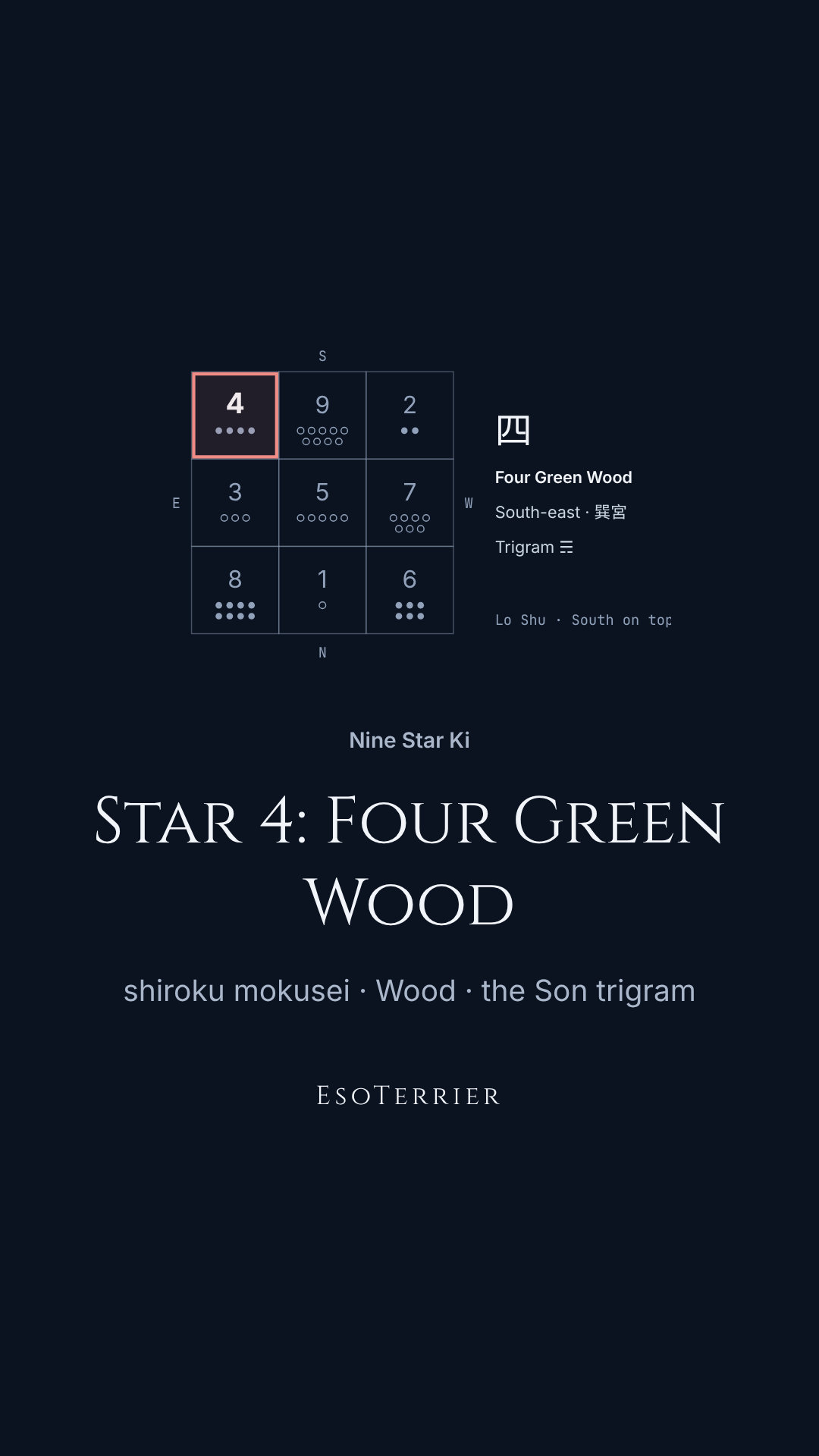
Four Green Wood is the south-east palace, the place of the 巽 trigram, which stands for both wind and wood. In the Shuogua's circuit this is the second step after the east: "齊乎巽", in 巽 all things are brought into full and even growth, which places it in late spring. The trigram's family role is the eldest daughter.
Japanese practitioners read a person whose year star is 四緑 as sociable, warm-hearted and soft-spoken, someone trusted by older people and good at bringing others together. Our own text calls it wind through the trees: diplomatic, romantic and creative, a networker and go-between with a love of culture and conversation, with indecision, anxiety and idealism as the shadow side. Legge's translation of the Shuogua lists "advancing and receding" and want of decision among the images of 巽, the same note struck by a classical text. The Kushi line calls the number 4 Tree and gives it late spring, the morning and the themes of growth and artistic expression.
As with 三碧, the colour decides the name: 緑 is plain green, while 碧 in the third star is jade. Lists that give this star the darker, bluer shade swap the two.
On the boards
四緑 is the star of the solar years 1987, 1996, 2005, 2014 and 2023, each from 立春. In a 四緑 year the first solar month has the star 八白, so a 四緑 person born in the 午 month, from 芒種 in early June to 小暑 in early July, has 四緑 as their month star too, and the inclination falls on the centre.
With any other month star in the centre, a 四緑 year star lands in 艮宮 (month star 1), 兌宮 (2), 乾宮 (3), 巽宮 (5), 震宮 (6), 坤宮 (7), 坎宮 (8) or 離宮 (9).
The south-east palace is the fourth house of the nine-step rhythm, which the tradition reads as the growing phase, a time of connections, travel and agreements; the reading describes a phase of the tradition's rhythm. A direction counts as auspicious for a 四緑 person, in the tradition's reading, where 一白 stands, the Water that generates Wood (生気); where 三碧 stands, the other Wood star (比和); or where 九紫 stands, the Fire that Wood generates (退気).
The trigram's classical correspondences
The Shuogua's lists for 巽:
- Family member: the eldest daughter (長女).
- Part of the body: the thighs (巽為股).
- Image: wind and wood (巽為木, 為風); Legge's translation adds a plumb line and a carpenter's square, what is long and what is high, and advancing and receding.
- Polarity of the trigram: yin, as one of the three daughters.
These are the trigram's symbols in a classical text. They do not describe a person's body, and the star has no yin or yang of its own in any source we found.
Names
The Japanese name reads shiroku mokusei: 四 four, 緑 green, 木 wood, 星 star. Traditional Chinese writes the colour 綠, so the Chinese form is 四綠木星; Chinese feng shui also calls it 四綠文曲星, after 文曲, the fourth star of the Northern Dipper in the 五行大義. The trigram is read Son in Japanese and Xùn in Chinese; in Zheng Xuan's commentary the spirit Taiyi reaches 巽 just before it rests in the centre. Its doubled form is hexagram 57 of the I Ching.
Correspondences
Each item with how it stands: “sourced” is in the work cited, “our construction” is EsoTerrier’s own, and “disputed” means the sources disagree.
- Place in the Later Heaven circuit
- The south-east, where the Shuogua says all things are brought to full and equal growth; late spring sourced
- The Kushi line's season and hour
- Late spring and morning, under the name 4 Tree; a modern Western reading sourced
- Character taught in Japan
- Sociable, warm-hearted and soft; trusted by older people sourced
- Colour name
- Green, the sense of 緑; lists that give star 4 the darker or bluer shade swap it with star 3 disputed
- Chinese Dipper name
- 文曲, the fourth star of the Northern Dipper; a name only here sourced
- Our one-line image
- Wind through the trees our construction
- Our reading of its house
- The growing phase, read as a time of connections and agreements our construction
How the schools read it
- Japanese 気学
- Sociable, kind and soft-spoken; a go-between whom older people trust.
- The Kushi line
- "4 Tree": late spring and morning, growth and a turn for the arts.
- Chinese feng shui (Xuan Kong)
- Names the number 四綠文曲星 and reads it for the sectors of a building over time; that reading is not about people and is not shown here.
- Eight Mansions feng shui
- A Kua number of 4 is the 巽 life trigram, from a formula that differs for men and women: a different number from the year star.
- EsoTerrier
- Wind through the trees: diplomatic, creative, a networker and go-between who loves culture and conversation, with indecision, anxiety and idealism as the shadow side.
Claims about it
-
Star 4 is the darker, bluer one of the two Wood colours.
disputedWhat the record shows: 緑 means green and 碧, in star 3, means jade. We call this star Four Green Wood, as the character says, and never call it jade.
-
The Traditional Chinese name of star 4 is 四緑木星.
falseWhat the record shows: 緑 is the Japanese shape; the Traditional Chinese form is 四綠木星. Our own engine had the Japanese shape in its Chinese field until October 2026.
-
The Chinese flying-star reading of 四綠 describes the people born under it.
disputedWhat the record shows: In Xuan Kong that reading belongs to the number in a sector of a building for a period. We show only the Chinese name.
-
四緑 has a fixed yin or yang of its own.
unverifiedWhat the record shows: No Japanese source gives one. The Shuogua makes its trigram, 巽, a yin trigram, as the eldest daughter.