Meaning
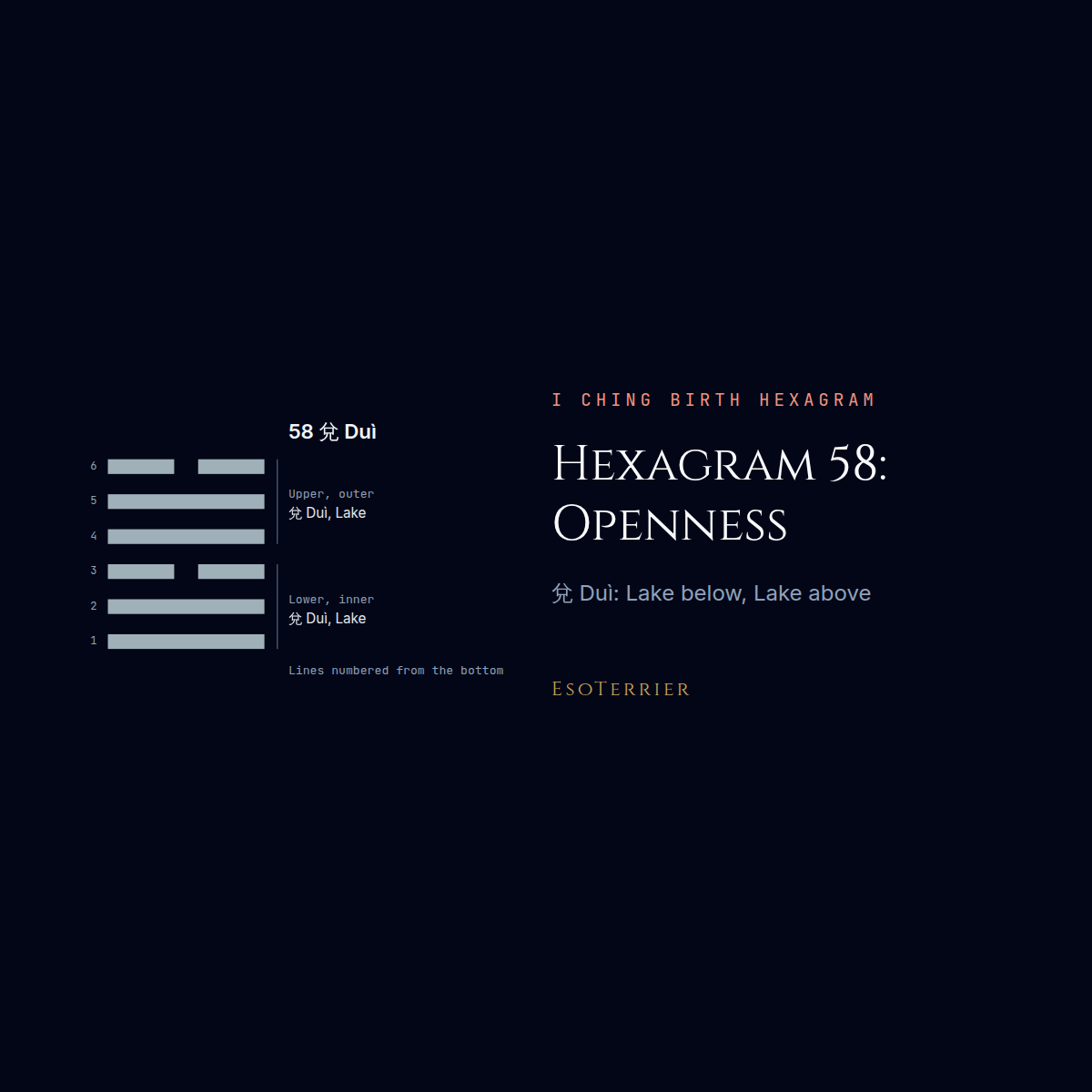
Two lakes side by side keep each other full: that is the Image, and it is the hexagram's whole idea. 兌 is the trigram of the youngest daughter and of the mouth, and its virtue in the Shuogua is 說, to be pleased, which is also the old way of writing to speak; the tradition hears gladness and exchange together. The Judgment promises progress on the condition of firmness, which the commentary reads as the whole lines inside each trigram, a firm centre under an open face. It is the one trigram for which the Shuogua names a season: autumn.
The Image is two lakes, one above the other, and the superior man gathers his friends to talk and to practise together. In our own reading, 兌 is gladness that comes from good company and an open manner, and the line texts draw the line between harmony and the pleasure that is bought or chased.
The lines
The first line is "the pleasure of (inward) harmony", in Legge's words, and the second pleasure that comes from sincerity. The third draws pleasure towards itself, and it goes badly; the fourth weighs what to take pleasure in and is uneasy, and escaping harm brings joy. The fifth trusts one who would harm it. The top line takes its pleasure in leading others on.
Its pair is 巽, hexagram 57; within 兌 lies 家人, hexagram 37, and every line flipped gives 艮, hexagram 52, stillness.
In the birth cast
The time cast arrives at 兌 when the year, month and day leave 2 on eight, which puts 兌 lake above, and the same total with the hour added leaves 2, which puts 兌 lake below. Which line moves depends on what the whole total leaves on six, and each line turns the figure into a different hexagram:
- Line 1 (初九) moving: becomes 47 困 Kùn, Confinement
- Line 2 (九二) moving: becomes 17 隨 Suí, Following
- Line 3 (六三) moving: becomes 43 夬 Guài, Breakthrough
- Line 4 (九四) moving: becomes 60 節 Jié, Measure
- Line 5 (九五) moving: becomes 54 歸妹 Guī Mèi, The Younger Sister Weds
- Line 6 (上六) moving: becomes 10 履 Lǚ, Treading
Lines 2 to 5 give the hexagram within, 37 家人 Jiā Rén, The Household. Everyone born in the same lunar day and double hour has the same cast, so the figure describes a moment, not a person.
Correspondences
Each item with how it stands: “sourced” is in the work cited, “our construction” is EsoTerrier’s own, and “disputed” means the sources disagree.
- Trigram virtues (Shuogua, chapter 7)
- 兌 pleased, open, doubled, in our English sourced
- Trigram family places (Shuogua)
- youngest daughter, doubled sourced
- Trigram body and animal images (Shuogua)
- mouth and sheep, doubled sourced
- Trigram phases (a classical correspondence: the Plum Blossom text's table)
- Metal, doubled. The Han assignment of 梅花易數, book 1, also used by Jing Fang; not stated as such in the Zhouyi sourced
- Inverse and opposite
- Upside down: 57 巽 Xùn, Entering Wind; every line flipped: 52 艮 Gèn, Stopping sourced
- Human Design gate
- Gate 58, from 273.875° to 279.5° of the tropical zodiac on Ra Uru Hu's wheel (1987): a modern placing, not the I Ching's sourced
- Our English title
- Openness: EsoTerrier's own, from the sense of 兌 our construction
How the schools read it
- The Zhouyi, in Legge's translation (1882)
- “Tui intimates that (under its conditions) there will be progress and attainment. (But) it will be advantageous to be firm and correct.”
- The Image (大象), one of the Wings, in our paraphrase
- Two marshes, one above the other; the superior man encourages the conversation of friends and their shared practice.
- The Plum Blossom method (Ming)
- A figure reached by numbers: 兌 above when the year, month and day leave 2 on eight, 兌 below when the same total with the hour leaves 2.
- Human Design (Ra Uru Hu, 1987)
- Takes the number for its gate 58 and puts it on the zodiac; its own reading, which we do not quote.
- EsoTerrier
- Lake upon lake: open exchange and the gladness of good company, friends talking and learning together; gladness with a firm centre holds, and pleasure pursued for itself does not.
Claims about it
-
Gate 58 of Human Design, at 273.875° to 279.5° of the zodiac, is where the I Ching itself places hexagram 58.
falseWhat the record shows: The wheel is Shao Yong's circle rotated by Ra Uru Hu in 1987 to 1989 so that hexagram 41 starts at 2° Aquarius. No Chinese source we found puts the hexagrams on degrees of the zodiac.
-
Being born under 兌 Duì fixes a person's character.
unverifiedWhat the record shows: A modern reading with no source in the tradition. The Zhouyi has no birth hexagram; the cast reads a figure, not a person, and everyone born in the same lunar day and double hour shares it.