How it works
A Zi Wei Dou Shu chart is a square board of twelve cells around an empty centre, one cell for each of the twelve earthly branches, 子 to 亥, with 寅 at the bottom left as charts draw it (Figure 1). Everything on the board is found by counting from the birth date and hour on the Chinese lunar calendar; no position in the sky is looked up.
What you enter. The birth date and clock time, the time zone of the birthplace, and the chart gender, which sets the direction of the decades. Today's date gives the current layers.
The calendar. The date is converted to the lunar calendar, and the year and its stem and branch turn at the lunar new year (正月初一), not at the solar term 立春 that BaZi uses. A birth in a leap month counts as the month it repeats on days 1 to 15 and as the next month from the 16th, the modern majority rule, traced to 王裁珊's 斗數宣微. The 全書 itself counts the whole leap month as the next: 「又若閏月正月生者要在二月內起安身命,凡有閏月具要依此為例」, a birth in a leap first month is set up in the second month, and every leap month likewise.
The hour. The clock time is taken as civil time, with daylight saving removed by the time-zone history of the birthplace (China 1986 to 1991, Taiwan 1946 to 1979, Hong Kong to 1979, and every other country that used it); no correction for true solar time is made. The double hour runs from 子 (23:00 to 01:00) to 亥, and a birth from 23:00 to 23:59 counts as the 子 hour of the next day, with the whole lunar date moved on.
Without a time, no hour is assumed. The result then holds twelve candidate boards and the facts that do not depend on the hour: the year, its transformations and the stars placed by year and month. An assumed hour would give the right board for about one person in twelve.
The board. The Life Palace (命宮) is found by counting: from 寅 as the first month, forward to the birth month, then back by the hour. The Body Palace (身宮) counts forward by the hour instead, so it can only fall in the Life, Spouse, Possessions, Travel, Career or Wellbeing palace; it marks one of them and is not a thirteenth palace. From the Life Palace the twelve run counter-clockwise in the 全書's order, with our names, which are the chart's:
| Palace | Our name | What the tradition reads there |
|---|---|---|
| 命宮 | Life | the self: temperament, outlook, the chart's direction |
| 兄弟 | Siblings | brothers, sisters and close peers |
| 夫妻 | Spouse | partnership (the 全書 writes 妻妾) |
| 子女 | Children | children, the young, what one makes or nurtures |
| 財帛 | Possessions | possessions and how one handles them, read as attitudes |
| 疾厄 | Health | the body, in the tradition; here energy, habits and strain |
| 遷移 | Travel | life away from home, and the outer world |
| 交友 | Friends | friends, colleagues and staff (the 全書's 奴僕, "servants") |
| 官祿 | Career | work, vocation and standing |
| 田宅 | Property | home, the family base and the places one keeps |
| 福德 | Wellbeing | contentment, leisure and tastes (literally "blessings and virtue") |
| 父母 | Parents | parents, mentors and elders |
Each palace takes a stem by the 五虎遁 rule from the year stem, and the Life Palace's stem and branch, through their nayin element, give the bureau (五行局), from Water 2 to Fire 6: the number the placing of the stars turns on.
The fourteen major stars. 紫微 is placed by the borrowed-days rule: borrow the fewest days that make the lunar birth day a multiple of the bureau number, count the quotient from 寅, then step back by the borrowed days if they are odd and forward if they are even. The 全書 gives no formula, only a verse and a thirty-day diagram for each bureau; on 13 October 2026 we parsed the five diagrams, and the rule agrees with all 148 legible entries. 天府 mirrors 紫微 across the 寅–申 axis. The other twelve follow at fixed distances, as the 全書's verse 安南北斗諸星訣 gives them:
紫微天機逆行旁,隔一陽武天同當,又隔二位廉貞地,空三復見紫微郎。天府太陰與貪狼,巨門天相及天梁,七殺空三破軍位,八星順數細推詳。
In our translation: Zi Wei, and Tian Ji beside it, counted backward; skip one for the Sun, then Wu Qu and Tian Tong; skip two more for Lian Zhen; three empty, and Zi Wei comes round again. Tian Fu, the Moon and Tan Lang, Ju Men, Tian Xiang and Tian Liang, Qi Sha, three empty, then Po Jun: eight stars counted forward, worked out with care. (Juan 2 is transcribed in simplified characters on Wikisource; we quote it in traditional ones.)
The other stars. Six supportive stars are placed by month (左輔, 右弼), hour (文昌, 文曲) and year stem (天魁, 天鉞); six challenging stars by year stem (擎羊 and 陀羅, either side of 祿存), by the triad of the year branch counted on by the hour (火星, 鈴星), and by hour (地空, 地劫); 祿存 by year stem and 天馬 by year branch; 38 minor stars by the 全書's verses; and four cycles of twelve (長生, 博士, 將前, 歲前). How many stars a chart needs is a matter of school; the "108 stars" of popular books is a round figure.
Brightness. The fourteen major stars and six others take one of seven levels in each branch, from Brilliant (廟) through Strong (旺), Gaining (得), Beneficial (利), Neutral (平) and Weak (不) to Fallen (陷), by the 全書's table, which is identical cell for cell to iztro's.
The four transformations (四化). The stem of the birth year turns four stars: one takes 化祿 (Lù, shown on our chart as prosperity and read as flow and opportunity), one 化權 (Quán, authority), one 化科 (Kē, recognition) and one 化忌 (Jì, obstruction, read as a focus of attention rather than a warning). We use the common table of most software, which reads 戊 右弼化科, 庚 太陰化科 and 壬 左輔化科; schools differ at those stems. Each palace's own stem also sends a set of transformations into other palaces (飛化); we show these as a layer and say that the method is modern.
Masters. The Life Master (命主) is the star the 全書 keys to the Life Palace's branch, and the Body Master (身主) the one it keys to the birth year's branch. They do not depend on the bureau.
Decades and years. The decades (大限) begin in the Life Palace, the first at the bureau number in nominal years (虛歲), and run forward for a yang-year male or yin-year female chart and backward otherwise; for anyone not male or female the chart gives both directions, labelled, because no source has a rule. The minor limit (小限) moves one palace a year, and the current year's palace is the one of its branch, with the year stem's own transformations. The tradition's rule of thumb is that the natal chart sets the tone, the decade the direction and the year the events.
What we compute and what we leave out. The chart prints the lunar date, the Life and Body palaces, the bureau, the masters, the four transformations, every palace with its stars, brightness, cycles, decade and flying transformations, the decades, the current decade, minor limit and year, and a line naming every convention. It does not judge the classical patterns (格局) that the texts and modern catalogues list, and it repeats none of the text's pronouncements on rank, kin, the body or length of life.
Origins and history
The name is first dated 1581, and the book printed under Chen Tuan's name is a Ming manual; the star names and the lore of the Dipper are far older.
| When | Who | What happened |
|---|---|---|
| Sui (581 to 618) | 蕭吉, 五行大義 | Quotes the 黃帝斗圖 for the names of the seven Dipper stars, 貪狼 to 破軍, each with the birth branches "belonging" to it: branch for branch the 全書's later Life Master table. |
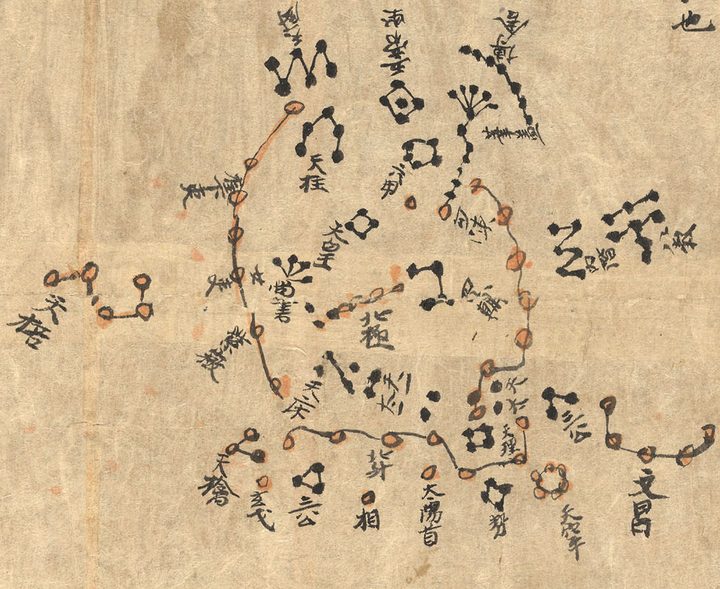
| Early Tang (649 to 684) | The Dunhuang star atlas | The oldest complete star atlas known draws the 紫微 enclosure round the pole and the Northern Dipper below it (Figure 2). |
| Tang to Song | Buddhist translators | Indian divinatory systems reach China with Buddhism and, in one historian's words, greatly influence Chinese astrology, this method included. |
| Died 989 | Chen Tuan 陳摶, 希夷先生 | A Daoist recluse of Mount Wudang and Mount Hua, received by two emperors. The Song History names his works, and no star text among them. |
| By 1445 | The Daoist canon | The Northern Dipper scripture repeats the seven names; the Southern Dipper scripture names six lords, 天府, 天相, 天梁, 天同, 天樞 and 天機. |
| Dated 1550 | A preface signed 羅洪先 | The book's own story of a young Daoist on Mount Hua, eighteen generations from Chen Tuan. A 2021 study concludes that Luo did not write it. |
| 1581 | Unknown | 紫微斗數捷覽: the earliest dated use of the name. |
| Wanli era (1573 to 1620) | Printers in Jianyang and Nanjing | Two commercial lines of the 紫微斗數全集; the Nanjing one signed 大宋華山希夷陳圖南著. No Song, Yuan or early-Ming catalogue mentions the system. |
| 1607 | Zhang Guoxiang, 50th Celestial Master | The canon's Wanli supplement prints a 紫微斗數 in three juan: a different system that starts from the four pillars and lays eighteen flying stars on palaces named after the twelve zodiac signs. |
| Qing | Commercial printers | Woodblock reprints. The 全書 on Wikisource, which we quote, is labelled Qing there. |
| 1910s to 1930s | 王裁珊 | 斗數宣微 and 斗數觀測錄; the Shanghai lithograph 全書, ancestor of the modern Taiwanese reprints. |
| 1971 to 1979 | Publishers in Taiwan, Hong Kong and Japan | Printed 全書 editions and new manuals; 張耀文 and 佐藤六龍 publish the 透派 methods in Japan. |
| 1981 to 1987 | 慧心齋主, 鍾直霖, 了無居士, 紫雲 | The Taiwanese publishing wave that made the system a mass practice. |
| 1985 on | 王亭之 (談錫永, 1935 to 2024); 蔡明宏; 梁若瑜 (2000) | 王亭之 makes the Zhongzhou school (中州派) public in Hong Kong, with its own transformation table; the self-transformation and flying-star methods reach print, though neither is in the old texts. |
| 2023 | SylarLong and contributors; Stéphanie Homola | iztro, the open-source engine behind most web charting tools; and an ethnography of fate calculation in Taipei, Beijing and Kaifeng, with this method one of the two commonest in Taiwan. |
| 2026 | EsoTerrier | The engine rebuilt on the 全書 rules on 9 October, checked against iztro on 44,195 charts. |

The scholarly picture, in short, is a Ming manual printed commercially under a Song name, on a star lore with Indian elements that Buddhism carried into China. The name was loose enough in 1607 for the Daoist canon to use it for a different method.
The fourteen major stars
The fourteen major stars (主星) carry most of the weight in a reading. Each has its own page: its characters and names, how it is placed, the 全書's element, Dipper seat and epithet, its brightness in each palace, the year stems that transform it, the text's own lines on it, and the claims made about it. They are listed in the order of the placing verse, in their two series.
The Zi Wei series (紫微星系): counted backward from Zi Wei
The Tian Fu series (天府星系): counted forward from Tian Fu
Ten of the names are Dipper names. 貪狼, 巨門, 廉貞, 武曲 and 破軍 are five of the seven Northern Dipper stars as the Sui 五行大義 already names them; 天府, 天相, 天梁, 天同 and 天機 are five of the six lords of the Daoist Southern Dipper scripture. 紫微 is the pole enclosure, 太陽 and 太陰 are the Sun and Moon, and 七殺 is in neither scripture. The 全書 seats the stars in the two Dippers by its own count, which does not follow the two series. On the star pages, a namesake star is always called symbolic: the chart reads none of them.
Variants and what we leave out
The rules are classical; the conventions are not agreed. We name ours on every chart and describe the others so you can recognise them.
- Schools. The three-harmony school (三合派) reads the full star set through the triad and opposite and the classical patterns. The flying-star school (飛星派) reads palace-stem transformations on about eighteen stars. The self-transformation systems add 自化 and trim the star set. The Zhongzhou school (中州派) has its own transformation table, keys the Life Master by the year branch and adds stars of its own. The 透派, published in Japanese from 1971, has conventions we have not read. Chinese Wikipedia records that the flying-star and self-transformation methods are not in the old texts. We compute the three-harmony chart, with flying transformations as a layer.
- Transformation tables. 化祿 and 化權 agree everywhere. The tables differ at 戊 (右弼 or 太陽 takes 化科), at 庚, where nine variants are on record, and at 壬 (左輔 or 天府). The Wikisource 全書 verse reads 庚日武陰同 and 壬梁紫府武, so it parts from the common table at 壬. We use the common table and name it.
- Brightness. Seven levels (the 全書's, ours and iztro's), four levels in other tables, the Zhongzhou tables, and the 全書's own list of idle palaces, which contradicts its table in places. One teacher holds that brightness matters little except for the Sun and Moon.
- The year at 立春. Some practitioners turn the year at 立春 as BaZi does. That changes the year, the Life Palace, the bureau and the transformations for births between the lunar new year and 立春. Documented, not our default.
- The 23:00 hour as the same day or the next. Under the other rule, 91 percent of late-hour births get a different position for Zi Wei.
- Leap months as the next month (the 全書), the same month, or split at the 15th (ours).
- The time basis. True solar time is offered by a few apps and rejected by others; the Zhongzhou lecture notes convert every birthplace to Luoyang mean time; a minority leaves daylight saving in. For a birth in Ürümqi at 03:00 Beijing time, true solar time (about 00:44) gives a wholly different board. We use civil time without daylight saving and plan solar time as an option the chart flags.
- Births abroad. Local civil time and the local date, mapped to the Chinese calendar, not Beijing time. Near a new moon the Japanese, Korean and Vietnamese calendars can give another day.
- The first decade starts one palace from the Life Palace in the 全書's verse (陽男陰女從命前一宮起順行), and in the Life Palace in mainstream practice, the Zhongzhou notes and iztro, as in ours. Some count decades in actual years instead of nominal ones.
- Smaller conventions. The Life Master by the year branch (Zhongzhou), which is how the Sui 五行大義 and the Northern Dipper scripture assign the same seven stars; one Void star or two; 天馬 by month; the Body Master for 子 and 午 years, which the 全書's verse writes 火玲 and we give as 火星.
- Gender. Every tool offers male and female only, and no source gives a rule for anyone else. We compute both directions and label them.
- Readings we do not take. Modern authors' pattern catalogues and star texts, which are in copyright; the readings of the cycle stars beyond their names; and the text's verdicts on rank, kin, the body and the length of life.
Myths and disputed claims
What is said about Zi Wei Dou Shu, who says it, and what the record shows. The label is ours.
-
Chen Tuan created Zi Wei Dou Shu in the Song.
told as loreWho says it: The book's own preface and title page; most introductions; our earlier page.
What the record shows: A transmission story the book tells of itself. The Song History lists his works and no star text; no Song, Yuan or early-Ming catalogue mentions the system; the name is first dated 1581. We say "attributed to Chen Tuan".
-
Luo Hongxian wrote the preface dated 1550.
disputedWho says it: The preface, which is signed in his name; most histories.
What the record shows: The one peer-reviewed study of the Daoist works under Luo's name concludes that none is his; a Daoist school's history finds the preface first in the late-Qing and Republican lithographs.
-
The system was a secret of the emperors, kept by the court astronomers for centuries.
falseWho says it: English marketing pages, and our own earlier page.
What the record shows: Ming editions were printed by commercial printers, the 1550 preface wants the book shown "to all the world", and the Daoist canon printed a text under the name in 1607.
-
The system has been practised for ten centuries.
disputedWho says it: Most popular introductions, by way of Chen Tuan.
What the record shows: About 450 years are documented, from the 1581 title, on a star lore that is much older.
-
The chart is fixed on the star at the celestial pole, and Zi Wei is that star.
falseWho says it: Our earlier page; many English introductions.
What the record shows: The name is borrowed from the 紫微 enclosure round the pole. The 全書 places the star by arithmetic on the lunar day and the bureau; nothing is observed.
-
The fourteen major stars are the stars of the two Dippers, read where they stand in the sky.
disputedWho says it: Popular introductions, and our earlier page.
What the record shows: Ten names are Dipper names, but every star is placed by counting. 紫微 is the enclosure, 太陽 and 太陰 the Sun and Moon in name only, and 七殺 is in no Dipper scripture.
-
The system needs, and our engine applies, a correction to true solar time.
falseWho says it: Our earlier page; some apps offer it.
What the record shows: Neither the 全書 nor most practice uses solar time, and our engine takes clock time with daylight saving removed, as the chart says. Solar time is a minority option.
-
Our engine computed the chart without any error, to astronomical precision.
falseWho says it: Our own earlier page.
What the record shows: Until 9 October 2026 the engine put ten of twelve palaces in the wrong cells. Agreement with iztro now shows that we apply a named convention, nothing more.
-
Zi Wei Dou Shu outdoes BaZi in detail and in esteem.
unverifiedWho says it: Our own catalogue line until October 2026.
What the record shows: A comparison with no measure. Practitioners in Taiwan treat the two as the commonest methods side by side.
-
The Health Palace foretells bodily harm, and the chart can warn of losses in given years.
unverifiedWho says it: The 全書 itself, many practitioner sites, and our old page writer.
What the record shows: The tradition says so. Here the palace is a life area.
Others we never repeat: an accuracy of 75 to 90 percent for timing events, which has no source; the four transformations as a Song innovation, which no Song text of the system exists to show; a Tang origin blending Chinese, Daoist and Hellenistic star lore, when nothing dates the system before the Ming; "108 stars", a round figure; and 福德 as a palace of earlier lives, when it means blessings and virtue.
Stories and lore
The stories below are told as the tradition tells them.
The meeting on Mount Hua. The preface at the head of the 全書 tells it in the first person. The writer gives up his post to seek the Way, climbs Mount Hua to the shrine of Master Xiyi, and on the way down meets a young Daoist, old in bearing, who brings out a book: 「希夷公紫微斗數集也」, "Master Xiyi's Zi Wei Dou Shu collection". He cannot at first follow how the stars are laid out, but tests the book on his own birth and finds it 「毫髮不爽」, not a hair off, and resolves to show it to all the world. The young man, he says, was eighteen generations from Chen Tuan and twenty-six years old. The preface is dated spring 1550 and signed by Luo Hongxian; its authorship is rejected by the one study of it.
Chen Tuan. The Song History's recluse: a prodigy who failed the examinations, lived in a cave on Mount Wudang and then on Mount Hua, gave up grain for more than twenty years, was received by two emperors and named 希夷先生, and announced the month of his own death in 989. Later tradition made him the source of this system.
Lü Dongbin's gift. "It is also said" that the immortal Lü taught the method to Chen Tuan. The Song History has a plainer story: a recluse from west of the passes, over a hundred years old with a child's face, whom the world took for an immortal, often came to Chen Tuan's studio. It says nothing of what they talked about.
The opening of the 太微賦. The 全書's first verse begins 「斗數至玄至微,理旨難明」: the numbers of the Dipper are most profound and most subtle, their principles hard to make plain. Its stars are 「分布一十二垣,數定乎三十六位」, spread over twelve enclosures and fixed in thirty-six positions, and 紫微 「司一天儀之象,率列宿而成垣」, governs the image of the whole celestial sphere and leads the ranks of stars into their enclosure. The court of the sky is the text's own image, and the reason the star is called the Emperor.
The general and the tiger. The 全書's verse on form and nature draws each star as a character, and borrows from the classics to do it: 七殺 is 「如子路暴虎馮河」, like Zilu, the disciple of Confucius, who would fight a tiger bare-handed and ford a river on foot, and 火星 and 鈴星 are like Yu Rang, the retainer who swallowed charcoal and feigned dumbness to take revenge.
The eighteen flying stars. The 1607 text in the Daoist canon is a different system under the same name, with its own star officials and the four pillars at its base. Practitioners call it the ancestor of the modern chart; the thesis that compared the two treats them as separate lines.
A secret of the emperors? The story that the system was kept for emperors and hidden by the court astronomers is a modern marketing tale; we found it in English web copy and in our own 2026 page, and in no older source.
王亭之. Tam Shek-wing took his pen name from the saying 姑妄言之,姑妄聽之, "speak it idly, hear it idly". A Buddhist scholar, painter and newspaper columnist, he made the Zhongzhou school public in Hong Kong from 1985, learned the system from 劉惠蒼, and died in Toronto on 26 October 2024.
Evidence and criticism
No study tests the system. We found no controlled study of Zi Wei Dou Shu's claims about character or events, and one would be hard to design: the chart is fixed by the lunar date, the double hour and the chart gender, so everyone born in the same double hour with the same gender shares it. The accuracy figures in marketing have no source.
The text's date. The Fo Guang thesis found no mention of the system in Song, Yuan or early-Ming bibliographies; the one peer-reviewed study of the preface rejects Luo's authorship; the earliest dated use of the name is 1581.
The text's quality. Reading the Wikisource edition, our research found a probable copying error in the 天魁 verse, a contradiction between the idle-palace list and the brightness table, and rules no modern implementation follows (天府 化科 in a 壬 year, decades starting one palace away, the whole leap month as the next). Our parse of the Zi Wei diagrams found one more slip: the Wood 3 diagram writes the ninth day in two palaces and leaves out the fifth. Wikisource has no juan 4 and names no source edition. Popular histories go further than the evidence: one charting site dates the 太微賦 to the Southern Song without a source.
The scholarship's stance. Homola studies fate calculation as a practice, a field of knowledge without academic standing, and learned the method herself to understand its practitioners; Ho Peng Yoke treats the older state systems and notes the Daoist canon's text. Neither evaluates whether the system is true.
The tradition's own debates are about conventions: the 23:00 hour, the leap month, the year boundary, solar time, the 庚 and 壬 transformations, how many brightness levels there are and whether brightness matters, where the first decade starts, and how many stars a chart needs. The commonest question on forums is why two tools give different charts, and the answer is always one of these.
What our checks show, and do not. Agreement with iztro and with an independent reference implementation on 44,195 charts shows that the engine applies the convention it names. Our first engine placed ten of the twelve palaces in the wrong cells, and our old page promised a precision nothing supported.
Names and marks. We found no trade-mark registration for the plain terms Zi Wei Dou Shu, Purple Star Astrology or 紫微斗數 in the US, international or Taiwanese registers. Some branded names used for charting tools and schools are registered marks, and we do not use them. Our catalogue line until October 2026 compared the system with BaZi in a way nothing measured; it has been replaced.
Terms
- Palace (宮)
- One of the twelve cells of the board, each tied to an earthly branch and named for a field of life. Never "house", which is a Western borrowing.
- Life Palace (命宮)
- The palace of the self, found by counting from 寅 forward to the birth month and back by the hour. The other eleven run counter-clockwise from it.
- Body Palace (身宮)
- A marker on one of six palaces, counted forward by the hour. The tradition reads it beside the Life Palace as what comes to the fore with maturity; no age is a rule.
- Bureau (五行局)
- Water 2, Wood 3, Metal 4, Earth 5 or Fire 6: the nayin element of the Life Palace's stem and branch, with the number the placing of Zi Wei turns on.
- Major star (主星)
- One of the fourteen stars placed from Zi Wei and Tian Fu, which carry most of a reading. Each has its own page.
- Series (星系)
- The two groups of major stars, counted backward from Zi Wei or forward from Tian Fu. A placement grouping, not a grouping by Dipper.
- Brightness (廟旺)
- A star's strength in a branch, on seven levels from Brilliant (廟) to Fallen (陷), by the 全書's table.
- Four transformations (四化)
- 化祿, 化權, 化科 and 化忌, given to four stars by the stem of a year or a palace. Shown on our chart as prosperity, authority, recognition and obstruction, and read as emphases.
- Flying transformations (飛化)
- The transformations a palace's own stem sends into other palaces; a self-transformation (自化) when the star stands in that palace. A modern method, worded so as not to be confused with the Flying Stars of feng shui.
- Life Master and Body Master (命主, 身主)
- The stars keyed to the Life Palace's branch and to the birth year's branch by two short verses of the 全書.
- Decade (大限)
- One palace's ten years, from the Life Palace onward, the first starting at the bureau number in nominal years. Not BaZi's luck pillars, though the direction rule is the same.
- Minor limit (小限)
- A palace for each year of life, moving one palace a year from the start of the birth year's triad.
- Triad and opposite (三方四正)
- A palace read together with the two palaces four apart from it and the one facing it across the board.
- Nominal age (虛歲)
- Age counted from one at birth and raised at each lunar new year, the count the decades are given in. Actual age (實歲) is counted from the birthday.