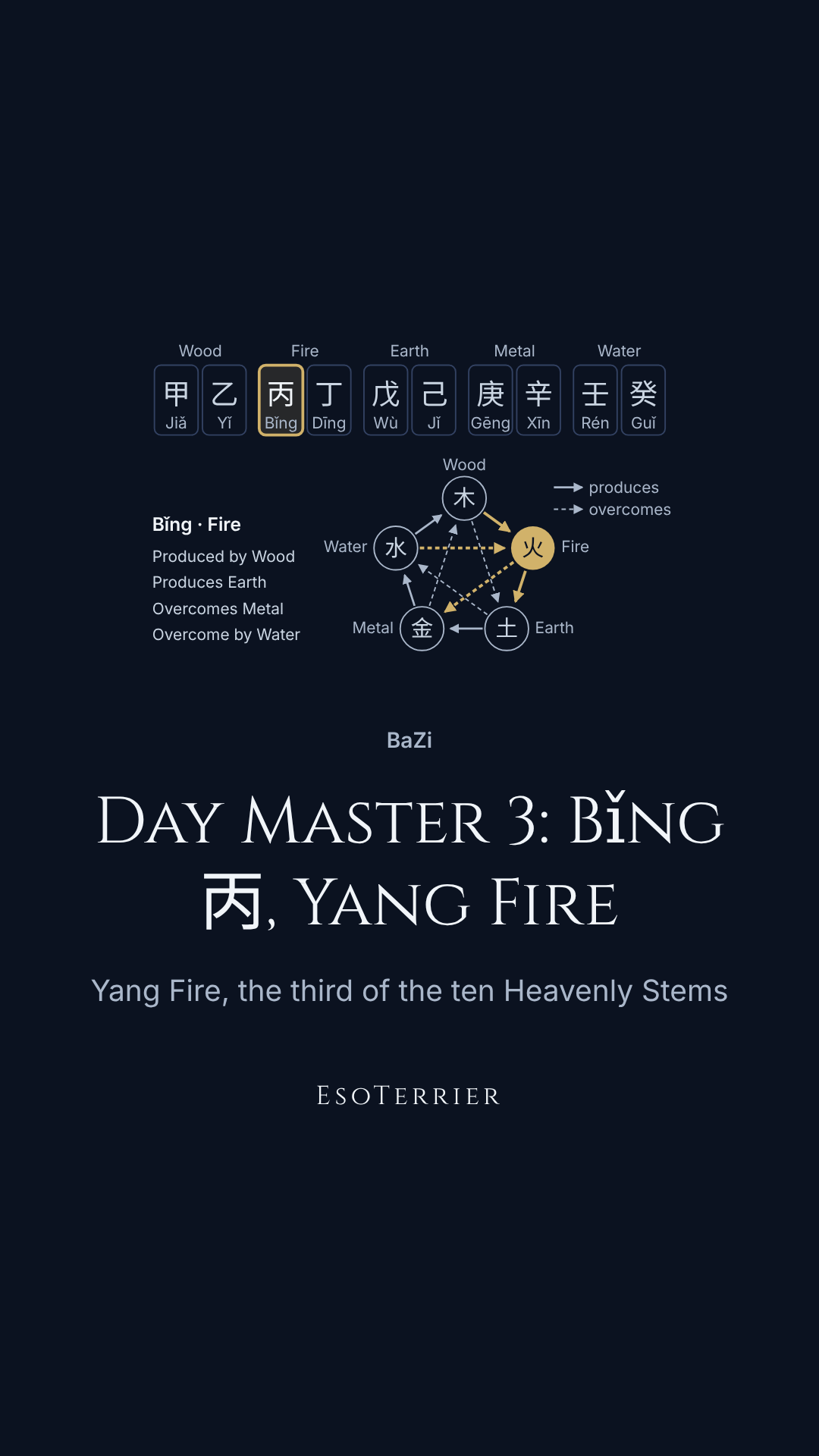
Meaning
The 滴天髓 gives each stem a verse of eight short lines. For 丙 it reads, in the 輯要 text:
丙火猛烈,欺霜侮雪,能煆庚金,逄辛反怯,土眾成慈,水猖顯節,虎馬犬鄉,甲來焚滅。
In our translation: Bǐng fire is fierce; it scorns the frost and slights the snow. It can smelt 庚 metal, yet before 辛 it turns timid. Among much earth it grows kindly; against raging water it shows its integrity. In the tiger, the horse and the dog, if 甲 comes, it burns itself out.
Its timidity before 辛 is their combination (丙辛合), which binds the fire. The tiger, the horse and the dog are the branches 寅, 午 and 戌, which together make a frame of fire; add more wood there, the verse says, and the fire consumes itself.
The 三命通會 sets 丙 as the sun and lightning in heaven and the furnace on earth: "dead fire" (死火), the hard fire that needs dead wood to burn, that metal and earth can dim, and that rises in the east and sets in the west. Its sky image is the sun. The 窮通寶鑑 gives the 丙 of spring its majesty: the sun returned to the land, scorning frost and snow, with 壬 water as its natural counterpart.
Our chart keeps the sun: radiant, generous, enthusiastic and charismatic, with overreach and tactlessness as its cost. Here the modern image and a classical one agree, which is not true of every stem; it is still EsoTerrier's image, labelled as ours, and the texts give lightning, the furnace and dead fire too.
In a chart
A 丙 day master has roots wherever 丙 is hidden in a branch: 寅 Yín (middle qi), 巳 Sì (main qi). Its 祿, the branch where its qi comes into office (臨官), is 巳; the branch after it, 午, is its blade (陽刃). It is born (長生) in 寅 and, as a yang stem, runs the twelve stages forward from there; the stages are phases of its qi.
It combines with 辛 Xīn (天干五合), a pair the 三命通會 calls 威制之合 (the match of authority and restraint), leaning to Water; it clashes with 壬 Rén. Its own phase is strongest in summer.
To a 丙 day master the ten stems are: 甲 Indirect Resource (偏印); 乙 Direct Resource (正印); 丙 Friend (比肩); 丁 Rob Wealth (劫財); 戊 Eating God (食神); 己 Hurting Officer (傷官); 庚 Indirect Wealth (偏財); 辛 Direct Wealth (正財); 壬 Seven Killings (七殺); 癸 Direct Officer (正官). A second 丙 elsewhere in the chart is a Friend; the day stem itself is the Day Master and is not one of the Ten Gods.
What this page leaves out
The classical chapters on 丙 also say, in the idiom of their age, what such a chart means for rank, kin, marriage and fortune. We record that they do and repeat none of it. Nor do we say whether a 丙 day master is strong or weak, or which useful god it needs: the tradition weighs both, and EsoTerrier computes neither.
Correspondences
Each item with how it stands: “sourced” is in the work cited, “our construction” is EsoTerrier’s own, and “disputed” means the sources disagree.
- Opening of the 滴天髓 verse
- 「丙火猛烈」 sourced
- Sky image, 三命通會
- The sun (日) sourced
- In heaven and on earth, 三命通會
- In heaven the sun and lightning, on earth the furnace (在天為日為電,在地為爐為冶) sourced
- The first month, 窮通寶鑑
- Spring 丙 "holds its majesty"; the sun returned to the land, scorning frost and snow, it uses 壬 water as its counterpart (三春丙火) sourced
- Combination, 三命通會
- With 辛: 威制之合 (the match of authority and restraint) sourced
- Nobleman star (天乙貴人)
- 亥 and 酉; a symbolic star we do not chart yet sourced
- Academic star (文昌)
- 申; a symbolic star we do not chart yet sourced
- Our image, traits and challenge
- The sun: radiant, generous, enthusiastic and charismatic; its challenge: overreach, and tactlessness our construction
- The sun as the classical meaning
- A modern image; the classics give the ones above disputed
- First meaning of the character
- Uncertain; the stems are first attested as day names of the Shang week disputed
How the schools read it
- 滴天髓, the verse
- Fierce fire that smelts 庚 and yields to 辛; kindly among earth, upright against water. Attributed to 京圖 of the Song or to Liu Bowen; one edition study dates the text mid-Ming or later.
- 任鐵樵, 滴天髓闡微 (after 1820)
- Ends 甲木若來,必當焚滅, "if 甲 wood comes, it must burn out", and prints 煅 and 逢 where the Wikisource 輯要 has 煆 and the slip 逄.
- 三命通會 (Ming)
- The sun and lightning, the furnace; dead fire that needs dead wood.
- 窮通寶鑑 (Qing)
- The sun returned in spring, with 壬 water as its counterpart.
- Modern English teaching
- The one-word image, the sun, a simplification of the classical images.
- EsoTerrier
- Shows the sun as its own image, labelled, beside the texts.
Claims about it
-
"The sun" is the traditional meaning of 丙, and the whole of it.
disputedWhat the record shows: Here the popular image matches the 三命通會's sky image. But the classics also give lightning, the furnace and dead fire, and the 滴天髓 gives a temper; the one-word image is a simplification.
-
The day stem is itself a Ten God, the Friend (比肩).
falseWhat the record shows: A 丙 in another pillar is a Friend to a 丙 day master; the day stem itself is the reference point, labelled Day Master (日主) by every tool we surveyed.
-
A 丙 day master can be scored strong or weak, and its useful god computed.
disputedWhat the record shows: The classics ground the useful god in at least four different ways. EsoTerrier computes neither the strength nor the useful god.
-
The classical chapters on 丙 tell a person's rank, marriage and length of life.
told as loreWhat the record shows: The texts do make such pronouncements, in the idiom of their age. We take only their images and the logic of the phases.
Elsewhere on EsoTerrier
- Dīng 丁, yin Fire the other Fire stem; to a 丙 day master, Rob Wealth
- Xīn 辛, yin Metal combines with 丙; to a 丙 day master, Direct Wealth
- Rén 壬, yang Water clashes with 丙; to a 丙 day master, Seven Killings
- Friend 比肩 what a second 丙 in the chart is to a 丙 day master
- Direct Wealth 正財 what 辛, its partner in combination, is to a 丙 day master