Meaning
The 滴天髓 gives each stem a verse of eight short lines. For 辛 it reads, in the 輯要 text:
辛金軟弱,溫潤而清,畏土之疊,樂水之盈,能扶社稷,能救生靈,熱則喜母,寒則喜丁。
In our translation: Xīn metal is soft and weak, warm, moist and clear. It fears earth heaped upon it and delights in water in abundance. It can uphold the altars of the state and rescue living things. In heat it likes its mother; in cold it likes 丁.
The commentary explains the large claim of the third couplet through 辛's combination with 丙 (丙辛合): bound to it, 丙 no longer burns the 甲 wood, and so living things are saved. The mother is 己, the moist earth that produces it. The same older commentary, the 原注, printed in both the 輯要 and the 闡微, adds the line that matters for our naming: 「辛乃陰金,非珠玉之謂」, 辛 is yin metal and does not mean pearls and jade, only gentle, clear metal. 任鐵樵 calls it the substance of the five metals of the human world.
The 三命通會 makes 辛 the essence of the moon (太陰之精) and, on earth, metal: the ore in the mountain, which the water of 子 washes free of sand until it shines and the earth of 巳 buries. Its sky image is frost. The 窮通寶鑑 finds the 辛 of the first month out of its season: it takes 己 as its source and owes its lustre to 壬.
Our chart calls 辛 fine jewellery: refined, perceptive, aesthetic and precise, with vanity and a thin skin as its cost. It is the image of most English teaching and EsoTerrier's own on the chart, kept as a modern image, labelled as ours, with the classics' warning beside it; it is not the classical meaning.
In a chart
A 辛 day master has roots wherever 辛 is hidden in a branch: 丑 Chǒu (middle qi), 酉 Yǒu (main qi), 戌 Xū (residual qi). Its 祿, the branch where its qi comes into office (臨官), is 酉. In the Ziping rule only the yang stems have a blade, though the 三命通會 reports an older rule that gave 辛 one in 戌. It is born (長生) in 子 and, as a yin stem, runs the twelve stages backward from there, the rule every tool prints and the classics dispute; the stages are phases of its qi.
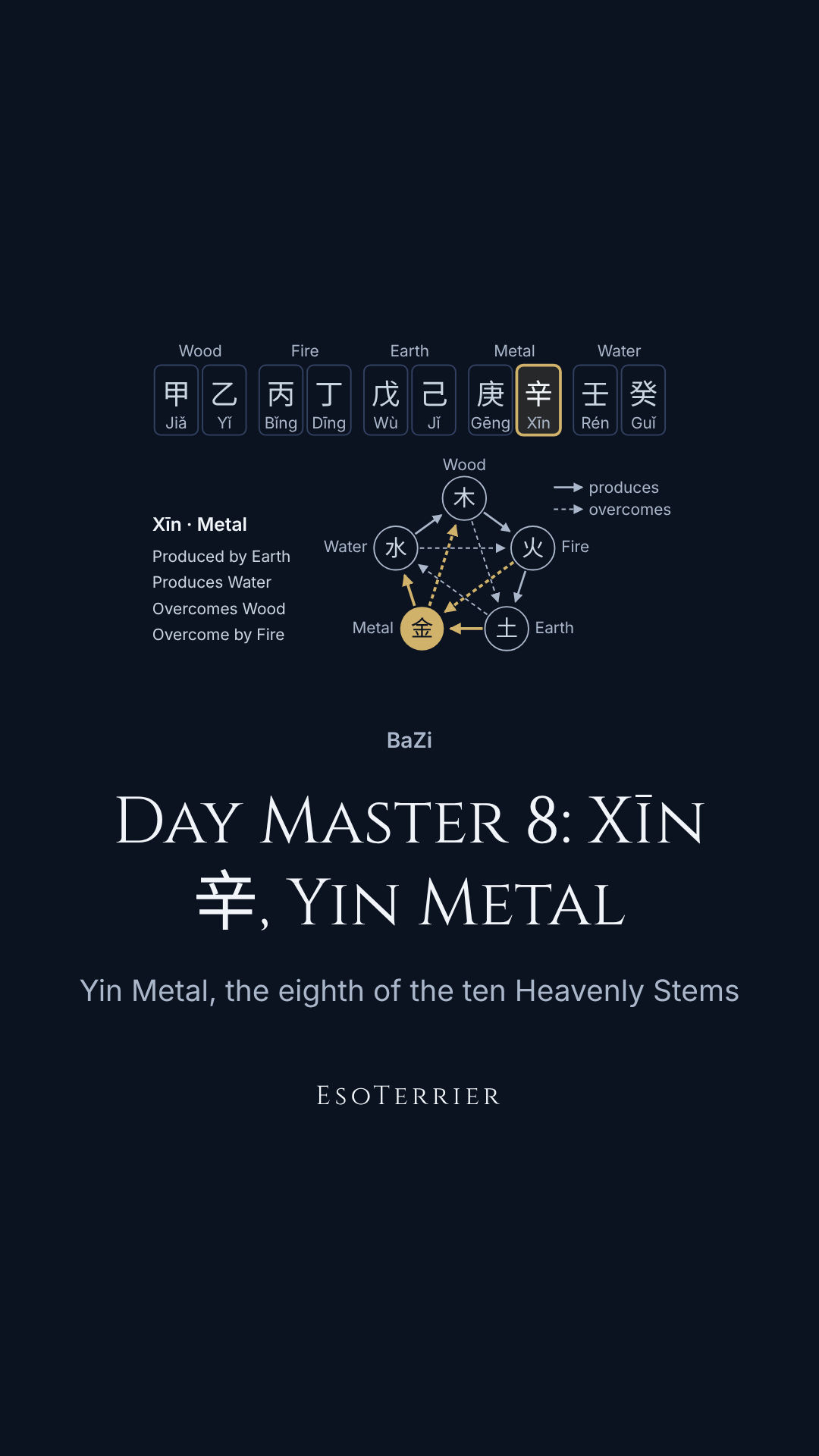
It combines with 丙 Bǐng (天干五合), a pair the 三命通會 calls 威制之合 (the match of authority and restraint), leaning to Water; it clashes with 乙 Yǐ. Its own phase is strongest in autumn.
To a 辛 day master the ten stems are: 甲 Direct Wealth (正財); 乙 Indirect Wealth (偏財); 丙 Direct Officer (正官); 丁 Seven Killings (七殺); 戊 Direct Resource (正印); 己 Indirect Resource (偏印); 庚 Rob Wealth (劫財); 辛 Friend (比肩); 壬 Hurting Officer (傷官); 癸 Eating God (食神). A second 辛 elsewhere in the chart is a Friend; the day stem itself is the Day Master and is not one of the Ten Gods.
What this page leaves out
The classical chapters on 辛 also say, in the idiom of their age, what such a chart means for rank, kin, marriage and fortune. We record that they do and repeat none of it. Nor do we say whether a 辛 day master is strong or weak, or which useful god it needs: the tradition weighs both, and EsoTerrier computes neither.
Correspondences
Each item with how it stands: “sourced” is in the work cited, “our construction” is EsoTerrier’s own, and “disputed” means the sources disagree.
- Opening of the 滴天髓 verse
- 「辛金軟弱」 sourced
- Sky image, 三命通會
- Frost (霜) sourced
- In heaven and on earth, 三命通會
- In heaven the sun and moon, the essence of the moon; on earth metal, the ore in the mountain (在天為日月,乃太陰之精,在地為金) sourced
- The first month, 窮通寶鑑
- In the first month 辛 has lost its season to 甲; it takes 己 as its source and owes its lustre to 壬 (正月辛金) sourced
- Combination, 三命通會
- With 丙: 威制之合 (the match of authority and restraint) sourced
- Nobleman star (天乙貴人)
- 寅 and 午; a symbolic star we do not chart yet sourced
- Academic star (文昌)
- 子; a symbolic star we do not chart yet sourced
- Blade under an older rule
- 戌, a rule the 三命通會 reports and the Ziping method drops disputed
- Our image, traits and challenge
- Fine jewellery: refined, perceptive, aesthetic and precise; its challenge: vanity, and thin skin our construction
- Fine jewellery as the classical meaning
- A modern image; the classics give the ones above, and the 原注 says 辛 is "not jewels" disputed
- First meaning of the character
- Uncertain; the stems are first attested as day names of the Shang week disputed
How the schools read it
- 滴天髓, the verse
- Soft, warm, clear metal that fears heaped earth and loves water; through 丙 it saves the wood. Attributed to 京圖 of the Song or to Liu Bowen; one edition study dates the text mid-Ming or later.
- 任鐵樵, 滴天髓闡微 (after 1820)
- The same verse; with the 原注 that 辛 is "not jewels", and 任鐵樵's own gloss, the metal of the human world.
- 三命通會 (Ming)
- The moon's essence and the ore in the mountain; frost.
- 窮通寶鑑 (Qing)
- Out of season in the first month, sourced in 己 and polished by 壬.
- Modern English teaching
- The one-word image, fine jewellery, a simplification of the classical images.
- EsoTerrier
- Shows fine jewellery as its own image, labelled, beside the texts.
Claims about it
-
辛 is jewellery, gold and precious stones.
disputedWhat the record shows: The 滴天髓's older commentary says 辛 is not jewels but gentle, clear metal; 任鐵樵 calls it the metal of the human world; the 三命通會 makes it the moon's essence and ore. Our chart keeps "fine jewellery" as a modern image, labelled as ours.
-
The day stem is itself a Ten God, the Friend (比肩).
falseWhat the record shows: A 辛 in another pillar is a Friend to a 辛 day master; the day stem itself is the reference point, labelled Day Master (日主) by every tool we surveyed.
-
辛 runs the twelve stages backward, born (長生) in 子.
disputedWhat the record shows: The 三命通會 says so and every tool prints it. The 滴天髓's older commentary already questions it, and 任鐵樵 rejects separate yin stages. We print the backward rule and label it.
-
A 辛 day master can be scored strong or weak, and its useful god computed.
disputedWhat the record shows: The classics ground the useful god in at least four different ways. EsoTerrier computes neither the strength nor the useful god.
-
The classical chapters on 辛 tell a person's rank, marriage and length of life.
told as loreWhat the record shows: The texts do make such pronouncements, in the idiom of their age. We take only their images and the logic of the phases.
Elsewhere on EsoTerrier
- Gēng 庚, yang Metal the other Metal stem; to a 辛 day master, Rob Wealth
- Bǐng 丙, yang Fire combines with 辛; to a 辛 day master, Direct Officer
- Yǐ 乙, yin Wood clashes with 辛; to a 辛 day master, Indirect Wealth
- Friend 比肩 what a second 辛 in the chart is to a 辛 day master
- Direct Officer 正官 what 丙, its partner in combination, is to a 辛 day master