How it works
Only the day and month of your birth decide your tree month; the year is used for nothing but finding 29 February. We follow Robert Graves, the documented origin of the calendar: thirteen months of 28 days in the ordinary calendar, the first beginning on 24 December, and 23 December left over.
The months run in his order: Birch, Rowan, Ash, Alder, Willow, Hawthorn, Oak, Holly, Hazel, Vine, Ivy, Reed and Elder, which ends on 22 December. Figure 1 shows them with their dates, and each month's page gives its own.
These are Graves' month dates as every source that follows him reports them; his book is in copyright and we give its facts, never its words. No source says where 29 February belongs, so by our own convention it falls in the Ash month, which then has 29 days. We checked every day of 2023 and 2024, 731 in all, against an independent recalculation, with no gap or overlap.
The letter. Each month has an Ogham letter, which we find by its official Unicode name, never by its position: Unicode keeps the order of the stones, B L F S N, and Graves' calendar does not, which is how our old table came to draw the wrong letter for eight months. We draw the letter ourselves, upright on its stemline and read from the bottom up as on the stones: the first five letters with strokes to the right of the line, the next five to the left, the next five across it. Its Modern Irish name leads (Beith, Luis, Nion and so on), the Old Irish form sits beneath it, and Graves' spellings, such as Beth and Duir, are kept as variants.
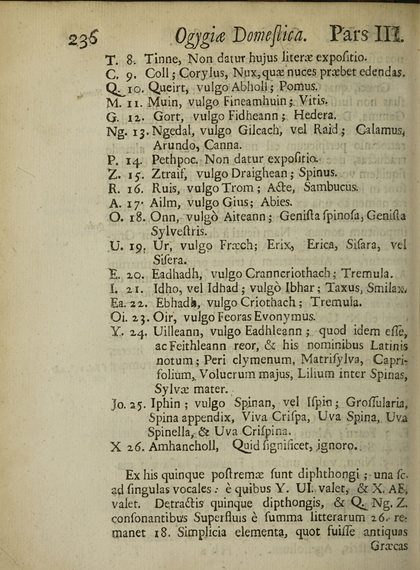
The tree. Only some letter names are tree names, so each month says how its letter is tied to its tree. For Birch, Alder, Willow, Oak and Hazel the name means the tree. For Rowan, Ash, Hawthorn, Holly, Ivy and Elder the medieval tracts link the letter to the tree, but the name means something else. The vine is doubtful, since it is not native to Ireland; for the reed the medieval tract glosses the letter as broom or fern, and the reed comes from a list of 1685.
The kenning. Each letter has short poetic phrases in the medieval word-ogham. We give the kenning of Morann mac Moín in Old Irish with George Calder's 1917 English and the tract's own explanation of the tree, each credited with its page. For Holly's letter Calder leaves the kenning trian untranslated, so there we give the word's plain meaning, "a third", and say that it is ours.
What you read. The readings and traits are our own, written from the tree, its letter, its kenning and attested Irish folklore. We give no planet, element, colour, gemstone, animal, personality title or compatibility.
Origins and history
The script is medieval, the tree names are medieval learning, and the calendar is from 1948.
| When | Who | What happened |
|---|---|---|
| About the 4th to 7th centuries AD | Irish speakers in Ireland and western Britain | Ogham cut on standing stones, mostly personal names; about 400 inscriptions of this kind survive, most of them in Munster. Twenty letters in four groups of five. |
| About the 7th to 9th centuries | Irish scholars | The three series of kennings, and the learned idea that the letter names are tree names; the core of the Auraicept may date from the early eighth century. |
| About 1390 | The scribes of the Book of Ballymote | The surviving copies of the Auraicept and the Ogam Tract, with tree glosses, kennings and a long list of cipher oghams, none of them a calendar. The Auraicept itself says that some of the trees are "not known to-day". |
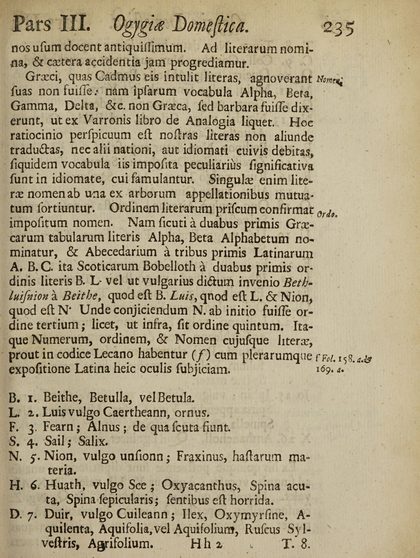
| 1685 | Roderick O'Flaherty, Ogygia | Lists the letters with tree glosses, argues from the name Beth-luis-nion that N must once have been third, and reduces the alphabet to eighteen simple letters. |
| 1804 and 1809 | Edward Davies | Antiquarian books on the Druids that treat trees as letters and as lots, with no calendar of tree months; Graves drew on them. |
| 1876 | Charles Graves, Bishop of Limerick | Robert Graves' grandfather writes on the ogham alphabet and doubts that all the letter names are trees. |
| 1944 to 1948 | Robert Graves | Drafts the book in three weeks of January 1944 and publishes The White Goddess in 1948: thirteen consonant months of 28 days from 24 December, 23 December left over for "a year and a day", and the five vowels placed at the solstices and equinoxes. |
| 1971 | Paula Delsol, Marie Claire | Invents a different "Celtic" horoscope of 21 or 22 trees in ten-day periods. |
| 1984 to 1991 | Annemarie Mütsch-Engel; the Bundesgerichtshof | A German book presents Delsol's horoscope as ancient lore; a copyright case decided in 1991 traces it to the 1971 magazine. |
| 1988 | Liz and Colin Murray | The Celtic Tree Oracle, a divination deck on Graves' tree alphabet. |
| 1992 and 1994 | Helena Paterson | Turns Graves' months into a thirteen-sign zodiac with ruling planets, among them the non-existent Vulcan, and gemstones, symbols and deities. |
| 1995 | Michael Vescoli | Der keltische Baumkalender, the best-known book of the 21-tree system. |
| 1999 | Unicode 3.0 | Encodes the Ogham letters in the order of the stones. |
| By 2008 | whats-your-sign.com | Publishes thirteen personality titles for the months, copied by many later calculators and by our own old pages. |
| 2013 | Heiss and Leskovar | The first peer-reviewed history of both tree systems: no ancient or medieval source documents a tree horoscope. |
| 2026 | EsoTerrier | The system rebuilt: letters by Unicode name, Graves' extra day, Calder's kennings, our own texts, no modern attributions. |
Graves himself said that he saw the calendar in the consonants almost at once, and he passed on the warning he had from the archaeologist R. A. S. Macalister: that O'Flaherty's alphabet was a late and artificial piece of learning. He kept it, because his argument depended on it. Graves' book is a work of poetic myth, and its tree calendar has no foundation in any historical calendar.
The thirteen months and the extra day
Each month has its own page: its letter drawn and named, the tree and how the letter is tied to it, the kenning in Calder's translation, its folklore where there is any, and the claims made about it. The extra day has a page of its own.
The thirteen months
The day outside the months
Variants and what we leave out
The name "Celtic tree" covers more than one system, and the lists disagree. We describe what you will meet and say what we do with it.
- Elder to 23 December, no extra day. Most tree-sign websites and calculators run Elder to 23 December and have no extra day, so their Elder month is a day longer than ours; the lists that follow Graves closely keep 23 December apart, as we do. All other dates agree.
- A mistletoe sign for 23 December. A later popular addition with no source, no letter and a wrong Irish name; our old engine used it. Dropped.
- Graves' vowels. Graves set the five vowels at the turning points of the year: A and I at midwinter, O at the spring equinox, U at midsummer, E at the autumn equinox. Left out: they are not months, and the solstices move.
- Graves' trees of the week. In another chapter Graves pairs seven trees with the planets of the week, among them Birch with the Sun and Oak with Jupiter. Left out with all planets.
- Paterson's thirteen signs (1992 and 1994): ruling planets, including the hypothetical Vulcan, with gemstones, symbols and deities. Left out: modern, with a planet that does not exist.
- The web correspondences. Gemstones, colours, animals and elements from later lists, which disagree with one another; no source at all gives the elements. Left out.
- Personality titles. The thirteen titles of a 2008 website. Never used.
- The 21-tree Celtic horoscope. Delsol's system of 1971, popular in France, Germany and Central Europe, is a different set of trees and dates: the same person can be Oak with us and a quite different tree there. Left out: it is no older than ours and unknown to most English-speaking readers.
- Culpeper's planets of plants (1652) are the real ancestry of "tree planets", and differ from Paterson's for most trees. Not used.
- The colour and bird ogams. The Ogam Tract lists, for each letter, a colour and a bird whose names begin with that letter, like its lists of churches and saints. They belong to the letter, not to a tree or a birth month; the tree pages give them as a curiosity.
- Divination with ogham sticks or cards is a modern practice. Out of scope.
- Your name in Ogham is planned for later; Ogham has no standard letters for J, V, W, X or Y.
Myths and disputed claims
What is said about the tree calendar and about Ogham, who says it, and what the record shows. The label is ours.
-
The thirteen tree months are an old Celtic calendar that the Druids kept.
falseWho says it: Helena Paterson's 1994 subtitle, most tree-sign websites, and our own pages before October 2026.
What the record shows: No ancient or medieval source has a tree calendar or a tree for each birthday. Graves set out the thirteen months in 1948, from a letter list of 1685. Scholars of Celtic religion and of ogham say so plainly.
-
The thirteen months follow the Moon.
falseWho says it: Paterson's "lunar zodiac", many websites, and our old docs and page.
What the record shows: A month of the Moon, from new moon to new moon, lasts about 29.5 days. Graves' months are fixed blocks of 28 days in the ordinary calendar and never follow the Moon.
-
23 December is the winter solstice, or the last day of the solar year.
falseWho says it: Popular "nameless day" pages, and our old engine text and page.
What the record shows: The December solstice falls on 21 or 22 December (UTC) in 195 of the 201 years from 1900 to 2100, and on 23 December only in 1903. 23 December is day 357 of a common year. The extra day is Graves' device.
-
23 December belongs to the mistletoe, a sign with its own Irish name and Ogham letter.
falseWho says it: Pagan calendar pages of the 2000s, and our old engine.
What the record shows: Graves left the day without a tree. No medieval tree list has the mistletoe, and it has no Ogham letter; the Irish word for it is drualus. The letter our old engine showed for it was Ruis, Elder's.
-
The Druids cut mistletoe at the winter solstice.
falseWho says it: Many popular pages, and our old mistletoe page.
What the record shows: The only ancient account, Pliny's, has them cut it on a day of the Moon, the sixth in his Latin (his Victorian translators print the fifth). No solstice is named.
-
The Gaulish bronze calendar found at Coligny is the background to the tree calendar.
falseWho says it: Some websites and apps, and our old page.
What the record shows: It is a lunisolar calendar of the second century AD with months of 29 and 30 days. It names months, not trees, and has nothing to do with Irish ogham.
-
Each tree month has a traditional personality title.
falseWho says it: whats-your-sign.com (by 2008) and the many sites that copied it, our old pages among them.
What the record shows: The thirteen titles are one website's labels from the 2000s, with no source in Graves, Paterson or anything medieval. We never use them.
-
Each tree month has a traditional planet, element, colour, gemstone and animal.
falseWho says it: Helena Paterson (1992), Tarot.com and the lists that follow them, and our old engine.
What the record shows: None is medieval or in Graves as a set. The planets are Paterson's and include Vulcan, which does not exist; the gemstones and animals come from later web lists; the elements have no source and the lists disagree.
-
Every Ogham letter is named after a tree, and the first thirteen letters are the thirteen months.
falseWho says it: Most tree-sign sites; the medieval tracts themselves give tree naming as one view.
What the record shows: Scholars accept at most eight of the twenty letter names as tree names, and the Heritage Council counts six. Graves moved N to third place and left out Q and Z, so the months are not the first thirteen letters.
-
Graves only popularised a calendar that already existed.
falseWho says it: Our old page, and many websites.
What the record shows: He built it, from O'Flaherty's guess about the letter order. He reported that R. A. S. Macalister had warned him that this alphabet was a late artificial one, and went ahead because his argument depended on it.
-
The 21-tree "Celtic horoscope" of continental Europe is old Celtic lore from a Polish monastery.
falseWho says it: Annemarie Mütsch-Engel's book of 1984 and its successors.
What the record shows: A German Federal Court of Justice case of 27 June 1991 traced it to Paula Delsol's articles for Marie Claire in 1971, by way of a Polish garden calendar.
-
Two publishers who turned down The White Goddess died soon after, and T. S. Eliot, who took it, was rewarded.
told as loreWho says it: Robert Graves, in a lecture of 1957.
What the record shows: A tall story. The publisher's archive shows a reader who admired the book, a refusal for wartime reasons, and a death ten months later.
Stories and lore
These are told as the tradition tells them.
Ogma and the first ogham. The Ogam Tract says the script was invented by Ogma, "a man well skilled in speech and in poetry", brother of the king Bres, and that the first thing written in it was seven b's cut on a switch of birch, a warning to Lug son of Ethliu that his wife would be carried off seven times into fairyland unless birch guarded her. That, says the tract, is why b is named from the birch and stands first. The Auraicept tells instead that the letters were named after the disciples of Fenius Farsaid, whose school made the Irish language after the tower of Babel.
The tract on its own trees. The medieval scholars did not claim to know every tree: the Auraicept says that some of them "are not known to-day", and the Ogam Tract that the letters took their names from the trees of the forest "metaphorically". Their copies disagree, glossing the same letter as rowan in one place and elm in another.
Pliny's Druids. The only ancient account of Druids and mistletoe is Pliny's: they "held nothing more sacred than the mistletoe and the tree that bears it", and a priest in a white robe cut it with a golden sickle on a set day of the Moon. It names no solstice and no calendar; it has shaped the popular image of the Druid more than any other passage.
How the book was written. Graves drafted The White Goddess in three weeks of January 1944 and sent it to publishers in 1946. In a lecture of 1957 he said that two publishers who turned it down died soon after and that T. S. Eliot, who took it, was rewarded; the archive tells a slower and kinder story.
The Polish monastery. Later editions of the German book on the 21-tree horoscope said it came from an old manuscript found in a Polish monastery; the 1991 court case found that it went back to a French magazine of 1971.
Irish tree lore. Some of the trees have real folklore, which the month pages tell as folklore: rowan hung over doors and cattle on May Eve against the fairies, as Irish schoolchildren recorded it in 1937 and 1938; the lone hawthorn as a fairy tree, around which a new road in County Clare was built in 1999; the salmon of knowledge in the medieval tale of Finn's boyhood; and the alder shield of the kenning.
Evidence and criticism
What ogham scholars say. Damian McManus showed that the kennings are Old Irish and that only some letter names are trees; the "tree alphabet" is a learned reading that grew because the letters were called feda, "trees", and their strokes flesca, "rods". Deborah Hayden and David Stifter count six genuine tree names, ten names glossed as trees that mean other things, and three artificial forms, and the Heritage Council's leaflet gives the public the same count. The original sounds of a few letters are still debated.
What historians say of Graves. Ronald Hutton writes that the tree calendar has no foundation in historical calendars and that the book remains a major source of confusion about the ancient Celts; scholars of Celtic religion and folklorists have rejected its history while granting its influence on poetry and modern Paganism. Peter Berresford Ellis called "Celtic astrology" a fabrication. Andreas Heiss and Jutta Leskovar, in the one peer-reviewed study of both tree systems, find no ancient or medieval source for a tree horoscope and show that Graves' months do not even match when the trees flower.
Inside the tradition. Irish teachers of Ogham object in public to the calendar being sold as Irish or Druid lore, and Pagan writers themselves call it Graves' invention and point out that thirteen months of 28 days is neither a month of the Moon nor a year.
We searched again for an older calendar. In October 2026 we read Calder's edition of the medieval tracts in full and searched it for months, calendars and years; we searched Edward Davies' two books the same way. The tracts give tree glosses, kennings and cipher lists, and their only count of days is a poetic comparison of 365 limbs and days; Davies has no tree months. The Gaulish calendar of Coligny is lunisolar and names no trees. No ancient or medieval tree calendar is documented.
No test of effect. No study tests whether a tree month says anything about a person, and the system makes no testable claim: the calculation is a lookup of the day and month in a fixed table.
Copyright. Graves died in 1985, so The White Goddess is in copyright in the United States until the end of 2043 and in the United Kingdom and the EU until the end of 2055; we state its facts and never its words. Calder's translation of 1917, O'Flaherty, Pliny in the 1855 translation and Meyer's Finn of 1904 are in the public domain and are quoted with credit.
Terms
- Ogham, ogam
- The Early Medieval Irish alphabet of strokes along a line. Ogham is the Modern Irish spelling, used by archaeologists; ogam the Old Irish one, used by Old Irish specialists. Both are correct.
- Beithe-Luis-Nin
- The medieval name of the alphabet, after its first letters. O'Flaherty's form Beth-luis-nion led him to think N had once been third.
- Fid, feda
- A letter of the alphabet; the word also means a tree or wood, which is one root of the idea that the letters are trees.
- Flesc, druim
- A flesc (plural flesca, "rods") is one stroke of a letter; the druim ("ridge") is the stemline the strokes are cut against, on a stone usually its edge.
- Aicme, aicmí
- One of the four "families" of five letters: strokes to one side of the line, strokes to the other, strokes across it, and notches for the vowels.
- Forfeda
- Five extra letters found in the manuscripts, added later than the twenty of the stones.
- Kenning
- A two-word poetic description of a letter, such as "faded trunk and fair hair" for Beith. We quote them in George Calder's 1917 translation.
- Bríatharogam
- "Word-ogham": the three series of kennings, named after Morann mac Moín, Mac ind Óc and Cú Chulainn. We use Morann's.
- Auraicept na n-Éces, In Lebor Ogaim
- "The scholars' primer" and "the Ogam Tract": medieval Irish texts on language and ogham, copied in the Book of Ballymote (about 1390) and other manuscripts, edited by Calder in 1917.
- Tree status
- Our label for how a letter is tied to its tree: the name means the tree; a medieval gloss on a name that means something else; doubtful (the vine); or contested (the reed).
- The extra day
- 23 December, the day left over after Graves' thirteen months of 28 days, for his "year and a day". It has no tree and no letter, and it is not the solstice.
- The 21-tree Celtic horoscope
- A different system of 21 or 22 trees in ten-day periods, popular in France and Germany, invented for the magazine Marie Claire in 1971. Not what we compute.