How it works
The birth card. Every card of the pack has a solar value, Richmond's number for it: the Ace to King of Hearts are 1 to 13, the Clubs 14 to 26, the Diamonds 27 to 39 and the Spades 40 to 52. Your birth card is the card whose solar value is 55 minus twice the month and minus the day. For the person in Figure 1, born on 19 January, that is 55 − (2 × 1 + 19) = 34, the Eight of Diamonds. 31 December gives 0, the Joker, and 29 February gives 22, the Nine of Clubs. Richmond's own example, 23 July, gives 18, the Five of Clubs.
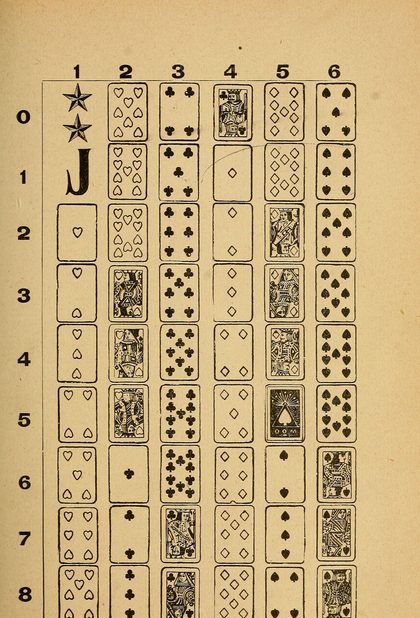
The formula is Richmond's, restated. His book finds the day card another way: add the “astral power” of the month to that of the day and take the “spirit” of the sum, which points to a cell of the plate of day cards on page 63 (Figure 2). Run from the 1893 scan for all 366 days, his rule and the formula give the same card on every one, once a single digit of his printed table, in the entry for the 9th of the month, is read as 5 rather than 4. Because the formula depends only on the month and the day, a card has the same birthdays every year: between one and twelve of them.
The spreads. Richmond deals the pack by a fixed rule he calls quadration. Face down in natural order, Ace of Hearts on top, the pack is dealt in blocks of three “without disturbing the order in which they come” to four quarters, Hearts, Clubs, Diamonds and Spades, until four cards remain, which are dealt singly; the quarters are gathered up, Clubs onto Hearts, then Diamonds, then Spades; the pack is dealt again one card at a time round the four quarters and gathered the same way. One such pass is a quadrate. The first quadrate of the natural order is the Life Spread, the spread every birth card is read from.
Repeat it and the cards keep moving, but not forever. Richmond saw that “90 quadrates” bring “every emblem in its original solar place”, and the arithmetic agrees: the rule is a fixed shuffle that returns the pack to its natural order on the ninetieth pass and not before. Along the way three cards never move at all, the Jack of Hearts, the Eight of Clubs and the King of Spades; two pairs, the Ace of Clubs with the Two of Hearts and the Seven of Diamonds with the Nine of Hearts, swap places at every pass; and the other 45 cards travel one cycle of 45 steps. Our engine checks all of this each time it starts.
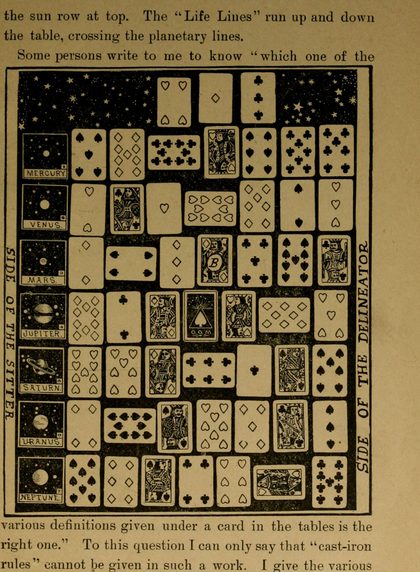
The layout. Richmond lays a spread out in seven rows of seven, one row for each planet, from the right-hand end of the table, and three “sun cards” above them. His 1893 text does not say which planet's row is on top; his engraving of 1896 (Figure 3) and Camp's published chart both put Mercury at the top and Neptune at the foot, and so do we. Each row is read from right to left, so the columns run Neptune to Mercury across the page, and the three crown cards sit over the Mars, Jupiter and Saturn columns. A card's place is its row and its column: the Ace of Clubs, for example, is in the Mercury row and the Venus column, and a card whose row and column share a planet is called double.
What is read from the Life Spread. Everything else is the modern line's, computed by us from Camp's documented rules; methods are not anyone's property, and his wording and card names are never used.
- The life path. The card before yours in the Life Spread is your Moon card; the seven after it are your Mercury to Neptune cards, and the next three your Pluto, Result and Cosmic Lesson cards. Reading order runs on from the crown back to the top right, so every card has a path.
- The planetary ruling card. The card of your life path in the place of your Sun sign's ruling planet, with the modern rulers the tradition uses: Aries Mars, Taurus and Libra Venus, Gemini and Virgo Mercury, Cancer the Moon card, Leo the birth card itself, Scorpio both Mars and Pluto, Sagittarius Jupiter, Capricorn Saturn, Aquarius Uranus, Pisces Neptune. We take the Sun's sign from an ephemeris. With a birth time it is exact; without one, if the Sun changed sign during the birth day, you are given both signs' cards, which is the tradition's own answer.
- The karma cards. The natural-order card that sits in your Life Spread place, and the Life Spread card that sits in your natural place. The semi-fixed cards are each other's, both ways; the fixed cards have none.
- The years. Age 0 is read from the Life Spread, age 1 from the next quadrate, and so on: age 89 uses the natural order, and age 90 the Life Spread again. From each year's spread come the seven period cards, a Pluto and a Result card, a Long Range card for the year as a whole (from a spread for each block of seven years), and an Environment and a Displacement card for every card outside the Family of Seven.
- The periods. The year from one birthday to the next is cut into seven periods of 52 days, Mercury to Neptune, with the birthday as the first day of Mercury, as in Camp's instructions; other schools start a day later. The periods are the tradition's themes for the year, never a timing for anything.
- The card of the day. Richmond's rule: “Day cards and birth cards are the same thing”, so today's card is the birth card of today's date, the same for everyone.
- The Joker. Not in the pack Richmond deals, so it has no place in any spread, and no life path, ruling card, karma cards or periods. “His solar value being zero”, Richmond writes, and yet “on the 31st of December the Jester rules supreme”.
Checked twice over. Our engine was written from Richmond's text and checked against every published example we found, Camp's own Life Spread chart cell for cell among them. A second program, written separately from Richmond with a different model of the pack, then agreed with it on every day of 1990 and 2000, on 65,610 yearly cards, on 9,477 seven-year cards and on 1,045 periods; Camp's own calculator agreed on ten dates out of ten. That shows the arithmetic is done as its authors describe it.
Origins and history
The cards are medieval, the calendar sums are a soldier's joke of the 1770s, the spreads are Richmond's of 1893, the character readings date from 1947, and the life path and yearly periods from 1992.
| When | Who | What happened |
|---|---|---|
| 9th century | Tang China | Playing cards most likely invented with woodblock printing. |
| 1371 to 1377 | Catalonia, Florence, Switzerland, Paris | The first European records of playing cards; Mamluk packs of 52 cards in four suits survive from the 15th century. |
| About 1480 | French card makers | The suits of hearts, clubs, diamonds and spades. |
| 1770s | Anonymous broadsides | Cards Spiritualized; or, the Soldier's Almanac: a soldier caught with cards in church explains them as his almanac, 365 spots for the days, 52 cards for the weeks, 13 tricks for the months. The calendar idea is a century older than Richmond. |
| 1799 to 1801 | Edward Ludlow and Ann Wilcox, England | Double-headed court cards patented and sold. |
| 22 February 1844 | Olney Hawkins Richmond | Born in Clinton County, Michigan; married at Cedar Springs, near Grand Rapids, in 1866. |
| 1850s to 1874 | American card makers | The Joker added to the euchre pack as its top trump, the “best bower”; sold in Britain from 1874. |
| 22 May 1873 | A newspaper advert in Missouri | “Gamblers Tricks, Cardology, Ventriloquism”: the earliest use of the word found, for card tricks. |
| 1892 | Richmond, Grand Temple of the Order of the Magi, Chicago | Temple Lectures of the Order of the Magi, given to its classes over about sixteen months. |
| 23 January 1893 | Richmond, The Temple Publishing Company, Chicago | The Mystic Test Book entered for copyright: the solar values, the Joker as zero and as 31 December, the quadration, the grand spread, the ninety quadrates, the day-card rule and the card tables are all here. |
| 1896 | Richmond | The Supplement, with the engraved spread of Figure 3 and the rule that day cards and birth cards are the same thing. |
| About 1915 | P. R. S. Foli, London | Fortune-Telling by Cards ties the nine of hearts to wishes, an early printed use of the label later pinned on the Nine of Hearts. |
| June 1919 | Richmond | Third edition, revised and enlarged. |
| 30 March 1920 | Richmond | Dies in Chicago. Camp's account has his daughter Arline carrying on the work. |
| 1934 to 1941 | Jan Eric; Michael F. Zens | “Astro-cardology” registered as works of art and a book; “Cardology of Tomorrow”, a card-magic pamphlet. Whether Jan Eric used Richmond's system is unknown. |
| 22 December 1947 | Edith L. Randall and Florence Evylinn Campbell, Hollywood | Sacred Symbols of the Ancients registered; by Camp's account the first book to read the 52 birth cards as personalities. Renewed in 1974. |
| 1978 | Arne Lein | What's Your Card?; Lein, Randall's student by Camp's account, taught the cards in Hollywood. |
| 1988 to 1991 | Robert Lee Camp | Meets Lein in 1988; says he was made Grand Master of the Order of the Magi in 1991. |
| 1992 | Camp, Seven Thunders Publishing, Tampa | The Cards of Your Destiny: the yearly spreads, the Long Range, Pluto, Result, Environment and Displacement cards and the 52-day periods in print. |
| 1997 and 1998 | Camp | Love Cards (the karma cards and the planetary ruling card) and Destiny Cards, whose title many people now use as a name for his system. |
| 2004 to 2014 | Camp; Sharon Jeffers | New editions of Camp's books, Your Birthday, Your Card (2008) and a book on the Seven Thunders (2013); Jeffers' Love and Destiny (2008) in the same line. |
| 2005 | Iain McLaren-Owens | The earliest catalogued use of “cardology” for the birth-card system. |
| 2018 to 2025 | The USPTO | CARDOLOGY registered for playing cards and their online sale (2019); the word disclaimed in a mark for courses (2022) and refused as merely descriptive (2023). |
| 2021 to 2026 | Many authors and app makers | More than twenty birth-card books and several apps with “Cardology” in the title; no major dictionary lists the word. |
| October 2026 | EsoTerrier | The engine rebuilt from Richmond's quadration and checked; the suit planets, elements and seasons dropped from the chart; every card text rewritten from Richmond. |
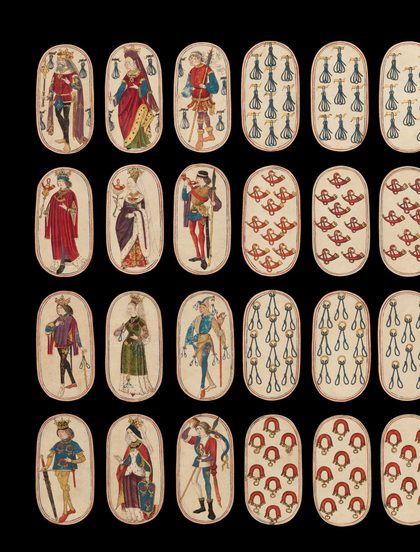
Nothing about the pack was designed for divination. The four suits and the courts came out of Mamluk and European games, and the French suit signs that Richmond read as seasons were a card maker's simplification of about 1480. What Richmond added was arithmetic: he numbered the cards, found a dealing rule that returns the pack to order after ninety passes, and wrote a book of meanings for each card under each planet. His book was a working manual for readings with a shuffled and cut pack; the fixed solar spreads, which he called “wholly arbitrary in formation” though worth study, became the whole of the modern system.
The modern line read Richmond's spreads as character rather than events. Randall and Campbell's book of 1947 gave the 52 birth cards personalities; Lein taught them in the 1970s; Camp added the life path, the planetary ruling card, the karma cards and the yearly periods, and his books made the system widely known. The word “cardology” came last: it named card tricks in 1873 and the birth-card system only from about 2005. Richmond never used it, and neither does Camp.
The 53 cards
Each card has its own page, in the natural order Richmond counts them, with the Joker last: its birthdays and the Sun signs they fall under, its place in the Life Spread, its life path and karma cards, its ruling card for each sign, Richmond's reading of it in his own words, ours, and what the schools say about it.
Hearts · solar values 1 to 13
Clubs · solar values 14 to 26
Diamonds · solar values 27 to 39
Spades · solar values 40 to 52
The Joker · solar value 0
Variants and what we leave out
Cardology has no single authority, and the schools disagree. We describe the choices so you can recognise them, and say what we do.
- Richmond's own practice. Richmond read events, not personalities: letters, visits, journeys, gains and losses, illnesses, under each of the seven planets, from a pack shuffled and cut by the sitter and the reader at timed intervals. He also taught minute and hour cards, “mystic crosses” and magic squares he called tarots. None of this is in our chart; his tables are quoted as history only.
- The character readings. Randall and Campbell, Lein and Camp read the birth cards as personalities. Their books are in copyright, and our texts owe them nothing: they were written from Richmond's tables and the plain sense of suit and number.
- Camp's additions we leave out. The personality cards (a Jack for men, a Queen for women), the decanate ruling card (sold as a course, its rule unpublished), a personal daily card (also unpublished), lists of favourable years, compatibility scores, and his nickname for each card.
- The start of the periods. Camp makes the birthday the first day of the Mercury period; Card Blueprints makes it a “day zero” and starts Mercury the next day. Ours is Camp's. For a 29 February birthday we use 28 February in other years; some programs use 1 March.
- Cusps. Some sites use a fixed table of cusp dates, some ask you for your sign. We compute the Sun and give both cards only when it changed sign during your birth day and no birth time is known.
- The fixed cards' karma cards. None, by the definition; some readers give each fixed card the other two.
- “Karma cousin”. Seven Reflections' name for the second karma card; a separate connection in Camp's Love Cards. The two uses differ, and we use neither.
- The Long Range and vertical cards. Our Long Range card follows the one teacher who states the rule, confirmed against Camp's calculator; the vertical card follows one published example.
- Longer life paths. Some authors add an eleventh and a twelfth card with varying names. We stop at the Cosmic Lesson.
- The Joker by the clock. One teacher reads a 31 December birth before noon as the Ace of Hearts and after noon as the King of Spades. A single source, never offered here.
- Suit elements, planets and seasons. Many sites give each suit an element and a planet, and they disagree; no founding text does. Richmond gives the suits seasons, Hearts spring, Clubs summer, Diamonds autumn, Spades winter, and two planets each. We report his as facts about his book and show none on the chart.
- Compatibility. Reading two people's cards against each other is the tradition's best-known extension. Not offered for now, and never with Camp's scores.
Myths and disputed claims
What is said about Cardology, who says it, and what the record shows. The label is ours.
-
Playing cards were first made in Atlantis and kept in its Temple of Wisdom, and the Order of the Magi carried them to Egypt about 13,000 BC.
told as loreWho says it: Richmond (1893, pp. 13 to 17, and the 1896 Supplement), repeated by Camp's site and the International Association of Cardology.
What the record shows: Richmond's own origin story, which he told as history. There is no evidence for Atlantis. Playing cards are recorded in 9th-century China and 14th-century Europe, the French suits from about 1480 and the Joker from the 1850s.
-
The Order of the Magi is more than 20,000 years old and counted the Chaldeans, the three Magi and Pythagoras among its members.
told as loreWho says it: Camp's site and the International Association of Cardology.
What the record shows: No record of the Order exists before Richmond's own, which met in Chicago by 1892. Told as the tradition's lore, with its tellers named.
-
The cards were disguised as a game and given to the Romani for safekeeping, which is how their secret survived.
told as loreWho says it: The International Association of Cardology; Richmond mentions the idea in passing (1893, p. 12).
What the record shows: The Romani story comes from nineteenth-century French occultists and has no evidence behind it; no Romani card reading is recorded before the twentieth century.
-
The 52-card pack was designed as a calendar: 52 cards for the weeks, four suits for the seasons, twelve court cards for the months, 365 spots for the days.
disputedWho says it: Richmond (1893, pp. 27 to 28, 36, 40), an 18th-century soldier's broadside, our own old page and most Cardology sites.
What the record shows: The sums are real and the idea is old folklore, printed in the 1770s. Nothing shows that anyone designed the pack this way: it grew out of Mamluk and European card games, and the Joker that makes 365¼ was added for euchre in the 1850s.
-
The Joker has a solar value of one and a quarter.
falseWho says it: Our own old page and one Cardology site.
What the record shows: Richmond gives the Joker a solar value of zero (“His solar value being zero”, p. 35). He counts the Jester as five-fourths only in a different sum, the spots of the whole pack, which makes 365¼ (p. 40).
-
The seven rows of the spread are the seven planets the ancient world could see.
falseWho says it: Our own old page.
What the record shows: Richmond's rows run Mercury, Venus, Mars, Jupiter, Saturn, Uranus and Neptune. Uranus was found in 1781 and Neptune in 1846; the old seven were the Sun, the Moon and five planets.
-
A solar year holds thirteen lunar months of 28 days each.
falseWho says it: Our own old page.
What the record shows: A lunar month is about 29.53 days, and a year holds about 12.37 of them. Richmond reads the thirteen cards of a suit as the Sun and the twelve signs (p. 56).
-
Richmond opened his Chicago temple years before the book, and timed the book to the World's Parliament of Religions.
unverifiedWho says it: Our own old page; Camp's site gives 1894 for the book.
What the record shows: The record supports less: the Temple Lectures were published in 1892 at the Grand Temple in Chicago, the book was entered for copyright on 23 January 1893, and the Parliament met that September. We write “by 1892 in Chicago” and nothing more exact.
-
Cardology gives an exact, fixed reading of a person's character and of the course of a life.
falseWho says it: Our own old page, and 39 of the 53 old card pages.
What the record shows: No study has tested it. The arithmetic is exact; the meanings are a tradition's symbols.
-
The meaning of the cards was kept secret by hidden orders and passed on by word of mouth until Richmond revealed it.
unverifiedWho says it: Our own old page, Camp, the International Association of Cardology, and Richmond himself (1893, p. 11).
What the record shows: No document, lodge record or earlier book shows the system before 1893. The only evidence of an older tradition is Richmond's word, and his own preface says the book was written because his Temple's members wanted a textbook.
-
Richmond's book introduced formulas that read a person's character from the birth date.
falseWho says it: Our own old page.
What the record shows: Richmond's book reads events, card by card under each planet, from spreads of a shuffled and cut pack. Character readings of the 52 birth cards begin with Randall and Campbell in 1947, and the life path and yearly readings with Camp from 1992.
-
Each suit has an element and a ruling planet.
disputedWho says it: Our own chart until October 2026, most Cardology sites, and tarot convention.
What the record shows: No founding text gives the suits elements, and the sources that do disagree with each other. Richmond gives each suit a season and two planets (pp. 27 to 28, 41), which we report as his. We dropped the attributes in October 2026.
-
The Nine of Hearts is the card of wishes.
disputedWho says it: English cartomancy, many Cardology sites, and our own old text.
What the record shows: A fortune-teller's label: P. R. S. Foli's Fortune-Telling by Cards (about 1915), which ties the nine of hearts to wishes, is an early printed use. In Richmond's table the Nine of Hearts is disappointment in love.
-
The Ace of Spades is a card of death and rebirth.
falseWho says it: Tarot and cartomancy readings, and our own old text.
What the record shows: In this tradition the Ace of Spades is Richmond's card of a secret and the emblem of his Order (“With mystics it represents the Order of the Magi”, p. 155). The other reading belongs to other systems.
-
The Joker is the rarest birth card, because it has only one birthday.
falseWho says it: Our own old text and some Cardology sites.
What the record shows: Four other cards also have a single birthday: the King of Spades (1 January), the Queen of Spades (2 January), the Two of Hearts (29 December) and the Ace of Hearts (30 December). The Joker's real distinction is that it stands outside the spreads.
-
The Joker is also the card of 30 December in leap years.
falseWho says it: Our own old Joker page.
What the record shows: 30 December is always the Ace of Hearts and 31 December always the Joker. A leap year changes only 29 February, which is the Nine of Clubs.
-
The ruling card follows a fixed table of cusp dates, the same every year.
disputedWho says it: Card Blueprints; Seven Reflections asks the user instead.
What the record shows: The Sun enters a sign on different days across the leap-year cycle and in different time zones, so a fixed table is wrong on some days of some years. We compute the Sun's sign and show both cards only when it changed sign during the birth day and no birth time is known.
-
Each fixed card has the other two fixed cards as its karma cards.
disputedWho says it: Some readers; Seven Reflections and Card Blueprints give the fixed cards none.
What the record shows: By the definition of the karma cards a fixed card's two karma cards would be itself, so we give none, as most schools do. The other view is noted as a variant.
-
Richmond was a pharmacist and a checkers champion, and corrected the published motion of Neptune with playing cards.
unverifiedWho says it: Camp's account of the founder.
What the record shows: No independent record of the pharmacy, the championship or the tables. A checkers problem credited to an O. H. Richmond of Grand Rapids was printed in the 1880s, which fits a player of that name, and nothing more.
-
The Order of the Magi passed from Richmond through his daughter, Randall and Campbell, Lein and Frank Koenig to Camp, made Grand Master in 1991.
unverifiedWho says it: Camp.
What the record shows: Camp's own account of his lineage; nothing outside his pages confirms it. We say that Camp states it.
-
The word “cardology” was first used in 1934.
falseWho says it: The International Association of Cardology.
What the record shows: Newspaper adverts for “Cardology”, meaning card tricks, ran in Missouri and Louisiana in 1873. The word was used for the birth-card system only from about 2005.
-
“Cardology” is a registered trade mark for the practice.
disputedWho says it: The International Association of Cardology.
What the record shows: The live US registration covers playing cards, puzzles and their online sale; the same owner's mark for courses disclaims the word, and the USPTO refused it in 2023 as merely descriptive. We use it only as the practice's common name. Not legal advice.
-
The birth-card formula is a modern shortcut, not Richmond's.
falseWho says it: Our own research notes of 9 October 2026.
What the record shows: Run from the 1893 scan for all 366 days, Richmond's own rule gives the formula's card on every one, once a single digit of his printed day table, for the 9th of the month, is read as 5 rather than 4. The formula is his table restated.
-
The pack of cards is the little book of Revelation 10, and the Seven Thunders are the voices of the seven planets.
told as loreWho says it: Richmond (1893, pp. 9 to 13).
What the record shows: Richmond's own reading of scripture, which gave Camp's publishing house its name. Quoted as his.
-
The Jack of Hearts is Christ, fixed at the centre of a cross in the spread, with the King of Spades and the Eight of Clubs fixed beside him.
told as loreWho says it: Richmond (1893, pp. 180 to 182; 1919).
What the record shows: The arithmetic is real: these three cards never move under the quadration. The reading of it is Richmond's theology, quoted as his.
-
The cards, and the Spades above all, foretell illness, accidents and losses.
disputedWho says it: Richmond's tables, Camp's period texts, and our own old texts.
What the record shows: The tradition does read such events into the cards. Richmond's event lines are quoted here as history, and our readings leave them out.
-
The cards show past lives and mark old souls, and the Spades are the suit of old souls.
unverifiedWho says it: Sites in Camp's line, and our own old texts.
What the record shows: Nothing of this is in Richmond. In Camp's system “karma” names a relation between two spreads; reincarnation is a belief, not part of the arithmetic.
-
The spread is the script of a life, and the quadration copies the orbits of the planets.
unverifiedWho says it: Our own old page, after a modern school's term.
What the record shows: Not Richmond's ideas. His quadration is a way of dealing a pack, which he explains through the houses and the Sun; it models no orbit.
-
The red and black suits stand for day and night, and for a positive and negative energy.
told as loreWho says it: Richmond (pp. 28 to 29) for day and night; our own old page for the energy.
What the record shows: Day and night are Richmond's symbolism and may be quoted as his. The energy is a modern addition with no source.
-
Each card has a traditional nickname.
disputedWho says it: Camp's texts and most Cardology sites.
What the record shows: The nicknames are Camp's coinages, or Randall and Campbell's, not Richmond's; taken as a set they mark a text as derived from his. We use none of them.
-
Double-headed court cards were new in 1893, and the court figures keep Egyptian emblems.
falseWho says it: Richmond (1893, pp. 29 to 30).
What the record shows: Double-headed courts were patented in England in 1799. The English court figures descend from fifteenth-century French designs, not from Egypt.
-
Tarot rests on intuition and the shuffle, while Cardology is fixed arithmetic.
disputedWho says it: Our own old page.
What the record shows: Richmond himself read shuffled and cut packs with timed cuts; only the solar spreads are fixed. And tarot birth cards are worked out from the date too.
-
The Sevens are spiritual tests, the Sixes fate and return, the Nines universal giving.
disputedWho says it: Camp and the sites that follow him.
What the record shows: Richmond reads the Sevens as obstacles, the Sixes as monotony and settlement and the Nines as disappointment (1893, pp. 42 to 45). The modern readings are the tradition's later development.
-
The Joker is the tarot's unnumbered trump under another name.
unverifiedWho says it: Camp and many sites.
What the record shows: Richmond links the Jester to no tarot card, and says only that someone invented it a few years before 1893 for certain games (p. 35). We record the link as Camp's.
Stories and lore
These are the tradition's stories, told as their tellers told them. Richmond's books are in the public domain, and the short quotations are his.
The little book and the Seven Thunders. Richmond opens with the tenth chapter of Revelation, where an angel gives John a little book, sweet in the mouth and bitter in the belly, and seven thunders utter their voices. The little book, he says, is the pack of cards, and the seven thunders are “the voices of the seven planets”. He calls the pack “the oldest book known”. Camp named his publishing house Seven Thunders after the passage. Told as Richmond's reading of scripture.
The Temple of Wisdom. Richmond's Atlantis is a round lake on a highland with a palace on a rock in the middle, canals to the four quarters and four rivers running from one source, and a Temple of Wisdom in its garden where the priests taught the Religion of the Stars. Its colonies reached Egypt, South America and a great lake over Michigan; the Order of the Magi dedicated its first Egyptian temple about 13,000 BC; and the island sank “in a day and night”, leaving the Azores. Told as legend.
The faces of the court cards. Richmond saw old emblems surviving on the modern cards: the King of Clubs, “the king of wisdom”, still holding the winged globe of Mercury; the Queens looking out “from the same Egyptian eyes”; the Queen of Spades not having laid aside her emblem of labour; and the Knaves, “originally honest men all”, gone bad when their modern counterparts took bribes. He thought double-headed courts were a few years old; they had been patented in 1799. Told as Richmond's lore.
The cross that never moves. Richmond drew a great cross in the solar spread with the Jack of Hearts at its centre, which he read as Jesus, the two Marys at its foot and “the secret emblem” at its head, and noticed that the quadration “endlessly produces Christ upon the same place in this cross”, while “the king of spades, a representative of the kingly power, and the 8 of clubs” stay put as well. The arithmetic is real, the three fixed cards; the reading is his theology.
The Jester's day. Richmond counted the spots of the pack, 364, as the 52 cards times the seven planets, and the Joker as five-fourths of a day to make 365¼. “On the 31st of December the Jester rules supreme, even the Members of the Court bow to him.” The card he calls the Jester had been made for euchre about thirty years before.
Figures will not lie. The book ends with a hymn to number against scripture: “figures are facts, figures will not lie”, and the belief that “man controls his own destiny” must give way before the figures of mysticism. The Order, Richmond writes, is a true secret order, “but the Religion of the Stars ... is not secret”, and its Grand Temple stands “at this date, 1893, at 1910 Washington Boulevard, Chicago”.
The founder as the tradition remembers him. Camp's page makes Richmond a pharmacist and a checkers champion who studied for twenty-five years before publishing, founded temples in Grand Rapids and Chicago and corrected the astronomers' tables of Neptune with cards. The records show a Michigan farmer's son, married near Grand Rapids in 1866 and dead in Chicago in 1920, and a checkers problem printed under the name in the 1880s. The rest is the tradition's.
Richmond and Papus. Handed Papus's Tarot of the Bohemians, Richmond was delighted by its chapter headings, then found its 78-card pack “worthless as a test book”, a “bogus test book” of “Popes and Devils”, and complained that the occult writers “all quote and re-quote from each other”. For him the word tarot meant the magic squares of his own system.
Evidence and criticism
No study exists. No scholar, sceptic or believer has studied Cardology, and no scholarly treatment of Richmond or his Order was found. The only sources on the system's history are the founder's books and the sites of the schools that descend from him.
The arithmetic is what it claims to be. Richmond's quadration is a fixed shuffle that returns after ninety passes, with three cards that never move, two pairs that swap and one cycle of 45; the birth-card formula equals his 1893 table on all 366 days; and independent programs, Camp's calculator and two other sites agree with ours on every date run. Nothing in the system depends on the sky except the Sun sign behind the ruling card.
One card for many birthdays. A birth-card reading gives one character to everyone born on a card's birthdays, a few days scattered through the year, with no mechanism offered beyond Richmond's “astral” correspondences. The feeling that such a reading fits is what the psychology of personal validation leads one to expect: Bertram Forer showed in 1949 that people rate a vague sketch meant for everyone as an accurate description of themselves.
The tradition disagrees with itself. Asked which of the several meanings under a card was the right one, Richmond replied that “cast-iron rules” could not be given. The modern schools differ on when the periods start, how cusps are handled, the fixed cards' karma cards, “karma cousins”, the names of the later life-path cards and the daily card, and the suit attributes they add disagree with each other and with Richmond. The history they teach, from Atlantis to Egypt, is contradicted by the documented history of playing cards and of the Joker.
Our own record. Until October 2026 our page called the pack a designed calendar, gave the Joker a solar value of one and a quarter, placed Richmond's temple years too early, gave him a profession no record shows, and promised a fixed reading of character; our card pages carried suit elements, other authors' card names, and readings about health and means, and were withheld from view in October 2026. All of that has been replaced.
What we keep apart. Richmond's tables foretell events of every kind, and Camp's texts give the Spades and the Saturn place to the body. We quote Richmond as history and write nothing about health, accidents, means or the law.
The name and the marks. “Cardology” is used here as the practice's common name. The word is registered in the United States for playing cards, puzzles and their online sale, and for greeting cards, but no mark covers readings, education or apps, and the USPTO has refused it as merely descriptive. We never use it as a brand, and the notice at the foot of every Cardology page names the holders. Camp's books and pages, Randall and Campbell's and Lein's books and the practitioner sites are cited for facts only; Richmond is quoted, briefly and with credit.
Terms
- Birth card
- The card of a birthday. Richmond calls it the day card too: “Day cards and birth cards are the same thing” (1896, p. 290).
- Solar value
- Richmond's number for a card, 1 to 52: the Hearts count from 0, the Clubs from 13, the Diamonds from 26 and the Spades from 39, with the Jack 11, the Queen 12 and the King 13. The Joker's is zero.
- Natural order
- The pack in order of solar value, Ace of Hearts to King of Spades. The tradition calls it the Spiritual or Natural spread; Richmond's “independent solar spread” is dealt from it.
- Quadration
- Richmond's dealing rule (1893, pp. 55 to 56): the pack dealt in blocks of three, then singly, to four quarters and gathered up, twice over. One application is a quadrate; ninety bring the pack back to its natural order.
- Life Spread
- The first quadration of the natural order, laid out in seven rows of seven with three cards above: the spread every birth card is read from. Richmond's “grand spread”.
- Crown line
- The three cards laid above the seven rows, over the Mars, Jupiter and Saturn columns. Richmond's “sun cards”.
- Life path
- The card before yours in the Life Spread (the Moon card) and the ten after it, named Mercury to Neptune, Pluto, Result and Cosmic Lesson. Camp's names, used descriptively.
- Planetary ruling card
- The card on your life path in the place of your Sun sign's ruling planet: Capricorn, ruled by Saturn, takes the Saturn card. Camp's term; Richmond's own “ruling card” means a day's card.
- Karma cards
- The natural-order card that sits in your Life Spread place, and the Life Spread card that sits in your natural place. A structural relation between two spreads; the name is Camp's, and nothing more is read into it.
- Fixed and semi-fixed cards
- The Jack of Hearts, Eight of Clubs and King of Spades never move under the quadration; the Ace of Clubs and Two of Hearts, and the Seven of Diamonds and Nine of Hearts, swap places in every spread. Camp calls the seven the Family of Seven.
- Yearly spread
- The spread for one year of age: age 0 uses the Life Spread, age 1 the next quadration, and so on to age 89, the natural order. The Long Range, Pluto, Result, Environment and Displacement cards of a year are read from it.
- 52-day periods
- The year from one birthday to the next in seven periods named Mercury to Neptune, each with a card. Camp's convention, with the birthday as the first day of Mercury.
- Card of the day
- Richmond's rule: the birth card of today's date, the same for everyone. Not a personal daily card.
- Order of the Magi
- Richmond's order, whose Grand Temple stood in Chicago by 1892 and for whose members he wrote The Mystic Test Book. Not the same body as N. E. Wood's Ancient Order of the Oriental Magi, a separate Chicago society of the same years.
- The Joker
- Richmond's “Joker or Jester”, solar value zero, the card of 31 December. It stands outside the 52 and has no place in any spread.