How it works
Everything starts from two inputs: the full name on the birth certificate and the date of birth. If you also give the name you go by, the Chaldean part reads that one.
The letters. On the table Balliett published, the alphabet is cut into rows of nine, so A, J and S are 1, B, K and T are 2, and so on to I and R, which are 9. Accents are dropped and letters such as Ø or ß are spelt out (O, SS) before counting; a hyphen or an apostrophe keeps a name in one piece.
| Value | Pythagorean (Balliett, 1908) | Chaldean (Cheiro, 1920s) |
|---|---|---|
| 1 | A J S | A I J Q Y |
| 2 | B K T | B K R |
| 3 | C L U | C G L S |
| 4 | D M V | D M T |
| 5 | E N W | E H N X |
| 6 | F O X | U V W |
| 7 | G P Y | O Z |
| 8 | H Q Z | F P |
| 9 | I R | none |
Reduction. Every total is reduced by adding its digits until one digit is left: 38 becomes 3 + 8 = 11, and 11 becomes 2. The school makes one exception. It stops at 11, 22 and 33, the master numbers, and reads them as a heightened 2, 4 and 6. Some totals pass through 13, 14, 16 or 19 on the way down; the school calls these karmic debts and reads them as a lesson the number carries. Both doctrines are twentieth-century American numerology, not ancient teaching.
The Life Path. The month, the day and the year are each reduced on their own, keeping 11 and 22, and the three results are added and reduced again, keeping 11, 22 and 33. For 8 November 1983 that is 11 + 8 + 3 = 22, a master number. This is the component method that Hans Decoz and Matthew Goodwin teach and most free calculators follow. Adding every digit of the date in a row gives 31 and then 4 for the same date: another method, the flat sum Dan Millman uses, which we name but do not follow.
The name numbers. The Expression takes every letter of the birth name, the Soul Urge the vowels, the Personality the consonants. Each name is added up and reduced on its own, the results are added and reduced again, and a karmic debt is read from that sum, as Decoz does; he calls a single sum over the whole name incorrect, because it can make masters and debts that the separate names do not carry. The engine keeps the whole-name sum as a labelled variant. Y is the awkward letter. Following Decoz, it is a vowel unless it follows a vowel or opens a name before one, so Lynn, Kyle and Bryan have a vowel Y and Kay and Yolanda a consonant; W is always a consonant. The chart says which rule decided each Y and W, and you can turn either letter the other way.
The other numbers. The Birth Day is the day of the month, reduced but keeping 11 and 22. The Maturity number adds the Life Path to the Expression; the Attitude number adds the month to the day. From the letters the chart also counts which values are most frequent (the Hidden Passion), which are missing (the Karmic Lessons), the initials (the Balance) and the first and last letters of the first name (the Cornerstone and Capstone). These are the school's shared vocabulary since Balliett and Jordan; "Destiny" and "Heart's Desire" are older names for the Expression and the Soul Urge.
The cycles. Four pinnacles divide a life: month plus day, day plus year, those two added, and month plus year. The first runs to the age of 36 minus the single-digit Life Path (34 for an 11, which counts as a 2), the next two last nine years each and the fourth runs on. Each has a challenge, a difference of single digits. Three period cycles come from the month, the day and the year. The personal year adds the birth month and day to the calendar year. Every span carries its ages and is marked when it is current. These are the school's themes for a stretch of time.
The Chaldean table. On a separate tab the name you go by (or the birth name, and the chart says so) is added up on Cheiro's table, where no letter is 9. Cheiro reads the two-digit total as a "compound" and gives the compounds from 10 to 52 names, such as "the Wheel of Fortune" for 10 and "a Lion Muzzled" for 11; he keeps no master numbers. A total above 52 is reduced until it is 52 or less, as Cheiro reads his example of Austen Chamberlain, 56, as 11. Cheiro himself usually builds a compound word by word (Lloyd 9 plus George 7 makes 16), while calculators add the whole name at once; the chart gives his word-by-word compound as a variant whenever it differs, and the single digit is the same either way.
What we do not compute. No planet is attached to any number. No number is read for compatibility, money, health or the law, and none is said to fix a personality. Decoz's later numbers (Bridge, Rational Thought, Planes of Expression, Transits and Essence) are left out.
Origins and history
The name honours an ancient philosopher; the system is American and a little over a century old; the Chaldean table is younger still.
| When | Who | What happened |
|---|---|---|
| About 570 to 490 BCE | Pythagoras of Samos | Founds a religious way of life at Croton and writes nothing. The twenty or so early references concern the soul, ritual and the rules of his community; the mathematics was credited to him later. |
| 4th century BCE | Aristotle, Metaphysics A5 | Reports that the Pythagoreans took things to be numbers. Huffman reads this as Aristotle's inference, not a doctrine they wrote down. |
| From the 5th century BCE | Greek and Hebrew scribes | Letters double as numerals, 1 to 9, then tens and hundreds, so that a word has a sum: the root of gematria, not of the repeating 1 to 9 table. |
| 1533 | Heinrich Cornelius Agrippa, De occulta philosophia, Book II | Chapters on the numbers one to twelve and their meanings; Latin letters valued on the Greek pattern; "the Pythagoreans" credited with divining by the numbers of names; a person's planet found from the name's total divided by nine. |
| 1662 | John Heydon, The Holy Guide | An English Rosicrucian writer, accused in his day of copying, reprints Agrippa's chapter almost word for word, planets included. |
| 1887 | S. L. MacGregor Mathers | The Kabbalah Unveiled tables the Hebrew letters with their values and Roman equivalents, the usual route by which occultists gave English words Hebrew values. |
| 1905 and 1908 | Mrs L. Dow Balliett, Atlantic City | Self-publishes How to Attain Success Through the Strength of Vibration, subtitled "a system of numbers as taught by Pythagoras", and The Philosophy of Numbers: letters valued 1 to 9 in order, vowels and consonants read apart, 11 and 22 left unreduced, a colour and a musical note for each number. Dudley calls modern numerology virtually her invention. |
| By the 1910s | Julia Seton and others | The word "numerology" spreads; Seton, a New Thought lecturer and Balliett's friend, popularises the system under it. Whether she coined the word is not established. |
| 1911 | Sepharial (Walter Gorn Old), London | The Kabala of Numbers prints "Hebraic" values for English letters (p. 30) and Heydon's planets for the numbers, which he calls without any due foundation (pp. 14 to 16). |
| 1912 | Isidore Kozminsky, London | Numbers: Their Meaning and Magic, a book of number symbolism that some say Cheiro drew on. |
| Undated, catalogued as 1926 | Cheiro (William John Warner), London | Cheiro's Book of Numbers: the "Chaldean" table, 1 to 8 with no 9, matching Sepharial's on 23 of 26 letters; a planet for each number, with Uranus and Neptune in place of Agrippa's second Sun and Moon; named compounds from 10 to 52. |
| 1926 | Ariel Yvon Taylor, Chicago | Numerology Made Plain names two master numbers, 11 and 22. |
| 1931 to 1965 | Florence Campbell; Juno Jordan | Campbell's Your Days Are Numbered (1931); Jordan's Your Number and Destiny (1936) and Numerology: The Romance in Your Name (1965), the school's standard textbook. |
| 1981 | Matthew Oliver Goodwin | Numerology: The Complete Guide, the working manual of the component method, the pinnacles, challenges and period cycles. |
| 1985 and 1994 | Hans Decoz | The DecozChart program and Numerology: Key to Your Inner Self, with Tom Monte; his website sets out the rules most free calculators now follow. |
| 1997 | Underwood Dudley | Numerology, or What Pythagoras Wrought, a mathematician's history and critique. |
| 2004 | Doreen Virtue and Lynnette Brown | Repeated digits read as messages: a separate genre, not computed here. |
| 2006 | Hartmann, Reuter and Nyborg | A study of more than 15,000 people finds no relation between date of birth and personality or intelligence. |
| 2026 | EsoTerrier | The engine rebuilt on Decoz's rules after 46 test cases showed three of our old rules wrong. |
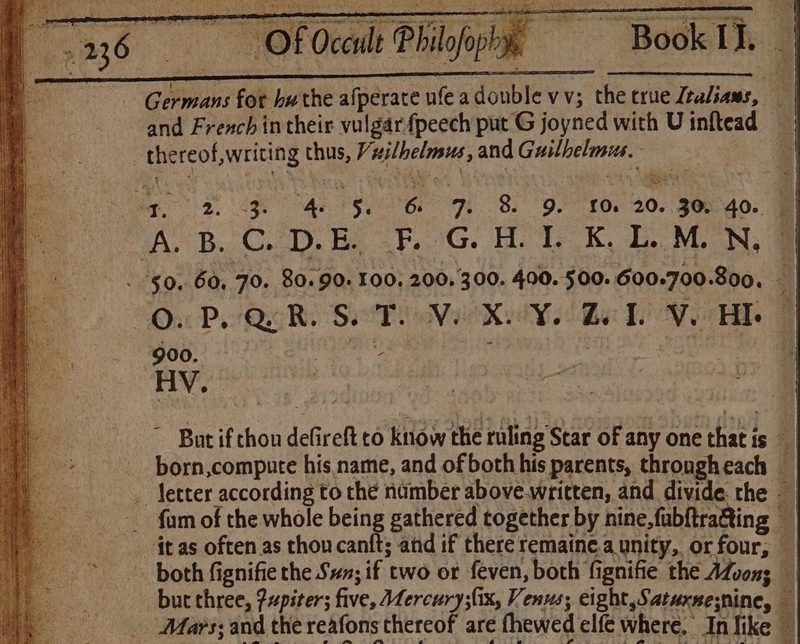
Agrippa matters because he is what the modern school is often mistaken for. His book gathers the number lore of late antiquity and the Middle Ages, unity as the source of every number, three as the holy number, four as the root of the rest, and reports, as the teaching of the Pythagoreans, ways of divining by the numbers of names. But his letters take the values of the Greek numerals, his arithmetic divides by nine to find a planet, and nothing in him resembles a Life Path. His chapter passed almost unchanged into Heydon's Holy Guide in 1662 and from there, through Sepharial in 1911, into Cheiro's planets for the numbers.
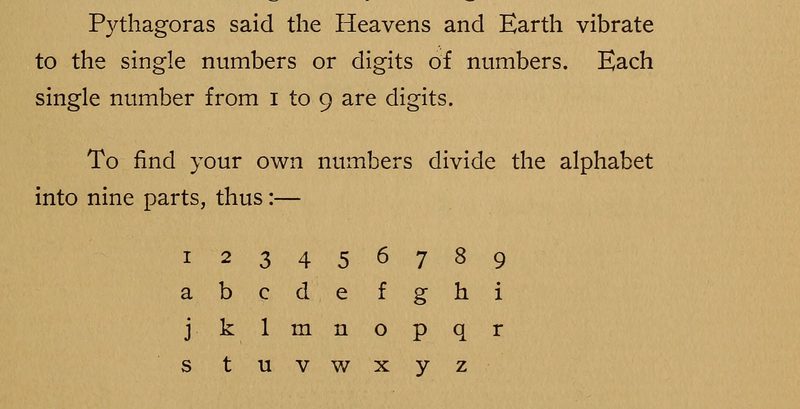
The modern system is Balliett's. In two self-published books she cut the alphabet into rows of nine, read the vowels and the consonants apart, kept 11 and 22 whole and gave every number a colour and a note; she credited all of it to Pythagoras. The sum of the birth month, day and year, she wrote in the 1917 printing of her first book, "shows the path in life we ourselves chose", an early statement of what the school now calls the Life Path. Her pupil Juno Jordan, who began with her as a girl in 1898, wrote the textbook of the school in 1965; Goodwin and then Decoz turned the rules into the precise method calculators use today.
The "Chaldean" table has another history. Sepharial printed in 1911 a list of "Hebraic" values for English letters: the Hebrew letters' numbers reduced to one digit and set on their usual Roman equivalents. Cheiro's table, published some fifteen years later as an ancient Chaldean and Hebrew alphabet, differs from it only for C, H and X, and drops the 9 that Sepharial had given to Th and Tz. In Greek and Roman usage "Chaldean" meant an astrologer; Agrippa already writes that the Chaldeans numbered with their letters after the manner of the Hebrews, and that Cheiro took the label from him is our guess, not something shown.
The twelve Life Paths
The Life Path is the one number the school reads the same way for everyone, so each of its values has its own page: the sums that reach it, how often it falls to a birth date, how Decoz, Cheiro, Agrippa and Balliett treated the number, our own reading of it, and the claims made about it.
Single-digit Life Paths
The shares are not equal. Under the component method seven numbers each take about 11.1 percent of the days from 1900 to 2099, but 2 takes only 5.0 percent and 4 only 7.7, because the sums that would land on them stop first at the masters 11 and 22. Of the masters, 11 takes 6.1 percent, 22 takes 3.4 and 33 takes 0.5: to reach 33 the reduced month, day and year must add up to exactly 33, which almost always needs a 22 among them. A share of days is a share of birthdays only if births fall evenly across the calendar.
Variants and what we leave out
The rules circulate in several versions. We describe them so you can recognise a different result from another calculator, and say which we follow.
- The Life Path sum. Three methods are in use: the component method (Decoz, Goodwin and most calculators), each part reduced to one digit first (reported as Jordan's), and every digit added in a row (popularised by Dan Millman). They nearly always agree on the final digit and differ on dates with a master in a part: 8 November 1983 is a 22 by the first and a 4 by the other two. We follow Decoz; the chart's data also records the plain digit sum, labelled as not his.
- How many masters. 11, 22 and 33 (Decoz); 11 and 22 only (Goodwin, Jordan, Taylor); 44 and beyond in some apps. We keep three.
- Where debts are read. Decoz reads 13, 14, 16 and 19 only at the compound stage of the core numbers and from the day of birth; some read them in every step of every sum, as our engine wrongly did until October 2026. We read them as Decoz does.
- Y and W. A single switch that makes every Y a consonant (as some calculators and our old engine did), or W a vowel after a vowel (a minority view), against Decoz's rule by position. In our tests the single switch gave a different answer from Decoz's rule in 23 of 45 cases.
- The personal year. The calendar year (Decoz, Goodwin) or the year from birthday to birthday. We use the calendar year and note the difference around the birthday.
- Chaldean on the birth name, with masters. Many sites run Cheiro's table on the birth certificate and keep 11 and 22 as masters. Cheiro reads the name a person is known by and has no masters; we follow him.
- A planet for each number. Agrippa's planets by the remainder of nine, Heydon's copy, Sepharial's restatement and Cheiro's list are left out of the chart and the readings; the Life Path pages name them only in a short, labelled history section.
- Sepharial's three alphabets and Agrippa's Latin table. Not in this chart; Agrippa's table is in the Gematria chart.
- Other genres. Messages read in repeated digits (2004), the Hebrew-value "Kabbalah" readings of English names on the Mathers table, and the favoured and avoided digits of Chinese custom are different practices and are not computed.
Myths and disputed claims
What is said about numerology, who says it, and what the record shows. The label is ours.
-
Pythagoras invented numerology, gave the letters their numbers or devised the reading of birth names and dates.
falseWho says it: Balliett's own 1905 title, Cheiro, most books, calculators and apps.
What the record shows: Pythagoras wrote nothing, and the twenty or so early references to him say nothing about letters or names. The repeating 1 to 9 table, the Life Path and the core numbers begin with Balliett, 1905 to 1908.
-
The Pythagoreans taught that "all is number", so numerology carries on their doctrine.
disputedWho says it: Cheiro and popular histories.
What the record shows: "Things are numbers" is Aristotle's inference about the school, not a quoted teaching. Old number symbolism is real and Agrippa passes it on in 1533; reading a person's name by it is modern.
-
Pythagoras learnt his number lore from the priests of Egypt and the Chaldeans and brought it to Greece.
told as loreWho says it: The ancient biographers, then Cheiro.
What the record shows: The travels belong to lives of Pythagoras written centuries after him; historians treat them as part of his legend.
-
The Chaldean table is the older system, from the ancient Near East, older than the Pythagorean table by thousands of years.
falseWho says it: Cheiro, most "Chaldean numerology" sites, and our own page before October 2026.
What the record shows: It was first printed by Cheiro in the 1920s. Its values are, for 23 of 26 letters, the Hebrew letter values Sepharial set on English letters in 1911, which is why 9 is empty. No letter table of this kind is known from the ancient Near East, whose cuneiform was syllabic.
-
Cheiro invented the Chaldean table himself.
disputedWho says it: Some sceptical pages; our own earlier page implied it.
What the record shows: Partly. Sepharial's 1911 list agrees with it except for C, H and X. Cheiro edited an English scheme of Hebrew values; he did not invent it outright.
-
The Chaldean values follow the sound of each letter.
unverifiedWho says it: Many Chaldean sites.
What the record shows: Sepharial grouped one of his lists by sound in 1911, and Cheiro follows such grouping loosely, but nobody gives a rule or a measurement, and the two lists differ.
-
No letter is 9 on the Chaldean table because 9 is the sacred number of God.
told as loreWho says it: Cheiro, and the calculators since.
What the record shows: That is Cheiro's own explanation. The plain reason is the Hebrew letters Teth (9) and Tzaddi (90), which have no single Roman letter; Sepharial's 1911 list gives 9 to Th and Tz.
-
Cheiro learnt his system from a sect of Brahmins who had kept it since prehistoric times.
unverifiedWho says it: Cheiro's preface and memoirs.
What the record shows: His own story, with no independent record. His table and his planets have printed English sources: Agrippa, Heydon and Sepharial.
-
Each number from 1 to 9 belongs to a planet, the Sun for 1 and so on to Mars for 9.
unverifiedWho says it: Cheiro, Sepharial, and Vedic and Chaldean numerology sites.
What the record shows: A European line, not an ancient one: Agrippa 1533, Heydon 1662, Sepharial 1911 (who calls it without foundation), then Cheiro, who put Uranus and Neptune in. We do not attach planets to numbers.
-
The karmic debt numbers 13, 14, 16 and 19 are an ancient or Vedic teaching about past lives.
falseWho says it: The old page writer's file and many sites.
What the record shows: They are twentieth-century American numerology: not in Balliett (1905, 1908) or Taylor (1926), and in no Vedic or ancient text. The past-life reading is the school's belief.
-
The master numbers 11, 22 and 33 are an ancient doctrine.
falseWho says it: Many sites; the old page writer's file.
What the record shows: Balliett's 1908 book calls 8, 9, 11 and 22 "free numbers", and the 1917 printing of her first book says that 11 and 22 "are never added". Taylor in 1926 still names only 11 and 22. Nothing older than 1905 has them.
-
44, 55, 66 and the other doubled digits are master numbers too.
disputedWho says it: Some practitioners and apps.
What the record shows: Decoz keeps 11, 22 and 33 and calls the rest power numbers; Goodwin and Jordan used 11 and 22 only. We keep three.
-
Life Path 22 outranks every other number in power, and 33 in spirituality.
unverifiedWho says it: Decoz and most sites.
What the record shows: A ranking the school makes. We do not rank; each page gives the share of birthdays instead (22: 3.4 percent, 33: 0.5 percent of days from 1900 to 2099).
-
Numbers show which days are favourable, which bring misfortune and when money will come.
unverifiedWho says it: Cheiro, many sites and apps.
What the record shows: Cheiro's compound names carry warnings, and he names days and periods for each number. We quote his names as his.
-
Numerology is a science, or has been validated by research.
falseWho says it: App and site marketing.
What the record shows: No controlled study supports a link between a birth date or name and personality. The one large test, on more than 15,000 people, found none.
-
Numbers act on people through their vibration or frequency.
unverifiedWho says it: Balliett from 1905, Seton, Jordan and nearly every site.
What the record shows: The school's own vocabulary since 1905, from the New Thought movement; not a physical claim anyone has tested. We write that the school reads a number, not that it vibrates.
-
When the Pythagorean and Chaldean numbers agree, a person has no inner conflict, and comparing both gives perfect precision.
falseWho says it: Our own public page before October 2026.
What the record shows: An invented doctrine with no source in either school. The two tables are two methods, not two measurements; we claim nothing from their agreement.
-
Our chart yields a score of core numbers or more, by a special reduction that keeps every master.
falseWho says it: Our own public page before October 2026.
What the record shows: There are five core numbers. The old engine even dropped masters in the parts, the opposite of the claim. Replaced on 10 October 2026.
-
Julia Seton coined the word "numerology".
unverifiedWho says it: Several histories, after a bibliography that says she "is said to have".
What the record shows: Dictionaries disagree on the word's first date, between 1871 and 1911. It was in use by the 1910s, and Seton popularised it.
-
The 1 to 9 letter table comes from the Greek alphabetic numerals.
falseWho says it: Popular histories.
What the record shows: The Greek numerals run 1 to 9, then tens and hundreds, as Agrippa's Latin table does. The repeating 1 to 9 is Balliett's.
-
Repeated digits such as 111 and 444 carry messages known to numerology since ancient times.
falseWho says it: Sites and apps after Doreen Virtue and Lynnette Brown.
What the record shows: A genre of 2004. We do not compute it.
Stories and lore
These are told as their tellers tell them.
The master who wrote nothing. The lives of Pythagoras written centuries after him give him a golden thigh, have him seen in two cities at once, send him to study with the priests of Egypt and the magi of the Chaldeans, and forbid his followers beans. Huffman reads these as a legend growing around the founder of a way of life; even the roundness of the earth, he notes, was credited to him falsely. Cheiro retells the Egyptian apprenticeship and adds a secret school that wrote nothing down.
Agrippa's arithmancy. Agrippa reports, as the Pythagoreans' teaching, that names of few letters foretell misfortune and names of many success, and quotes the old verse "so Hector did Patroclus slay, so Hector to Achilles was a prey". He adds that the numbers of a name and of the parents' names reveal a person's planet and sign, and other matters of the body and of death that we do not repeat.
Mrs Balliett of Atlantic City. The widow of a music teacher in a seaside resort, Balliett published from 1905, gave each number a colour and a tone (1 the note C, 2 the note D, and so on up the scale) and found the colour of a colour's name by adding its letters. Dudley's reviewer passes on his surmise that she changed her own first name to improve its number.
The doctor's daughter. Juno Jordan began studying with Balliett at fourteen, in 1898, and later with her own mother, Julia Seton, a New Thought physician and lecturer. She published the school's textbook at eighty-one and lived to a hundred.
Cheiro's Brahmins. Cheiro wrote that on his travels in the East he met a sect of Brahmins who had kept occult studies since prehistoric times and allowed him to learn their theories of numbers; his memoirs add a guru in the Konkan and a book written on human skin in gold. The printed trail runs instead through Sepharial, whose 1911 values match his on 23 of 26 letters.
"A Lion Muzzled". Cheiro gave his compound numbers names and pictures that recall the tarot: 10 the Wheel of Fortune, 11 "a Clenched Hand" or "a Lion Muzzled", 12 the Sacrifice, 13 change and upheaval, 16 "the Shattered Citadel". He insisted that the dread of 13 was unfounded.
Lloyd George's nine. Cheiro worked his table on the statesmen of his day, finding the fighter's number 9 in "Lloyd" alone, to show that the name a person is called by, not the one on paper, carries the number.
Evidence and criticism
On Pythagoras. Carl Huffman's entries in the Stanford Encyclopedia of Philosophy set out what can be known: no writings, about twenty early references, a reputation for teaching about the soul and ritual, with the mathematics and cosmology added later; "things are numbers" is Aristotle's reading of the school. Nothing in that record concerns names, birth dates or the letters of an alphabet.
On the modern system. The mathematician Underwood Dudley traces numerology to Balliett and explains its apparent hits by what he calls the law of small numbers: with only nine values to go round, coincidences among them are certain, so any method that reduces names and dates to 1 to 9 will seem to fit. The one large controlled test, by Hartmann, Reuter and Nyborg in 2006, compared birth dates with personality scales and general intelligence in two samples of more than 4,000 and more than 11,000 people, and found no relation. We found no comparable study of name numbers, and none that claims the contrary.
The schools disagree with each other. They differ on the Life Path arithmetic, on how many masters there are, on where debts are read, on the letter Y, on when the personal year begins and on whether the Chaldean table takes the birth name. Decoz argues each point on his website, and the free calculators mostly follow him.
The Chaldean pedigree. No scholar defends an origin in the ancient Near East. Akkadian was written in syllabic cuneiform with numbers counted in sixties, and "Chaldean" in Greek and Latin meant an astrologer. The printed line of the table and its planets is European and occult, Agrippa in 1533, Heydon in 1662, Sepharial in 1911 and Cheiro; its values are the Hebrew letter values reduced to one digit, which is why the two Hebrew letters with no Roman equivalent, Teth (9) and Tzaddi (90), leave 9 empty.
What the school says about itself. "Vibration", "frequency" and "energy" are the vocabulary of the New Thought movement that Balliett wrote in from 1905; they describe the school's belief, not a physical effect anyone has measured.
Our own test. In October 2026 we compared our engine on 46 names and dates with a textbook implementation, two software packages and four web calculators, and checked our test person against Affinity Numerology, numerologist.com and numerologycalc.org. The arithmetic was right wherever a documented rule was followed, but three of our rules were not the credible ones: masters were lost in the parts of the Life Path, karmic debts were read at every step, and Y followed a single switch. All three were changed. Our earlier public page also claimed over twenty core numbers and a hidden agreement between the two tables; both claims were withdrawn.
Copyright and credit. The rules of a method are free to use; the words of the books that teach them are not. Balliett, Sepharial, Heydon and Agrippa are in the public domain and are quoted briefly here. Cheiro's book is in the public domain too, but the copies we could read are later revised printings, so we give his rules and his compound names and do not quote his prose. Jordan, Goodwin, Decoz and the calculators are in copyright: we use their rules as facts, in our own words, and our meanings for the numbers were written from scratch.
Terms
- Life Path
- The number of the birth date: the month, the day and the year each reduced, then added and reduced again. The school reads it as the main theme of a life.
- Reduction
- Adding the digits of a number until one digit is left (38 gives 11, then 2), except that the school stops at the master numbers.
- Component method
- Decoz's and Goodwin's way of finding the Life Path: reduce the month, the day and the year apart, keeping 11 and 22, then add the three. The method we use.
- Master number
- 11, 22 or 33, left unreduced and read as a heightened 2, 4 or 6. Balliett called 11 and 22 "free numbers" in 1908; 33 came later. Some apps add 44 and higher; Decoz calls those power numbers.
- Karmic debt
- 13, 14, 16 or 19 found behind a core number or as the day of birth, read by the school as a lesson to learn. A twentieth-century American doctrine, not an ancient one.
- Compound
- The two-digit total behind a number before its last reduction (the 14 behind an Expression of 5). Cheiro reads the compounds 10 to 52 by name.
- Expression
- The number of all the letters of the full birth name, read as a person's abilities. Older books call it the Destiny number.
- Soul Urge
- The number of the vowels of the birth name, read as what a person wants inwardly. Older books call it the Heart's Desire.
- Personality
- The number of the consonants of the birth name, read as the impression a person makes.
- Birth Day
- The day of the month, reduced but keeping 11 and 22; a day of 13, 14, 16 or 19 counts as a karmic debt.
- Vowel Y
- Decoz's rule: Y counts as a vowel unless it follows a vowel or opens a name before one (Lynn and Bryan have a vowel Y, Kay and Yolanda a consonant). W is a consonant. Either can be read the other way.
- Pinnacle
- One of four periods of a life, each with a number and a challenge. The first ends at 36 minus the single-digit Life Path; the next two last nine years each; the fourth runs on.
- Period cycle
- Three long cycles taken from the month, the day and the year of birth; the second begins with the first personal year 1 after the 27th birthday and lasts 27 years.
- Personal year
- The birth month and day added to the calendar year and reduced: the theme the school gives a year, January to December. Some practitioners count from the birthday instead.
- Chaldean table
- Cheiro's letter values of the 1920s, 1 to 8 with no 9; 23 of its 26 letters match the "Hebraic" values Sepharial printed in 1911. Neither ancient nor from the Chaldeans.
- Current name
- The name a person goes by. Cheiro holds that the name a person is most known by, not the one on paper, is the one that counts on his table.