How it works
Before separate digits came into use, the Greeks, the Jews and the Arabs wrote numbers with the letters of their alphabets. The first nine letters stood for 1 to 9, the next nine for 10 to 90 and the rest for the hundreds, so any written word could also be read as a sum. Gematria is that reading: add the values of a word's letters and set the word beside others with the same total.
| Script | Units | Tens | Hundreds | Our methods |
|---|---|---|---|---|
| Greek | α to θ, with ϛ for 6 | ι to ϟ | ρ to ϡ | Isopsephy; the ordinal behind "more" |
| Hebrew | א to ט | י to צ | ק to ת (400) | Seven methods, from the standard value to two letter substitutions |
| Arabic | ا to ط | ي to ص | ق to غ (1000) | The eastern and the western abjad |
| Latin | A to I | K to S | T to Z, then J, U, V, W | Agrippa's table of 1533 and twelve English ciphers |
The scripts are kept apart. Text in Latin letters is scored under the Latin ciphers only. A value in Hebrew, Greek or Arabic needs the text written in that script, as its speakers write it: we do not transliterate a name from one alphabet into another, because a letter-for-letter swap gives spellings nobody writes and values no two tools agree on. A text that mixes scripts is scored script by script, and the chart says so.
Before counting. The text is upper-cased and stripped of accents, Hebrew vowel points and Arabic short-vowel marks. Letters such as Ø, Æ and ß are folded to O, AE and SS. In Hebrew a final letter counts as its ordinary form, except in Mispar Gadol; in Greek the final sigma counts as sigma; in Arabic the forms of alif with hamza count as alif and the final ta' marbuta as ha'.
Each total, three ways. For every cipher the chart gives the total, its digital root (the digits added until one is left) with the chain of sums, and the letters with their values word by word. Cheiro's Chaldean table is read as he read it, a compound number with its single digit, exactly as on our Numerology chart.
The ciphers differ a great deal. The same word gives very different numbers depending on the table. GEMATRIA itself, for instance, under each of our thirteen Latin ciphers:
| Cipher | Rule | GEMATRIA |
|---|---|---|
| English Ordinal | A 1 to Z 26 | 74 |
| Full Reduction | A to I 1 to 9, then again | 38 |
| Reverse Ordinal | Z 1 to A 26 | 142 |
| Reverse Reduction | the reverse ordinal reduced | 52 |
| Latin (Agrippa) | units, tens and hundreds, Agrippa 1533 | 233 |
| Ordinal x 6 (Sumerian) | the ordinal times six | 444 |
| Chaldean | Cheiro's 1 to 8 | 21 |
| Standard | units, tens and hundreds in alphabet order | 353 |
| Offset 36 | A 36 to Z 61 | 354 |
| Septenary | 1 to 7 and back | 32 |
| Trigonal | the triangular number of the ordinal | 562 |
| Squares | the ordinal squared | 1,050 |
| Primes | the 26 first primes | 228 |
In Hebrew the word שלום, shalom, "peace", is 376 by the standard method, 936 when its final mem counts 600, 52 by the letters' places, 16 with the zeros dropped and 7 as a digital root; exchanged letter for letter by Atbash it gives 112, by Albam 93.
Matches. The point of the practice is the equivalence: two words with the same value, which the tradition reads together. The chart keeps a short table of famous values of ordinary words from the Hebrew and Greek traditions, each recomputed in our tests: in Hebrew love and one (13), life (18), wisdom (73), king (90), light and secret (207), serpent (358), peace (376), truth (441), the two Nero Caesar readings (616 and 666) and the first word of Genesis (913); in Greek love (93), holy and good (284), the Nile (365) and the dove (801). No sacred name is among them: the chart never sets a name's total beside a name or title of God, a prophet, a saint, a messiah or a deity, a scripture or a sacred formula. When one of your totals lands on a famous value, the chart names it and says whether the script and the method agree. A match across scripts, an English total that equals a Hebrew word, is a coincidence of numbers that no tradition draws, and the chart says that too.
What we do not do. No number here is read as a message. We do not read events, dates or news by number, and we do not compute letter skips in scripture.
Origins and history
The alphabets were numerals for centuries before anyone is known to have added up a word; the practice, once it appears, belongs to three traditions, and the English ciphers are the newest layer of all.
| When | Who | What happened |
|---|---|---|
| 717 to 706 BCE | Sargon II of Assyria | His Cylinder Inscription says the wall of his new city was made "16,283 cubits, the numeral of my name" (Luckenbill's translation). Cuneiform has no letter values, so how the number was reached is unknown. |
| By the 5th century BCE | Ionian Greeks, around Miletus | The alphabetic numerals: 1 to 9, 10 to 90 and 100 to 900 on the letters, with three old letters kept for 6, 90 and 900. In official use in Greece by about 200 BCE. |
| 3rd century BCE | Apollonius of Perga | The earliest known number play on a Greek verse, by multiplying the letters' values. |
| About 200 to 78 BCE | Judean coins and scribes | The Hebrew letter numerals, modelled on the Greek, appear; the earliest dated coins carry them. |
| Before 79 CE | Pompeii; Leonidas of Alexandria | Graffiti such as "I love her whose number is 545"; Leonidas writes epigrams whose couplets add up to the same total. |
| After 59 CE | Roman wits, recorded by Suetonius | Nero's name and the words "killed his own mother" both make 1005. |
| 70 to 132 CE | The Epistle of Barnabas | Reads the 318 servants of Abraham (Genesis 14:14) as the letters of Jesus' name and the cross. |
| 2nd century CE | Rabbi Eleazar Hisma; the thirty-two rules | The Mishnah names gematria (Avot 3:18); the rules of interpretation attributed to Rabbi Eliezer ben Jose the Galilean list it. |
| About 180 CE | Irenaeus of Lyon | Attacks Gnostics who read Jesus as 888, and discusses 666 and the variant 616 without naming anyone. |
| Late 3rd or early 4th century | P115, a papyrus from Oxyrhynchus | The oldest surviving manuscript with 616, published in 1999. |
| About 200 to 500 CE | The Talmud and the midrash | Gematria used as a support (asmakhta), not a proof: wine and secret are both 70. |
| 7th century onward | Arabic scribes | The abjad: the 28 letters in the old Semitic order as numerals up to 1000, in an eastern and a western order; kept for chronograms after positional digits arrived. |
| 12th and 13th centuries | The Hasidei Ashkenaz; Eleazar of Worms | Gematria applied on a large scale in commentary and prayer; Nahmanides later tries to limit it. |
| 1205 | Judah al-Harizi | The earliest known Hebrew chronogram, in a poem; dates in epitaphs follow from the 13th century. |
| 1240 to after 1291 | Abraham Abulafia | The "Kabbalah of names": letter combination and permutation as a contemplative practice. |
| 1340 to 1394 | Fazlallah Astarabadi | Founds Hurufism, a Sufi letter mysticism of the Arabic and Persian alphabets. |
| 1389 or 1390 | The tomb of Hafez, Shiraz | A Persian chronogram gives the poet's death year, 791 of the Hijra, in the letters of a phrase. |
| 1523 | John Skelton | Hides a name in two rows of numbers, one per letter: a substitution cipher, not gematria. |
| 1533 | Heinrich Cornelius Agrippa | De occulta philosophia, Book II: the Greek, Hebrew and Latin letter tables side by side; the Latin one is new. |
| 1831 to 1837 | Fritzsche, Benary, Hitzig, Reuss | Four scholars independently read 666 as Nero Caesar in Hebrew letters. |
| 1865 to 1869 | Leo Tolstoy | In War and Peace Pierre Bezukhov makes Napoleon 666 on a French table. |
| 1887 | S. L. MacGregor Mathers | A table of Hebrew letters with Roman equivalents, the route by which occultists gave English words Hebrew values. |
| 1906 | Schechter and Levias | The Jewish Encyclopedia's article, still the standard short account of the methods. |
| 1920s | Cheiro | Prints the "Chaldean" letter table, 1 to 8. |
| 1976 | James Lees | English Qaballa, the one modern English cipher with a documented origin. |
| 1994 and 1999 | Witztum, Rips and Rosenberg; McKay and colleagues | The "Bible code" paper and its refutation, both in Statistical Science. |
| 2007 | P. J. Williams | Shows that P115's 616 does not settle the Nero reading. |
| By February 2010 | gematrix.org | The most used English calculator, with the ordinal, the ordinal times six and Agrippa's table, and a phrase list fed by its users. |
| 2013 onward | Video channels | Reading the news by gematria on YouTube, which made the practice notorious. |
| By January 2017 | Gematrinator (Derek Tikkuri) | A calculator of dozens of ciphers; renames Agrippa's table "Latin". |
| 2026 | EsoTerrier | The engine rebuilt: Agrippa's table added, the mirror ciphers dropped, the Hebrew methods extended, transliteration removed, a checked table of famous values. |
Greek. The alphabetic numerals were in place by the 5th century BCE, but the summing of words is attested only in the Roman period. A wall in Pompeii carries a lover's "whose number is 545"; Leonidas of Alexandria, a Greek poet in 1st-century Rome, wrote couplets of equal sums; and after Nero had his mother killed, Suetonius records the verse that went round Rome, "a calculation new: Nero his mother slew", because Νέρων and the Greek for "killed his own mother" both make 1005. Christians took up the device: the Epistle of Barnabas finds Jesus and the cross in Abraham's 318 servants, and Irenaeus, about 180 CE, has to argue with Gnostics who built doctrine on the 888 of Jesus' name.
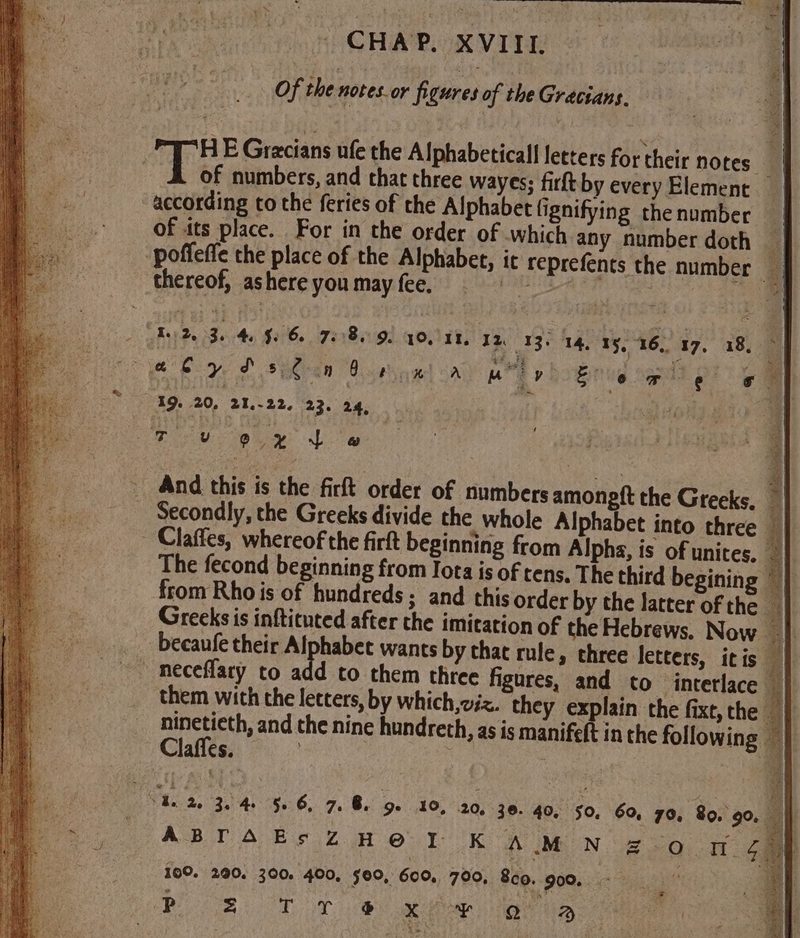
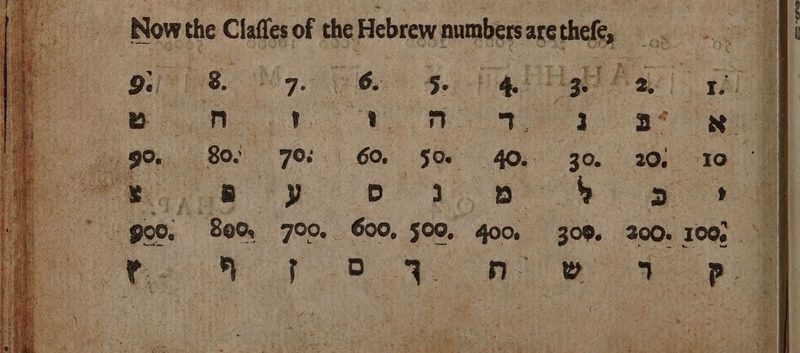
Hebrew. The Hebrew letter numerals were adapted from the Greek in the last two centuries BCE, and the word gematria, itself probably from the Greek, appears in the Mishnah in the 2nd century CE. There Rabbi Eleazar Hisma calls the reckoning of the equinoxes and gematria the parperaot of wisdom, its side dishes rather than its meal; the thirty-two rules of interpretation list gematria among the ways of reading a verse. The rabbis' classic case is Abraham's 318 servants read as Eliezer, his one servant, whose name makes 318. The Talmud uses such readings as an asmakhta, a support for a teaching already held, and later authorities such as Ibn Ezra and Nahmanides held that it could support a teaching but not establish one; Nahmanides accepted only the gematrias received from tradition. The Hasidei Ashkenaz of the 12th and 13th centuries used gematria far more widely, in commentary on law and liturgy, and in the Kabbalah it became one of the main tools for reading scripture.
Arabic. The abjad keeps the old Semitic order of the letters, abjad hawwaz hutti, and adds the six letters peculiar to Arabic for 500 to 1000. Positional digits took over arithmetic from the 8th century, but the letter values stayed in use for numbering lists and for chronograms, phrases whose letters give the date of what they record, such as the line on Hafez's tomb. Hurufism, from the 14th century, made the letters themselves the centre of a mystical teaching. In South Asia the number 786, the basmala's value in the eastern order, is written on shop signs, letterheads and the top of letters in place of the words themselves: a South Asian custom, which many scholars and most of the Arab world do not follow.
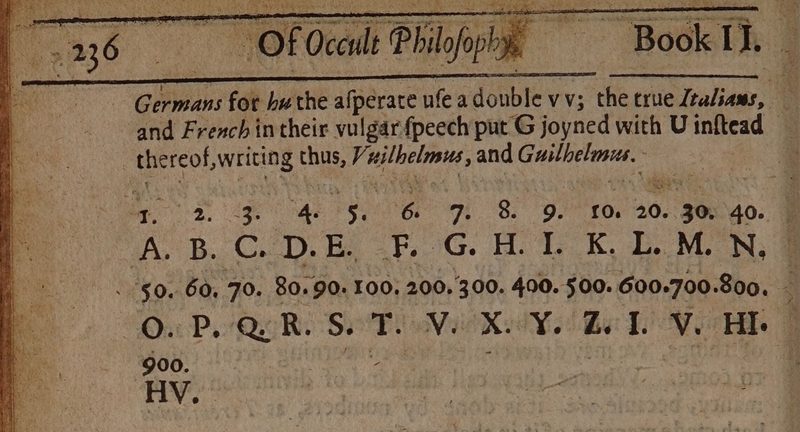
Latin. The Latin alphabet was never a numeral system in this way. In 1533 Agrippa, after giving the Greek and Hebrew tables, wrote that "the Pythagorians say ... that the very Elements of letters have some certain divine numbers" and set out Latin values on the Hebrew pattern, using consonantal I and V, HI and HV to fill the twenty-seven places, together with a rule for finding a person's ruling planet from a name's number divided by nine. We found no recorded use of his table between his day and the calculator sites; Ashe argues that he never used it himself.
The English ciphers. The Golden Dawn and its heirs gave English words Hebrew values through Mathers' table of equivalents, and Cheiro's "Chaldean" table of the 1920s was built from Hebrew values reduced to one digit. The ciphers most calculators show first are younger still. When the Wayback Machine first saw gematrix.org in February 2010 it already offered the ordinal, the ordinal times six and Agrippa's table under a religious label it has nothing to do with; Gematrinator, a website by 2017, lists dozens more and renamed Agrippa's table "Latin". From 2013 video channels used these calculators to read the news, and the practice became a byword for conspiracy theories. Who first named most of the community ciphers is not known.
The ciphers
Each cipher the chart computes has its own page, except the Greek ordinal, which the chart offers behind "more" for comparison: the rule and the full letter table, where the cipher comes from and how sure that is, the names other sites give it, worked examples, and the claims made about it.
Latin script: the six core ciphers
Hebrew script
Greek script
Arabic script
The Latin core six are the ciphers the popular calculators open with, plus Agrippa's; the other seven are shown behind "more ciphers". The Hebrew, Greek and Arabic methods apply only to text written in those scripts.
Variants and what we leave out
- Five mirror ciphers. Reverse versions of the Ordinal x 6 (Sumerian), Offset 36, Trigonal, Squares and Primes ciphers, which our old chart showed as equals: dropped. Reverse Ordinal and Reverse Reduction stay, because every calculator opens with them.
- Transliteration. Giving an English name Hebrew, Greek or Arabic values by swapping letters, as some sites do with Mathers' table: not offered.
- Agrippa's own 27 values. His table doubles I and V as consonants and has HI 800 and HV 900. No strict Agrippa cipher is offered; the chart uses the 26-letter placement every site uses, labelled as the popular sites' placement of J, U, V and W.
- The "Offset 36" name. The sites call that cipher "Satanic", explaining that the 36th triangular number is 666. We use a name that says what it does.
- Other English ciphers. English Qaballa, the Bacon ciphers, keypad and Fibonacci ciphers and the rest of Gematrinator's list: not computed.
- More Hebrew methods. TorahCalc and Kesher offer some twenty-five, among them the cumulative, squared and spelled-out values: not yet computed, so no page calls our seven complete.
- Variant counts. Some tools give the Hebrew finals 23 to 27 in the ordinal, write Greek stigma as sigma and tau, or ignore a lone hamza; ours counts finals as their base, stigma as 6 and hamza as 1.
- Word lists. "Words with the same value" lookups over the Hebrew Bible and the Greek New Testament from open texts are later work; no calculator's user-fed phrase list is used.
- Letter skips. The so-called Bible code is not gematria and is not computed.
Myths and disputed claims
What is said about gematria, who says it, and what the record shows. The label is ours.
-
Isopsephy, and with it gematria, began with Pythagoras and his school at Miletus in the 6th century BCE.
disputedWho says it: Popular histories and our retired research file.
What the record shows: The alphabetic numerals arose around Miletus and are attested by the 5th century BCE, but no early source has Pythagoras number letters, and the summing of words is attested only from the 1st century CE.
-
Sargon II made the wall of his new city 16,283 cubits long to match the number of his name, the first gematria.
unverifiedWho says it: Encyclopaedias, after the inscription.
What the record shows: The inscription does say "the numeral of my name" (Luckenbill's translation). How the scribes reached the figure cannot be checked: cuneiform is not an alphabet and has no letter values.
-
Hebrew letters stood for numbers in the time of Moses and the prophets, so the Torah was composed with gematria in mind.
falseWho says it: Many religious sites.
What the record shows: The Hebrew letter numerals were adapted from the Greek between about 200 and 78 BCE, the date of the earliest coins with them. A text written before they existed cannot have been composed with them.
-
The Kabbalists were the first to use gematria widely.
disputedWho says it: Our retired research file.
What the record shows: The rabbis of the 2nd century CE come first; the Hasidei Ashkenaz, Eleazar of Worms and Abulafia expanded the practice greatly in the Middle Ages.
-
The word gematria comes from the Greek geometria.
disputedWho says it: Most dictionaries.
What the record shows: Possibly; others derive it from grammateia, and the Jewish Encyclopedia already recorded the dispute in 1906.
-
666 is proven to mean Nero Caesar, and 616 proves it.
disputedWho says it: Many commentaries and gematria sites, and our own earlier page.
What the record shows: Nero Caesar in Hebrew letters makes 666, and the Latin spelling 616: the usual scholarly reading since the 1830s. But Irenaeus, about 180 CE, knew no such reading, and the Greek word for "beast" written in Hebrew letters gives the same two numbers. A reading, not a proof.
-
The Gospel writers meant the name Jesus to make 888, a divine signature.
unverifiedWho says it: Christian numerology pages; our retired research file.
What the record shows: The value is right and ancient: the Sibylline Oracles set it as a riddle, and the Gnostics whom Irenaeus attacked used it. That the evangelists intended it is claimed by none of the early sources and cannot be shown.
-
The name Abraxas was made so that its letters would give 365, the days of the year.
told as loreWho says it: Irenaeus, reporting on Basilides; gnostic tradition.
What the record shows: The sum is right, and Irenaeus links the name to 365 heavens. That the name was built for the number is the ancient account, told as such.
-
786 is sacred throughout Islam and may stand for the basmala anywhere.
disputedWho says it: Many sites.
What the record shows: 786 is the basmala's value in the eastern order (1,026 in the western). Writing 786 for it is a South Asian custom, which many scholars and most of the Arab world do not follow.
-
The cipher A 1 to I 9, K 10 to S 90, T 100 and on is a Jewish or Hebrew method.
falseWho says it: gematrix.org, the sites that copy it, and videos built on it.
What the record shows: It is Agrippa's Latin table of 1533 fitted to the 26-letter alphabet. No Jewish tradition uses it. Gematrinator renamed it "Latin" for that reason, and Ashe documents how the old label feeds antisemitic conspiracy talk. We call it Latin (Agrippa).
-
Agrippa's letter table dates from 1531.
falseWho says it: Our retired research file.
What the record shows: Book I of his work was printed in 1531; the letter table is in Book II, first printed in the complete Cologne edition of 1533.
-
The English ciphers with names such as Septenary, Trigonal and Ordinal x 6 (Sumerian) go back to antiquity or to some source outside the modern gematria sites.
falseWho says it: Sites that list them without saying where they come from.
What the record shows: They were named by the online English-gematria community of the 2000s and 2010s. The one modern English cipher with a documented origin, English Qaballa (1976), we do not compute.
-
The Ordinal x 6 (Sumerian) cipher comes from Sumer or from its counting in sixties.
falseWho says it: Calculator sites.
What the record shows: It is the ordinal multiplied by six. Sumerian cuneiform has no alphabet to value; the name is a borrowing.
-
The Chaldean cipher is Babylonian.
falseWho says it: Chaldean numerology sites; our earlier page.
What the record shows: It is Cheiro's table, printed in the 1920s. Its values are, for 23 of 26 letters, the Hebrew letter values reduced to one digit, as Sepharial had printed them in 1911.
-
Mispar Katan is the digital root of a word's value.
falseWho says it: Our earlier page.
What the record shows: Mispar Katan drops the zeros of each letter before adding (yod 1, qof 1, tav 4). The digital root of the standard total is Mispar Katan Mispari. The chart computes both, correctly named.
-
A name in Latin letters can be given a Hebrew, Greek or Arabic value by swapping its letters one for one.
falseWho says it: Our engine before October 2026; many calculators.
What the record shows: A letter-for-letter swap gives spellings no speaker writes and values no tool agrees on. A value in another script needs the name written in it, as its speakers write it.
-
Greek architects used isopsephy for the proportions of buildings.
unverifiedWho says it: Our retired research file; some sites.
What the record shows: No source was found. An architect of the 2nd century CE, Galen's father, wrote isopsephic verse; that is not evidence that buildings encode names.
-
John Skelton used Latin gematria in 1523 to hide a name in his Garland of Laurel.
falseWho says it: Our retired research file.
What the record shows: He did hide a name in numbers, but each letter became a number and nothing was added: a substitution cipher, not gematria.
-
"L'Empereur Napoléon" makes 666.
told as loreWho says it: Tolstoy's Pierre Bezukhov, in War and Peace.
What the record shows: A novelist's scene. Pierre gets 666 only by bending the spelling, which is part of Tolstoy's joke.
-
Words or names with the same value are connected, so a match shows a link between them.
falseWho says it: Gematria sites and channels; our page before October 2026.
What the record shows: Reading equal values together is the tradition's way of interpreting a text, a support and not a proof in the Talmud's own terms. With dozens of ciphers and millions of phrases, every total matches something.
-
Letters found at equal skips in the Hebrew Bible prove that it foretells events.
falseWho says it: Witztum, Rips and Rosenberg (1994); popular books since 1997.
What the record shows: Refuted in the same journal in 1999: the result depended on choices made in gathering the data and disappeared in new tests. Letter skips are not gematria, and we do not compute them.
-
Gematria shows that news events are scripted by their numbers.
falseWho says it: Videos and forums built on the calculator sites since 2013.
What the record shows: A search with unlimited freedom always finds a match; fact-checkers have shown it. Nothing on this site reads events, dates or news by number.
-
Our engine finds matching values across Hebrew, Greek, Arabic and Latin at once.
falseWho says it: Our public page before October 2026.
What the record shows: The old engine found no matches at all. The rebuilt one checks totals against a short table of famous values and says when a match crosses scripts.
Stories and lore
These are told as their sources tell them; some are history, some legend, and each says which.
The king's wall. Sargon II had it written that the wall of his new capital measured "16,283 cubits, the numeral of my name". No one now knows how his scribes made the sum, and the line stands alone in cuneiform as a boast that a name is a number.
The number of her honourable name. On a wall in Pompeii someone wrote that he loved a girl "whose number is 545", and another that "the number of her honorable name is 45": isopsephy as flirtation, buried in 79 CE.
Nero's lampoon. Suetonius records the line that went round Rome after the death of Agrippina: "a calculation new: Nero his mother slew", since the emperor's name and the phrase add up alike.
Abraham's 318. Genesis says Abraham armed 318 servants. The Epistle of Barnabas reads the number as IH, the first letters of Jesus' name (18), and T, the cross (300); the rabbis read it as the name Eliezer, his one servant, whose letters make 318. Two traditions used the same device on the same verse to opposite ends.
Wine in, secret out. The Talmud notes that יין, wine, and סוד, secret, are both 70: when wine goes in, the secret comes out.
Love and one. אהבה, love, and אחד, one, are both 13: a staple of Jewish teaching.
The beast's number. Irenaeus, about 180 CE, already had to argue that 666 was the right reading "in all the most approved and ancient copies" and that 616 came from a copyist's slip; he tried several Greek names and declined to choose. Seventeen centuries later four scholars found Nero Caesar in Hebrew letters, נרון קסר, 666, with the Latin spelling נרו קסר giving 616. In 1999 a papyrus with 616 made the news. It is the usual scholarly reading, and still a reading: the word for "beast" written in Hebrew letters gives both numbers too.
Jesus 888. The Sibylline Oracles set the name as a riddle, "eight ones, and as many tens on these, and yet eight hundred" (Terry's 1899 translation), and the Gnostics whom Irenaeus attacked built on it. The sum is ancient; that the Gospel writers meant it is nobody's claim in the early sources.
Abraxas and the year. Basilides, as Irenaeus reports him, taught 365 heavens, and the name Abraxas adds up to 365, the days of the year.
Skelton's adversary. In 1523 John Skelton ended a Latin satire in his Garlande of Laurell with two rows of numbers instead of a name. Numbering the vowels 1 to 5 and the consonants by their place in the Latin alphabet turns them into ROGERUS STATHUM; that key is our reading, since the edition gives none. Each letter becomes a number and nothing is added, so it is a cipher, not gematria.
Pierre's calculation. In War and Peace Pierre Bezukhov, using a French table that values the letters Hebrew-fashion, makes "L'Empereur Napoléon" 666, then forces his own name to the same total and decides he is destined to stop the emperor.
Evidence and criticism
What is documented. The alphabetic numerals and their dates are epigraphic fact, and the uses of isopsephy and gematria in the sources above are textual fact. So is the rabbis' own view of the device: the Talmud treats a gematria as support for a teaching, not as its proof, and medieval authorities said so explicitly.
Equal values are certain. Any table that maps many words onto a few thousand numbers makes coincidences unavoidable; the mathematician Underwood Dudley calls this the law of small numbers. With dozens of ciphers and a list of millions of phrases, every total matches something, which Lead Stories demonstrated in 2022 for the videos that read the news by gematria. A match is a fact about arithmetic.
The Bible code. In 1994 Statistical Science published a paper claiming that names and dates were encoded at equal letter skips in Genesis. In 1999 the same journal published the reply of McKay, Bar-Natan, Bar-Hillel and Kalai, who showed that the result depended on choices made in gathering the data and found nothing in fresh tests.
666 and 616. Modern critical scholarship broadly reads the number as Nero Caesar, but P. J. Williams (2007) shows that the oldest manuscript with 616 does not settle it, since the Greek word for "beast" in Hebrew letters gives both numbers, and Irenaeus, the writer closest to the text, knew no Nero reading.
The English ciphers. No scholarship treats them; the criticism comes from inside the practice. Bethsheba Ashe, who makes a Hebrew calculator, argues that Agrippa never used his table, that calling it a Jewish method is false and feeds antisemitic conspiracy talk, and that the community's ciphers have no texts behind them. The practitioner Joachim Bartoll reports the community's own explanations of the names.
Isopsephy and Pythagoras. No early source has Pythagoras number letters, and his biographers wrote centuries after him; the claim that Greek buildings encode names rests on nothing we could find. Psychoyos's study of isopsephy, known to us through citations, places the practice in the Roman period.
Our own test. In October 2026 we checked the engine on 76 strings against a textbook implementation, open-source packages and three calculator sites, and the Hebrew methods against native calculators. Every table was right, but three things were wrong by design: Agrippa's table was missing, five mirror ciphers were shown as if they were equals, and transliterated values matched no tool. All three were changed, and our earlier page's claims of matching across four scripts were withdrawn.
Terms
- Gematria
- The value of a word as the sum of its letters, and the practice of reading words of equal value together. The Hebrew word comes from Greek, probably geometria or grammateia; scholars disagree.
- Isopsephy
- The Greek practice, from isos "equal" and psephos "pebble", the counter used for reckoning: words that come to equal pebbles.
- Abjad
- The old order of the Arabic letters, named after its first four (alif, ba', jim, dal), and the number values that go with it, 1 to 1000.
- Mashriqi and Maghribi
- The eastern and the western orders of the abjad. They give six letters different values; a word without them scores the same in both.
- Numeral letters
- Stigma or digamma (6), koppa (90) and sampi (900): Greek letters kept only as numbers after they had left the alphabet.
- Final letters
- The five Hebrew letters with a separate form at the end of a word (kaf, mem, nun, pe, tsadi). They count as their base letter, except in Mispar Gadol, where they are 500 to 900.
- Digital root
- A total reduced to one figure by adding its digits again and again: 376 gives 16, then 7.
- Compound
- In Cheiro's Chaldean table, the two-digit total read before its single digit, as in our Numerology chart.
- Equivalence
- Another word or name with the same value. The tradition reads such pairs together; it does not take them as proof of anything.
- Asmakhta
- Aramaic, "a support": the Talmud's word for a reading, such as a gematria, that supports a teaching without proving it.
- Chronogram
- A phrase whose letters add up to a date, the year of the event it records; common on Hebrew epitaphs and in Arabic and Persian verse.
- Letter substitution
- Exchanging each letter for another by a fixed rule before counting, as Atbash and Albam do. A substitution cipher of this kind is not itself a sum.
- Core and more
- Our chart's two tiers: the core ciphers are shown at once, the others behind "more ciphers".
- The number of the beast
- 666, or 616 in some manuscripts, in Revelation 13:18. Its usual scholarly reading is Nero Caesar in Hebrew letters, which remains a reading, not a proof.