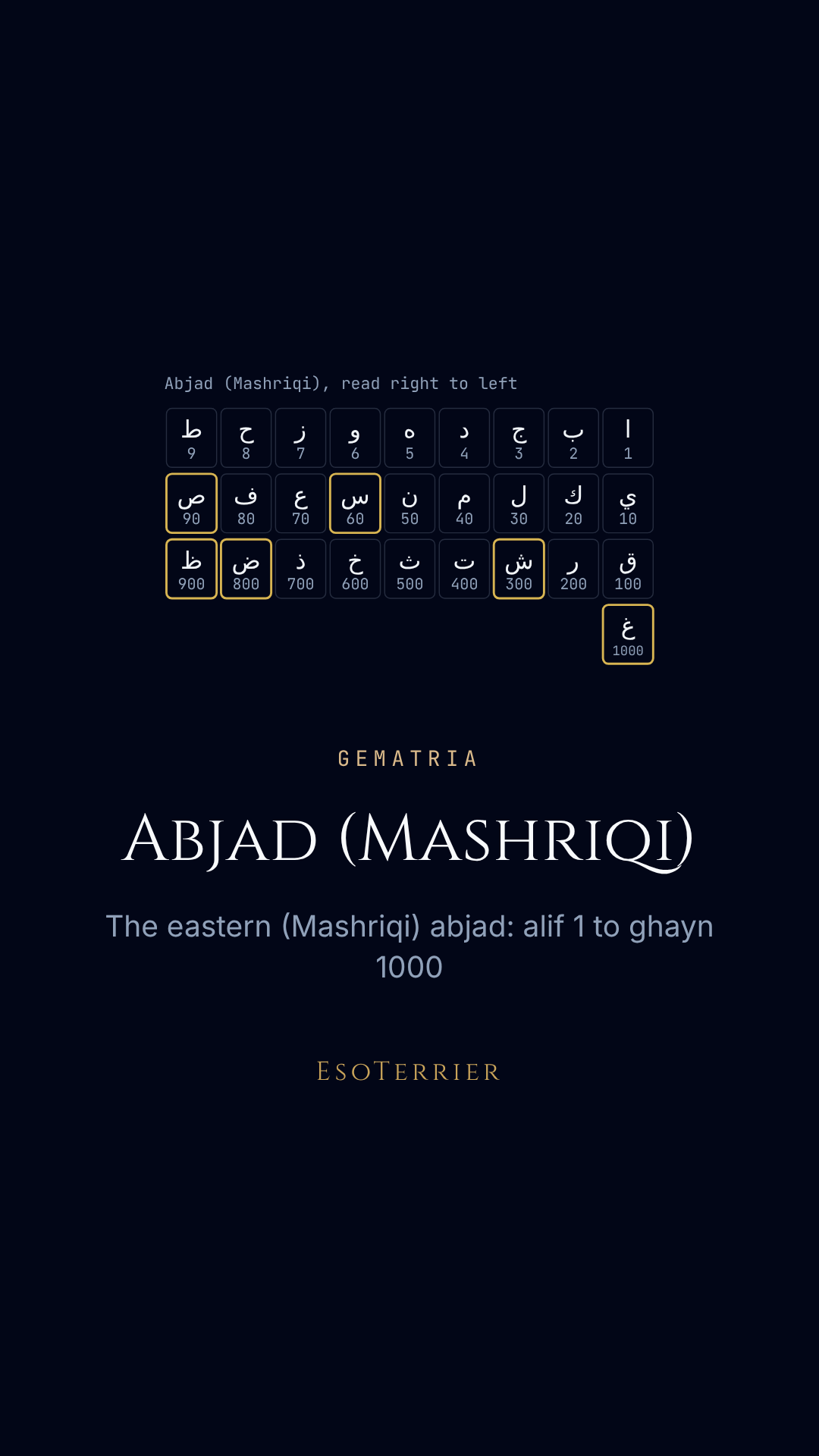
Meaning
The abjad is the old order of the Arabic letters, the order of the Semitic alphabets, remembered by the nonsense words abjad hawwaz hutti kalaman sa'fas qarashat thakhadh dazagh. In that order the letters were numerals: alif to ta' 1 to 9, ya' to sad 10 to 90, qaf to ta' 100 to 400, and then the six letters that Arabic added to the older alphabet, tha', kha', dhal, dad, za' and ghayn, for 500 to 1000. The values of the first twenty-two match the Hebrew letters that stand in the same places.
Positional digits took over arithmetic from about the 8th century, but the letter values stayed in use: for numbering, and above all for chronograms, phrases whose letters add up to the year of the event they record. The tomb of Hafez in Shiraz gives the poet's death year, 791 of the Hijra, in this way. In the 14th century the Hurufi movement made the letters themselves the centre of a mystical teaching.
In South Asia the number 786, the value of the basmala in this order, is written on shop signs, letterheads and the top of letters in place of the words themselves. It is a South Asian custom; many scholars and most of the Arab world do not follow it.
How it is counted
سلام, salam, "peace": س 60 + ل 30 + ا 1 + م 40 = 131.
كتاب, kitab, "book": ك 20 + ت 400 + ا 1 + ب 2 = 423.
شمس, shams, "sun": ش 300 + م 40 + س 60 = 400.
The chart strips the short-vowel marks, counts every form of alif with hamza, and the connecting alif wasla, as alif, the final ta' marbuta as ha' and the alif maqsura as ya'.
The order and its words
The mnemonic words group the letters by their old sequence: abjad for alif, ba', jim, dal; hawwaz for ha', waw, zay; and so on to dazagh, the last three. The same order underlies the Hebrew and Greek numerals, which is why a Hebrew and an Arabic word made of corresponding letters have the same value up to 400.
Correspondences
Each item with how it stands: “sourced” is in the work cited, “our construction” is EsoTerrier’s own, and “disputed” means the sources disagree.
- Chronograms
- Phrases whose letters give a date; Hafez's tomb carries one for 791 of the Hijra sourced
- Hurufism
- A 14th-century Sufi letter mysticism of the Arabic and Persian alphabets sourced
- 786
- The basmala's value in this order; writing 786 for it is a South Asian custom disputed
- Counterpart
- The Hebrew standard count, with the same order and values to 400 sourced
How the schools read it
- Arabic scribes
- Letter numerals in the old order, kept for lists and dates after the new digits came.
- Poets and stone-cutters
- Chronograms in Arabic and Persian verse and on tombs.
- South Asian custom
- Writes 786 in place of the basmala.
- EsoTerrier
- For text written in Arabic; the eastern order by default, as abjadcalc does.
Claims about it
-
786 is sacred throughout Islam and may stand for the basmala anywhere.
disputedWhat the record shows: The value is right in this order (1,026 in the western). Writing 786 for the basmala is a South Asian custom, which many scholars and most of the Arab world do not follow.
-
An English name written in Arabic letters one for one has an abjad value.
falseWhat the record shows: Only a name as Arabic speakers write it has a value; a mechanical swap gives spellings nobody uses.