Skip to content

Gematria · Hebrew script · cipher 15 of 23

Mispar Gadol: the large count with the final letters at 500 to 900

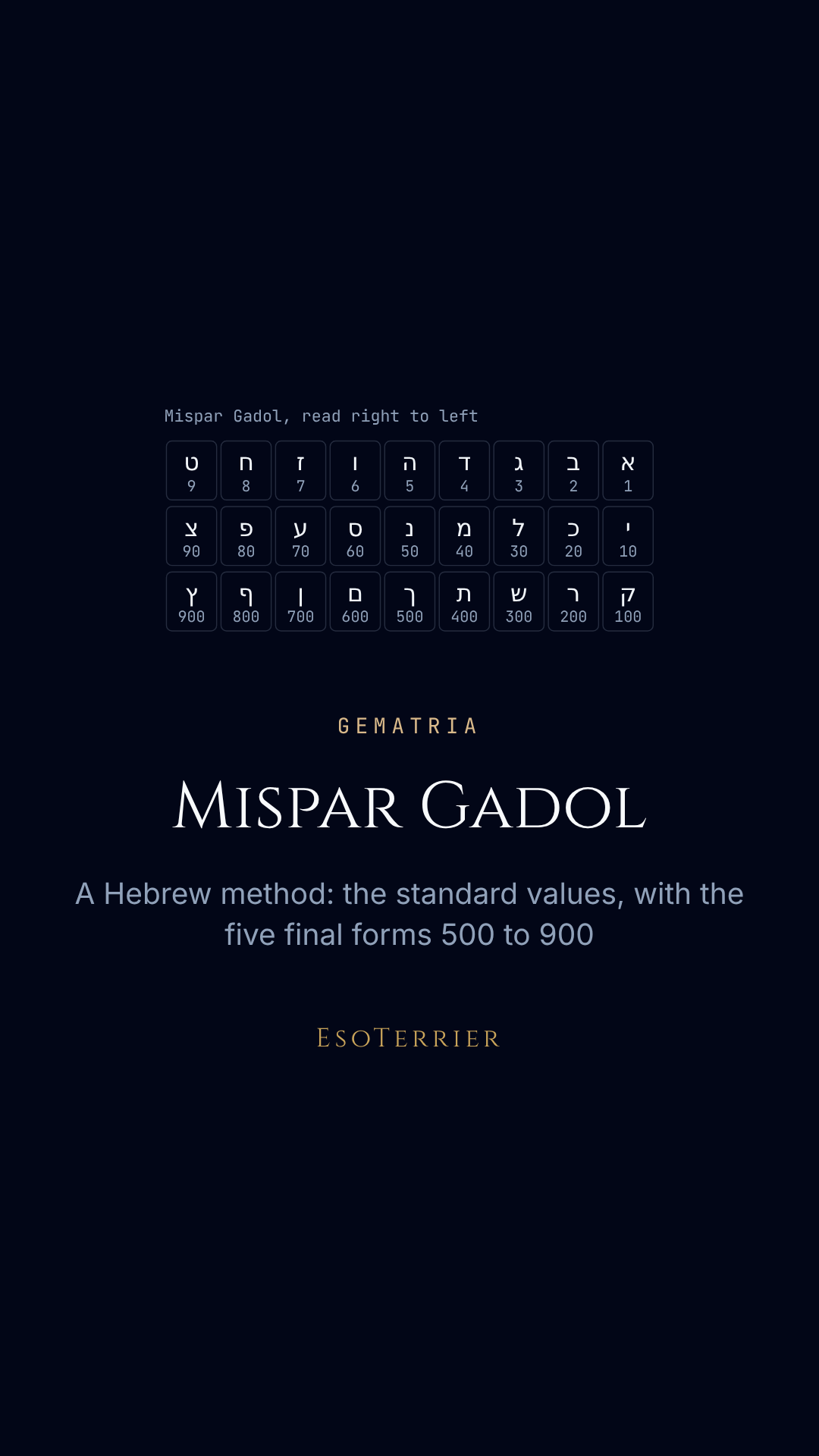
Mispar Gadol, the large count, is the cipher that keeps the standard values of the Hebrew letters and lets the five final forms carry the count past tav: final kaf 500, mem 600, nun 700, pe 800, tsadi 900. Only words that end in one of those letters change.

A table of the 22 Hebrew letters in alphabetical order with their values under Mispar Gadol: alef 1, bet 2, gimel 3, dalet 4, he 5, vav 6, zayin 7, het 8, tet 9, yod 10, kaf 20, lamed 30, mem 40, nun 50, samekh 60, ayin 70, pe 80, tsadi 90, qof 100, resh 200, shin 300, tav 400; the five final forms count 500, 600, 700, 800, 900. Mispar Gadol, read right to left א 1 ב 2 ג 3 ד 4 ה 5 ו 6 ז 7 ח 8 ט 9 י 10 כ 20 ל 30 מ 40 נ 50 ס 60 ע 70 פ 80 צ 90 ק 100 ר 200 ש 300 ת 400 ך 500 ם 600 ן 700 ף 800 ץ 900
The Mispar Gadol values of the 22 letters, in alphabetical order from alef; the five final forms follow the rule given in the facts.

Facts

Script
The 22 Hebrew letters and their five final forms; vowel points stripped
Rule
As the standard, with ך 500, ם 600, ן 700, ף 800, ץ 900
Tier in our chart
Core: shown at once for Hebrew text
First known source
A traditional count; printed by Agrippa in 1533 as the Hebrew hundreds after tav
Alternative notation
Some write 500 to 900 as tav plus a hundred (תק 500 and so on), as Agrippa notes
What changes
Only words ending in one of the five final forms
Examples
שלום 936 (376 in the standard count); נחש 358; אמת 441

Meaning

Five Hebrew letters change shape at the end of a word: kaf, mem, nun, pe and tsadi. In the standard count they are worth what their ordinary forms are worth. Mispar Gadol, the large count, gives them the hundreds that the alphabet otherwise lacks: after tav at 400 come final kaf 500, final mem 600, final nun 700, final pe 800 and final tsadi 900. The Hebrew alphabet thus reaches 900 just as the Greek does with sampi.

Agrippa printed exactly this in 1533, setting the finals as the last row of the Hebrew hundreds, and added that some writers instead write 500 to 900 with tav and another hundred. The Jewish Encyclopedia of 1906 lists the large count among the methods, and the Hebrew calculators carry it as one of the main ones.

How it is counted

שלום, shalom, "peace": ש 300 + ל 30 + ו 6 + ם 600 = 936; reduced to 18, then to 9.

נחש, nachash, "serpent": נ 50 + ח 8 + ש 300 = 358; reduced to 16, then to 7.

אמת, emet, "truth": א 1 + מ 40 + ת 400 = 441; reduced to 9.

Only a word that ends in one of the five forms changes; shalom, which ends in a final mem, rises from 376 to 936, while emet and nachash, which do not, are unchanged.

Which rule we follow

Our other Hebrew methods count a final as its base letter, and this page is the one place where they do not. The chart names the method beside every total, so a reader can see which rule produced it.

The other way to write 500 to 900

Agrippa notes that not everyone used the finals as numbers. Some wrote the hundreds above 400 by adding to tav: tav with qof for 500, tav with resh for 600, tav with shin for 700, two tavs for 800, and two tavs with qof for 900. Under that convention a final letter is only a final letter, and a word's large count and standard count are the same; Mispar Gadol is the method that gives the finals their own values. The difference can be large: king, מלך, is 90 by the standard count and 570 by the large.

Correspondences

Each item with how it stands: “sourced” is in the work cited, “our construction” is EsoTerrier’s own, and “disputed” means the sources disagree.

Agrippa's Hebrew table (1533)
The finals as 500 to 900, completing the hundreds sourced
Jewish Encyclopedia (1906)
Describes the finals counted 500 to 900 among the methods sourced
Calculators
TorahCalc and Kesher list it among the main methods sourced

How the schools read it

Agrippa (1533)
Gives the finals as the hundreds 500 to 900, and mentions the compound alternative.
Reference works
List it as the large count beside the standard.
EsoTerrier
A core Hebrew method; the only one in which finals are not their base letter.

Claims about it

  • The finals have always been worth 500 to 900.

    false

    What the record shows: Only in this method. In the standard count, and in our other Hebrew methods, a final letter counts as its ordinary form; some writers put 500 to 900 as compounds of tav instead.
Elsewhere on EsoTerrier

Sources

Primary texts (4)
  1. Henry Cornelius Agrippa, Three Books of Occult Philosophy, Book II, chapters xviii to xx, translated by J. F. (London, 1651), edited by Joseph H. Peterson; first printed in Latin as De occulta philosophia libri tres, Cologne, 1533. esotericarchives.com/agrippa/agripp2b.htm
  2. Solomon Schechter and Caspar Levias, "Gematria", The Jewish Encyclopedia (New York: Funk and Wagnalls, 1906). jewishencyclopedia.com/articles/6571-gematria
  3. TorahCalc, gematria calculator of 25 Hebrew methods. Facts only. torahcalc.com/tools/gematria
  4. Kesher Gematria, methods and Tanakh word finder. Facts only. keshergematria.com/en
Studies and other sources (1)
  1. "Gematria", Wikipedia (orientation only). en.wikipedia.org/wiki/Gematria
Our own research (2)
  1. EsoTerrier calculation engine, the gematria service and its documentation.
  2. EsoTerrier, example values of test words under every cipher, computed from the engine's tables (October 2026).

Your Gematria reading, $4.99. Includes this system's raw data. Written for you by AI. Read a sample. Charts and the written text are free in every account.

By EsoTerrier. Written with AI assistance from our research and checked against its sources; last revised 24 October 2026. How we write these pages.

First published ; last revised . Corrections: support@esoterrier.com.