Meaning
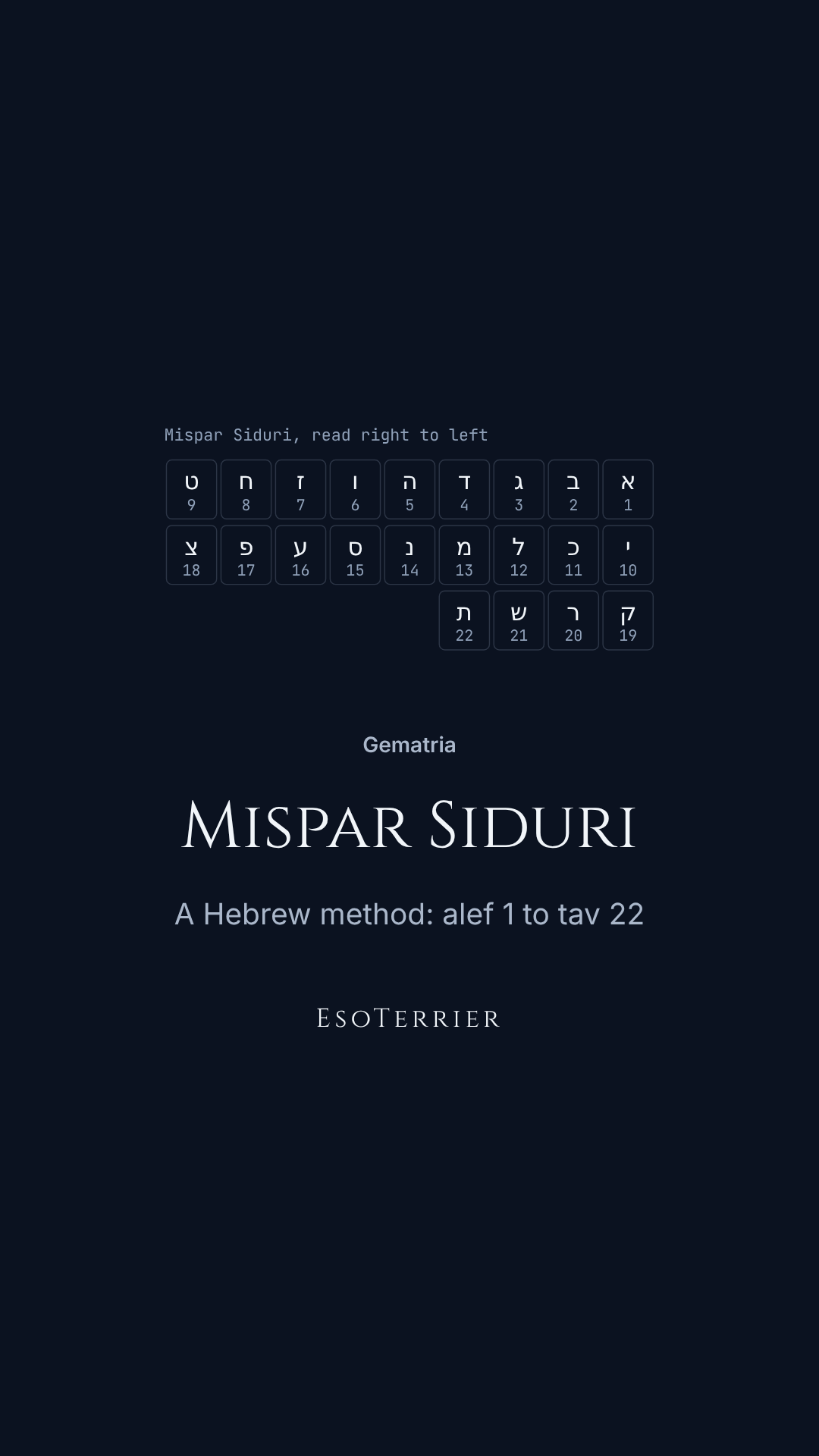
Mispar Siduri, "the ordinal number", ignores the numeral values and counts each letter by its place in the alphabet: alef 1, bet 2, and so on to tav 22. Where the standard count puts qof at 100 and tav at 400, the ordinal puts them at 19 and 22, so totals stay small and differences between letters stay even. It is the Hebrew counterpart of the English Ordinal, but unlike it, it counts an alphabet that also had a numeral order, and it stands beside that order rather than replacing it.
The method is listed by the Hebrew calculators and the reference tables among the traditional ones; when it was first used is not established.
How it is counted
שלום, shalom, "peace": ש 21 + ל 12 + ו 6 + ם 13 = 52; reduced to 7.
נחש, nachash, "serpent": נ 14 + ח 8 + ש 21 = 43; reduced to 7.
אמת, emet, "truth": א 1 + מ 13 + ת 22 = 36; reduced to 9.
Shalom and nachash, 18 apart in the standard count, are 9 apart here. Ordinal counts compress differences, so they produce more equal pairs than the numeral values do.
The final letters
Tools disagree on the five final forms. Some continue the count through them, final kaf 23 to final tsadi 27; ours counts each as its ordinary letter, as the standard count does, and the chart says so. A total from another tool that differs from ours by a few points usually comes from this choice.
Why an ordinal count
An ordinal count keeps every letter between 1 and 22, so a word's total stays close to a few dozen whatever its letters. Truth, אמת, is 441 by the standard count and 36 here. Small totals make comparisons between short words easy, and they also make equal totals far more common than in the standard count, which is why the ordinal is a supplementary method rather than the main one. A shalom counted with its final mem at 24, as some tools do, would give 63 instead of 52.
Correspondences
Each item with how it stands: “sourced” is in the work cited, “our construction” is EsoTerrier’s own, and “disputed” means the sources disagree.
- Calculators
- TorahCalc and Kesher list it among the main methods sourced
- Finals
- Counted as their base here; 23 to 27 in some tools disputed
- English counterpart
- English Ordinal our construction
How the schools read it
- Hebrew calculators
- Carry the ordinal count beside the standard.
- Some software packages
- Continue the count through the finals, 23 to 27.
- EsoTerrier
- Finals as their base letter, as in the standard count.
Claims about it
-
The Hebrew ordinal of an English name is that name's Hebrew value.
falseWhat the record shows: Only a name written as Hebrew speakers write it has a Hebrew value; a letter-for-letter swap gives spellings no speaker writes.