Meaning
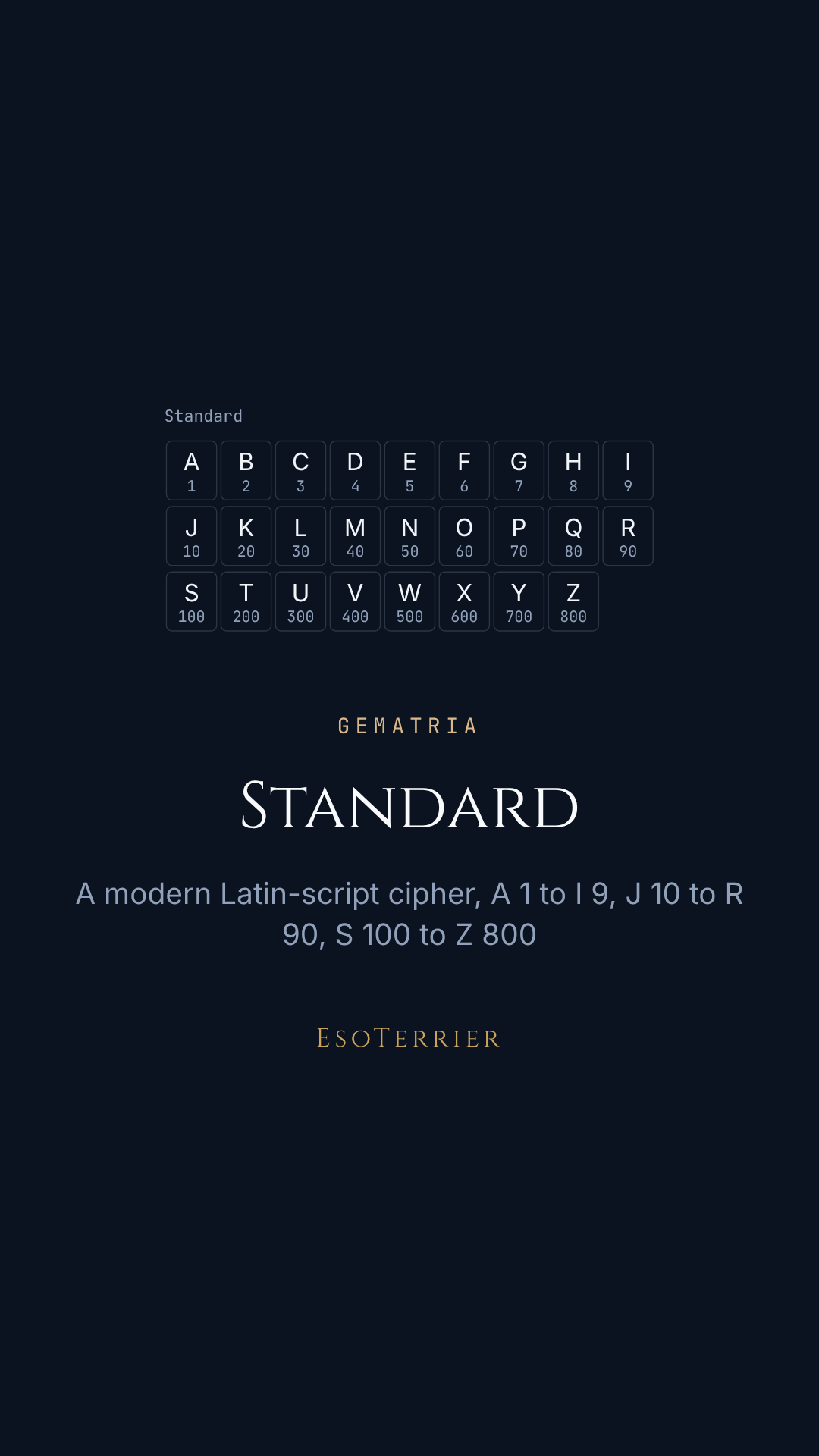
The Standard cipher takes the numeral pattern of the Hebrew and Greek alphabets, nine units, nine tens and the hundreds, and runs it straight across the modern alphabet. A to I are 1 to 9, J to R are 10 to 90, and S to Z are 100 to 800; with 26 letters the hundreds stop at 800. It looks like Agrippa's Latin table and differs at once: Agrippa had no J, U or W in his alphabet, so his tens begin at K, and he put the extra letters at the top. Running the modern alphabet in order moves every letter from J onwards.
Some calculators called it English Extended; Gematrinator now calls it Standard. Nobody has traced it to a printed source, and it reads as the obvious thing to try once Agrippa's table is on the screen. Following the Hebrew pattern does not make it a Hebrew method, any more than Agrippa's does.
How it is counted
GEMATRIA: G 7 + E 5 + M 40 + A 1 + T 200 + R 90 + I 9 + A 1 = 353; reduced to 11, then to 2. ALPHABET: A 1 + L 30 + P 70 + H 8 + A 1 + B 2 + E 5 + T 200 = 317; reduced to 11, then to 2.
As in Agrippa's table, the late letters dominate: a single Z (800) outweighs every letter from A to R together (495). Comparisons between totals mostly compare how many letters from S to Z two words contain.
What this page leaves out
We give no reading of a Standard total. The cipher is shown behind "more ciphers" because the calculators carry it, so that a total someone has seen elsewhere can be checked.
The difference in practice
The two tables part company from the tenth letter on. Take the name JOHN: under the Standard cipher J is 10, O 60, H 8 and N 50, a total of 128; under Latin (Agrippa) J is 600, O 50, H 8 and N 40, a total of 698. A reader comparing totals from different calculators should check which of the two a site means, since both are sometimes simply called the English or extended cipher.
Correspondences
Each item with how it stands: “sourced” is in the work cited, “our construction” is EsoTerrier’s own, and “disputed” means the sources disagree.
- Names on the popular sites
- "English Extended", later "Standard" (Gematrinator) sourced
- Pattern
- The Hebrew and Greek numeral classes, as in Agrippa's Latin table sourced
- A Hebrew method?
- No: a Latin cipher on a borrowed pattern, like Agrippa's sourced
How the schools read it
- Gematrinator
- Once "English Extended", renamed "Standard".
- EsoTerrier
- Behind "more ciphers", labelled as units, tens and hundreds over the 26 letters.
Claims about it
-
Because it follows the Hebrew pattern, this cipher is a Hebrew method.
falseWhat the record shows: It borrows the pattern of units, tens and hundreds and nothing else. No Jewish tradition gives English letters these values.
-
Two words or names with the same value under this cipher are connected.
falseWhat the record shows: Equal values are what any table of this kind produces in quantity; the tradition reads them together as a way of interpreting a text.
-
Totals under this cipher show that news events are planned by their numbers.
falseWhat the record shows: A search with dozens of ciphers and millions of phrases always finds a match; fact-checkers have shown it. Nothing on this site reads events, dates or news by number.