Meaning
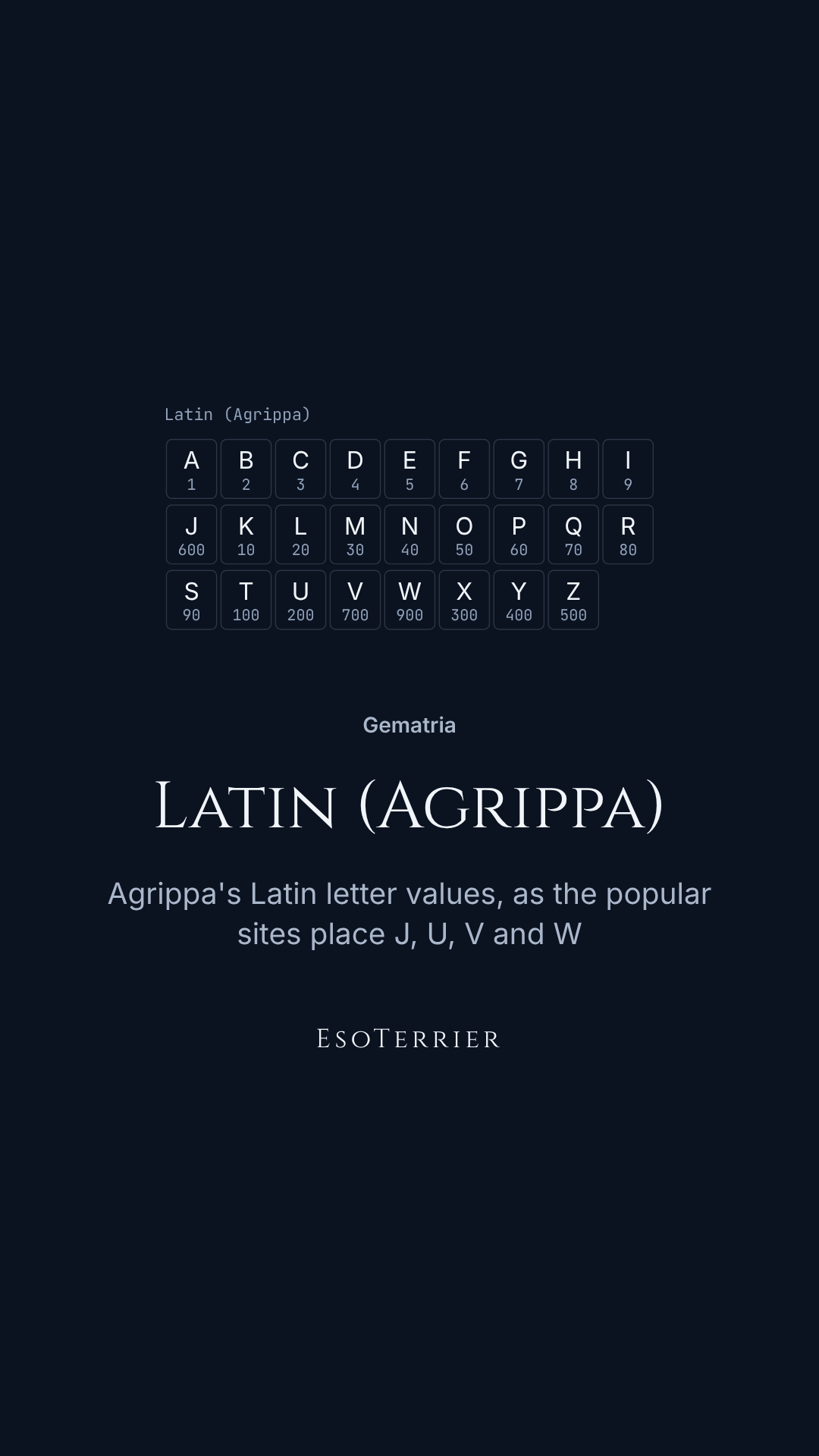
In Book II of De occulta philosophia, printed at Cologne in 1533, Heinrich Cornelius Agrippa set out the numeral letters of the Greeks and then of the Hebrews, and in chapter xx turned to Latin: "The Pythagorians say ... that the very Elements of letters have some certain divine numbers" (the English of 1651). Latin had never been a numeral alphabet in this way, so he made one on the same pattern, A to I for the units, K to S for the tens, T to Z for the first hundreds. The Latin alphabet had too few letters for the twenty-seven places, and he filled the last four with consonantal I (as in John) for 600, consonantal V (as in Valentine) for 700, and HI and HV for 800 and 900, the last because "the Germans for hu the asperate use a double vv".
His use for the table was a planet, not a match: add up the numbers of a name, divide by nine, and the remainder names a ruling star. We found no recorded use of the table between his day and the calculator sites, and Ashe argues that he never used it himself.
How the sites changed it
gematrix.org, which offered the cipher by 2010, fitted Agrippa's twenty-seven values to the 26-letter alphabet: J takes his consonantal I at 600, U takes 200, V takes his consonantal V at 700, W takes 900, and nothing is left at 800. Every site has copied that placement, and our chart uses it, labelled as the popular sites' placement of J, U, V and W; no strict Agrippa cipher with HI and HV is offered. gematrix.org also put a religious label on the cipher, as if it were a Jewish or Hebrew method. It is neither, and Gematrinator renamed it "Latin". We call it Latin (Agrippa).
How it is counted
GEMATRIA: G 7 + E 5 + M 30 + A 1 + T 100 + R 80 + I 9 + A 1 = 233; reduced to 8. ALPHABET: A 1 + L 20 + P 60 + H 8 + A 1 + B 2 + E 5 + T 100 = 197; reduced to 17, then to 8.
Because the later letters run into the hundreds, a few letters dominate any total: one W outweighs a whole word of early letters.
Correspondences
Each item with how it stands: “sourced” is in the work cited, “our construction” is EsoTerrier’s own, and “disputed” means the sources disagree.
- Agrippa's 27 values (1533)
- A 1 … I 9, K 10 … S 90, T 100, V 200, X 300, Y 400, Z 500, I 600, V 700, HI 800, HV 900 sourced
- Pattern
- The units, tens and hundreds of the Hebrew and Greek numerals, which Agrippa sets out in the two chapters before sourced
- Agrippa's use for it
- A ruling planet found from the remainder of a name's number divided by nine sourced
- "Jewish" or "Hebrew"
- A label on gematrix.org and its copies; the table is Latin and no Jewish tradition uses it disputed
How the schools read it
- Agrippa (1533; English 1651)
- "The Pythagorians say ... that the very Elements of letters have some certain divine numbers"; the table follows, with the rule of nine.
- gematrix.org
- The 26-letter placement, under a religious label the table has nothing to do with.
- Gematrinator
- Renamed the cipher "Latin".
- Bethsheba Ashe
- Argues that Agrippa never used the table and that the label feeds antisemitic conspiracy talk.
- EsoTerrier
- The sites' placement, under the name Latin (Agrippa), with this page noting where it departs from him.
Claims about it
-
This cipher is a Jewish or Hebrew method.
falseWhat the record shows: It is a Latin table by a Christian Renaissance author, fitted to English by a website. It transliterates nothing from Hebrew and no Jewish tradition uses it; Ashe documents how the label is used in antisemitic conspiracy talk.
-
Agrippa's letter table dates from 1531.
falseWhat the record shows: Book I was printed in 1531; the table is in Book II, chapter xx, first printed in the complete Cologne edition of 1533.
-
Two words or names with the same value under this cipher are connected.
falseWhat the record shows: Equal values are what any table of this kind produces in quantity; the tradition reads them together as a way of interpreting a text.
-
Totals under this cipher show that news events are planned by their numbers.
falseWhat the record shows: A search with dozens of ciphers and millions of phrases always finds a match; fact-checkers have shown it. Nothing on this site reads events, dates or news by number.