Meaning
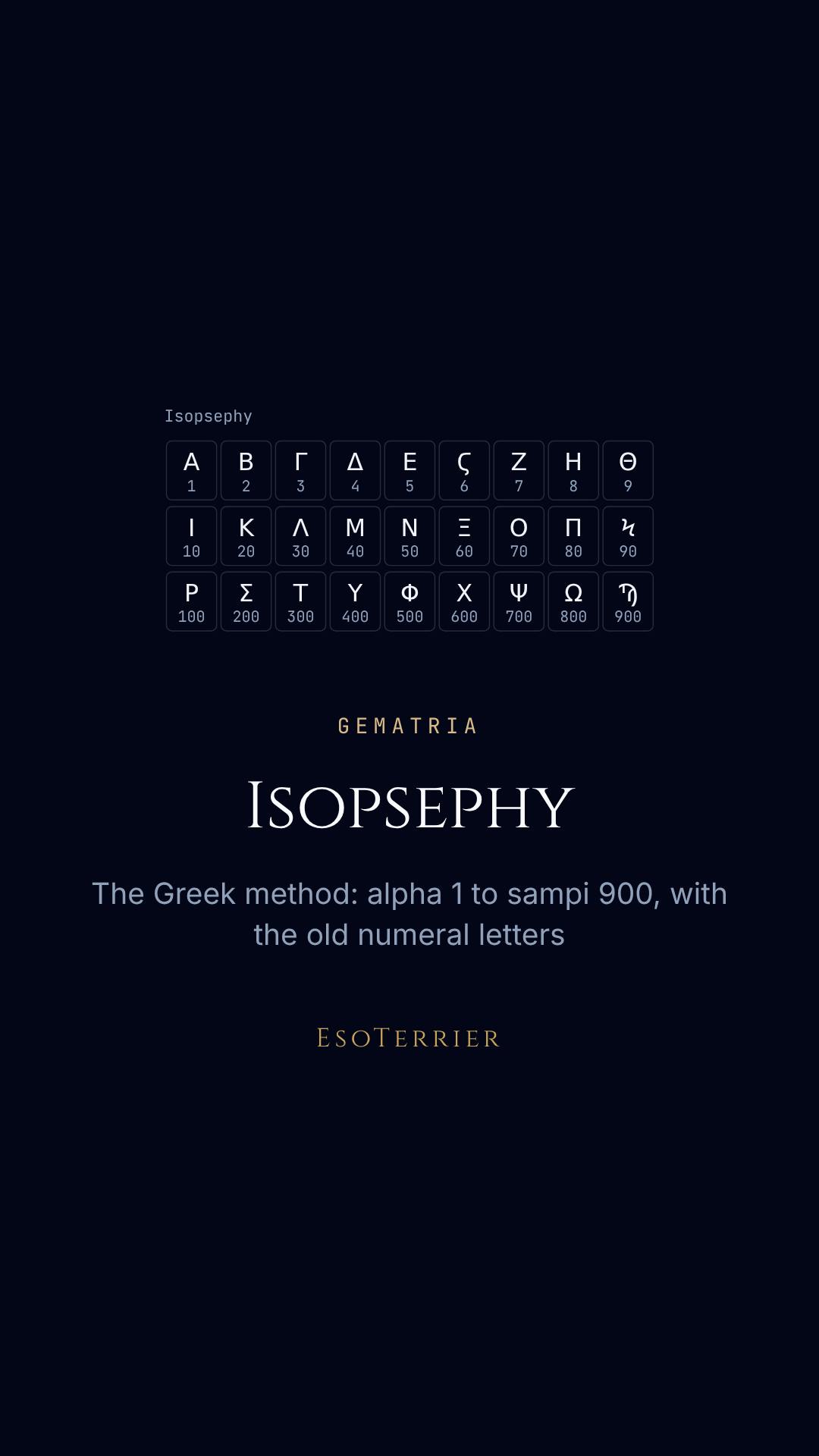
The Greeks wrote numbers with their letters: alpha to theta for 1 to 9, iota to koppa for 10 to 90, rho to sampi for 100 to 900. Three letters that had dropped out of the alphabet, digamma or stigma (6), koppa (90) and sampi (900), were kept for the purpose. The system grew up around Miletus and is attested by the 5th century BCE; it was in official use in Greece by about 200 BCE. Isopsephy, from isos "equal" and psephos "pebble", is the play of setting words with equal sums side by side.
The play is attested later than the numerals. A 3rd-century BCE puzzle by Apollonius of Perga multiplies letter values; summed words appear in the 1st century CE, in graffiti at Pompeii ("I love her whose number is 545"), in the epigrams of Leonidas of Alexandria, and in the Roman joke Suetonius records about Nero: Νέρων and the Greek for "killed his own mother" both make 1005. Christians used the device too. The Epistle of Barnabas reads Abraham's 318 as IH and T, Jesus and the cross; the Sibylline Oracles pose Jesus' name as a riddle whose answer is 888; and Irenaeus, about 180 CE, condemns Gnostics for building doctrine on such sums.
How it is counted
ΛΟΓΟΣ, logos, "word": Λ 30 + Ο 70 + Γ 3 + Ο 70 + Σ 200 = 373; reduced to 13, then to 4.
ΑΓΑΠΗ, agape, "love": Α 1 + Γ 3 + Α 1 + Π 80 + Η 8 = 93; reduced to 12, then to 3.
ΝΕΡΩΝ, Neron, Nero, the 1005 of the Roman joke: Ν 50 + Ε 5 + Ρ 100 + Ω 800 + Ν 50 = 1,005; reduced to 6.
The chart ignores accents and breathings, counts final sigma as sigma, and counts the numeral letters, in their classical or archaic forms, when they occur.
Famous equal values
Holy and good, ἅγιος and ἀγαθός, both make 284; the Nile, Νεῖλος, makes 365, the days of the year; and the dove, περιστερά, makes 801, a sum Irenaeus reports the Marcosians made much of. The sums are correct and our chart checks them; what they were taken to mean belongs to the people who drew them. The chart matches ordinary words only, never a sacred name.
Correspondences
Each item with how it stands: “sourced” is in the work cited, “our construction” is EsoTerrier’s own, and “disputed” means the sources disagree.
- Nero's lampoon
- Νέρων and "killed his own mother" both 1005 (Suetonius, Nero 39) sourced
- Barnabas (70 to 132 CE)
- Abraham's 318 read as IH and T, Jesus and the cross sourced
- Jesus 888
- Ἰησοῦς = 888, a Sibylline riddle and a Gnostic doctrine; not shown to be the evangelists' intent disputed
- Abraxas 365
- The sum is right; that the name was built for it is the ancient account disputed
How the schools read it
- Graffiti and epigram
- Love notes at Pompeii; Leonidas's couplets of equal sums.
- Roman satire
- The verse about Nero, recorded by Suetonius.
- Early Christian writers
- Barnabas on 318; the Sibylline riddle on 888.
- Irenaeus (about 180 CE)
- Attacks Gnostic speculation on 888 and 801; discusses 666 and 616.
- EsoTerrier
- For text written in Greek: numeral letters counted, final sigma as sigma, accents ignored.
Claims about it
-
Isopsephy began with Pythagoras at Miletus in the 6th century BCE.
disputedWhat the record shows: The numerals are attested from the 5th century BCE; no early source has Pythagoras number letters, and the summing of words appears in the Roman period.
-
The Gospel writers meant Jesus' name to make 888.
unverifiedWhat the record shows: The sum is right and ancient: the Sibylline Oracles set it as a riddle and the Gnostics Irenaeus attacked built on it. No early source says the evangelists intended it.
-
The name Abraxas was made to give 365.
told as loreWhat the record shows: Irenaeus links Basilides' Abraxas to 365 heavens, and the sum is right; that the name was built for the number is the ancient account.
-
Greek architects used isopsephy in the proportions of buildings.
unverifiedWhat the record shows: No source was found; an architect of the 2nd century CE who wrote isopsephic verse is not evidence that buildings encode names.
-
An English name written in Greek letters one for one has a Greek value.
falseWhat the record shows: Only a name as Greek speakers write it has an isopsephy value.