Meaning
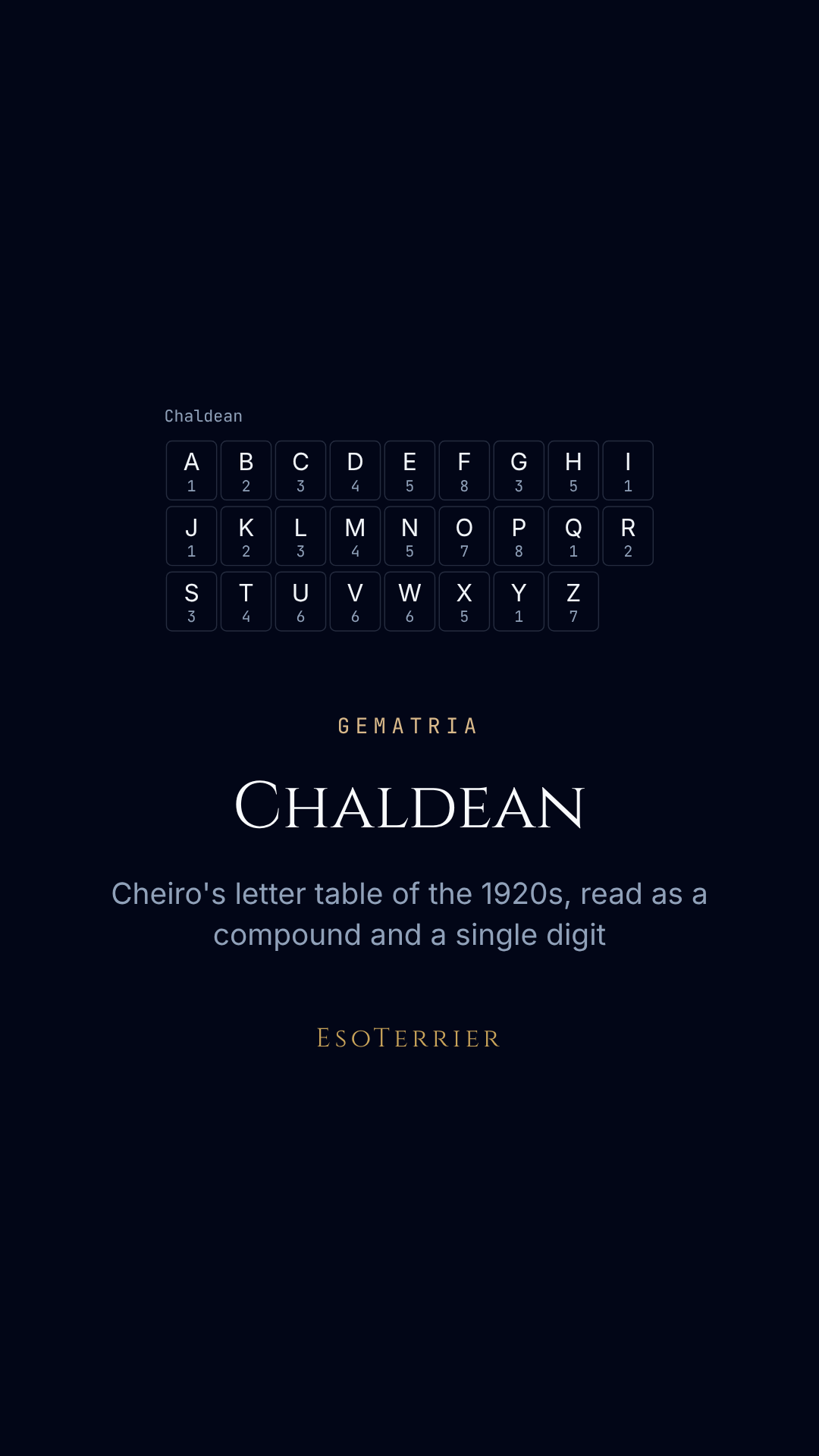
The Chaldean table is the one Cheiro printed in his Book of Numbers, an undated book catalogued as 1926: eight values for the 26 letters, and no letter at 9. Cheiro read a name's total as a compound number, reducing it until it was 52 or less, gave the compounds names, and then reduced them once more to a single digit. Our chart reads it exactly so, and the Numerology chart's Chaldean tab gives the same compound and the same digit.
He called it an ancient Chaldean and Hebrew alphabet. The printed trail is shorter. In 1911 the astrologer Sepharial published "Hebraic" values for English letters: the Hebrew numeral values reduced to one digit and set on their usual Roman equivalents. Cheiro's table agrees with it on 23 of the 26 letters. The missing 9 has a plain explanation: the two Hebrew letters worth 9 and 90, tet and tsadi, have no single Roman letter to land on, and Sepharial had given 9 to the pairs Th and Tz.
How it is counted
GEMATRIA: G 3 + E 5 + M 4 + A 1 + T 4 + R 2 + I 1 + A 1 = 21; compound 21, single 3. ALPHABET: A 1 + L 3 + P 8 + H 5 + A 1 + B 2 + E 5 + T 4 = 29; compound 29, single 2.
The name
"Chaldean" in Greek and Latin writing meant an astrologer, and Agrippa already wrote in 1533 that the Chaldeans numbered their letters after the manner of the Hebrews. Whether Cheiro took the label from such a passage is a guess; what is certain is that no letter table of this kind is known from Babylon, whose cuneiform had no alphabet. Many Chaldean sites also keep 11 and 22 as master numbers; Cheiro does not, and neither do we.
Correspondences
Each item with how it stands: “sourced” is in the work cited, “our construction” is EsoTerrier’s own, and “disputed” means the sources disagree.
- Antecedent
- The "Hebraic" values Sepharial printed in 1911 agree on 23 of 26 letters (not C, H, X) sourced
- Why no 9
- Cheiro gives a religious reason; the plain one is that Hebrew's two 9-letters, tet and tsadi, have no single Roman equivalent disputed
- "Chaldean"
- In Greek and Latin usage, an astrologer; nothing ties the table to Babylon sourced
- Use in our charts
- The Numerology chart's Chaldean tab gives the same compound and single digit sourced
How the schools read it
- Cheiro (1920s)
- Reads names, mainly the name a person goes by, as compounds with names and a single digit.
- Chaldean numerology sites
- The same table, often on the birth name and often with master numbers, which Cheiro does not use.
- Gematrinator
- Lists it among its ciphers as "Chaldean".
- EsoTerrier
- Behind "more ciphers", read as Cheiro reads it and labelled with his date.
Claims about it
-
The Chaldean cipher is Babylonian.
falseWhat the record shows: It is first printed by Cheiro in the 1920s. Its values are, for 23 of 26 letters, Sepharial's 1911 "Hebraic" values, the Hebrew letter numbers reduced to one digit. Nothing in it is Babylonian.
-
Two words or names with the same value under this cipher are connected.
falseWhat the record shows: Equal values are what any table of this kind produces in quantity; the tradition reads them together as a way of interpreting a text.
-
Totals under this cipher show that news events are planned by their numbers.
falseWhat the record shows: A search with dozens of ciphers and millions of phrases always finds a match; fact-checkers have shown it. Nothing on this site reads events, dates or news by number.