Meaning
The modern school keeps 11 whole because, it holds, the doubled digit carries more than the 2 it would reduce to. It reads the 11 as intuition, inspiration and a nervous sensitivity: a life that lights things up for others and has to find its own footing while doing so. Grounding is the whole task in this reading; without it, the school says, insight turns into tension and self-doubt. Decoz calls the 11 the intuitive master number, inspiring and high-strung.
The older readings of eleven are far from flattering. Agrippa reports that eleven, going beyond the ten commandments and falling short of the twelve of grace, was called the number of sins and of the penitent. On Cheiro's Chaldean table 11 is no master at all but a compound he named "a Clenched Hand" or "a Lion Muzzled", a warning of hidden trials. The master reading is twentieth-century and American, and we say so.
In our own words, the 11 is the person who illuminates for others, more intuitive and more easily overwhelmed than the 2, and whose risk is nervous strain.
How the number is reached
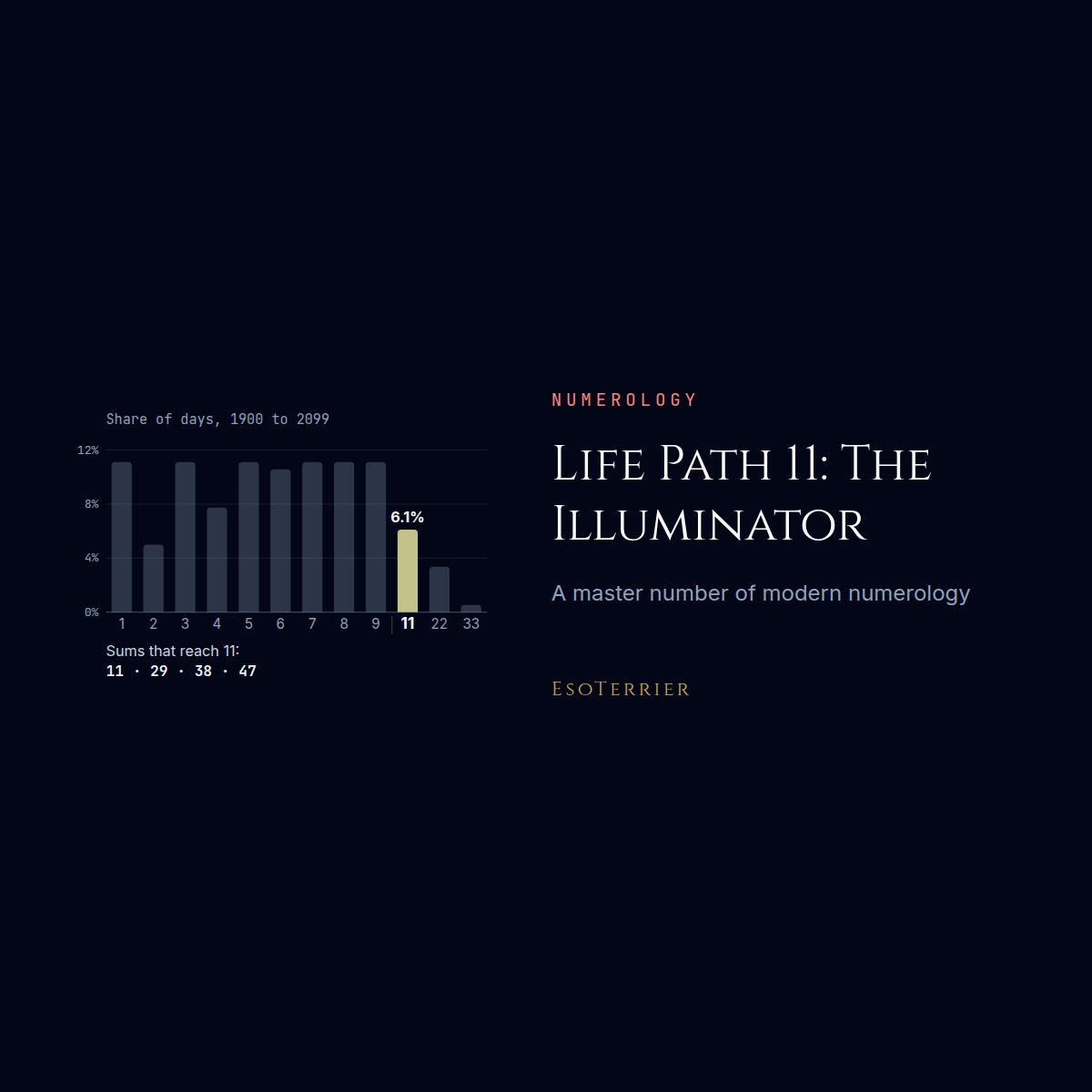
Four sums are kept as 11: 11 itself, and 29, 38 and 47, which reduce to 11 and stop there. Born on 5 January 1985, a person adds 1 + 5 + 5 = 11; on 22 February 1985, 2 + 22 + 5 = 29, then 11; on 22 November 1985, 11 + 22 + 5 = 38, then 11. The person in the sample chart on the Numerology page, born on 19 January 1989, has 1 + 1 + 9 = 11.
From 1900 to 2099 the 11 falls to 4,464 days in 73,049 (6.11 percent), and from 1926 to 2025 to 2,354 in 36,525 (6.44 percent). The rule matters here more than anywhere: a calculator that keeps no masters, or that keeps them only in the final sum, sends many of these dates to 2, and adding every digit in a row reaches 11 on other dates. We follow Decoz and keep 11 and 22 already in the month and the day.
Where master numbers come from
Master numbers are not old. Balliett, in 1908, called 8, 9, 11 and 22 "free numbers"; the 1917 printing of her first book says that 11 and 22 "are never added". Ariel Yvon Taylor in 1926 still names only 11 and 22. The third master, 33, came later and is not universal: Goodwin and Jordan are reported to have used only two, while Decoz keeps three and calls 44 and the higher doubles power numbers.
The planet line, as history
Agrippa's remainder rule divides by nine, so 11 leaves 2 and falls to the Moon; Heydon, Sepharial and Cheiro kept the Moon for 2. On the Chaldean side Cheiro reads 11 only as his named compound. None of these sources has a master number, and we attach no planet to the 11.
What this page leaves out
Cheiro gives each of his numbers favourable days of the week and periods of the year; we leave them out. The school reads a Life Path as a theme of a life.
Correspondences
Each item with how it stands: “sourced” is in the work cited, “our construction” is EsoTerrier’s own, and “disputed” means the sources disagree.
- Strengths (EsoTerrier)
- Heightened intuition, Inspirational presence, Spiritual insight, Charisma our construction
- Challenges (EsoTerrier)
- Nervous tension, Self-doubt, Impracticality, Overwhelm our construction
- Decoz's reading, in our words
- The intuitive master number in Decoz's reading: inspiring and high-strung, a source of inspiration to others. sourced
- Cheiro (1920s), in our words
- On Cheiro's Chaldean table 11 is not a master but a compound with a warning name: "a Clenched Hand" or "a Lion Muzzled", hidden trials and misplaced trust. sourced
- Agrippa's number lore (1533)
- Eleven goes beyond ten, the number of the commandments, and falls short of twelve, the number of grace, so it is called the number of sins and of the penitent; it has no scale. sourced
- Balliett's note and colour (1908)
- The octave of C; the colours white, black, yellow and violet. One of her "free numbers" of 1908. sourced
- Colour on modern sites
- A rainbow order (1 red, 2 orange and so on) circulates without a source; Balliett's own colours differ, and we use none disputed
How the schools read it
- Decoz and Goodwin
- The component method: month, day and year reduced apart, then added. The total is kept as a master number.
- Jordan (as reported); Millman
- Each part reduced to one digit first, or every digit added in a row: the same final digit on most dates, other compounds, and fewer masters.
- Cheiro (1920s)
- No Life Path: he reads the day of birth by its digit and its compound, and the name on his own table, with no masters.
- Agrippa (1533)
- Number lore of the Pythagoreans and the Christian tradition, and a planet for the name's total by the remainder of nine; nothing about birth dates.
- Balliett (1905 to 1908)
- The first to read birth dates and names on the 1 to 9 table; each number has a note and a colour, and 11 and 22 are kept whole.
- EsoTerrier
- Read here as the person who lights things up for others and must find footing while doing so, whose risk is nervous strain.
Claims about it
-
The meaning of Life Path 11 goes back to Pythagoras.
falseWhat the record shows: Pythagoras wrote nothing and no early source mentions names or birth dates. The Life Path is twentieth-century American numerology, from Balliett (1905 to 1908) to Decoz.
-
The master number 11 is an ancient doctrine.
falseWhat the record shows: Nothing older than Balliett (1905 to 1908) keeps 11 unreduced; she called them "free numbers" in 1908, and the name master number came later.
-
11 is a master number on the ancient Chaldean table too.
falseWhat the record shows: The Chaldean table is Cheiro's, from the 1920s, after Sepharial's 1911 values; it has no master numbers, and Cheiro reads 11 as a warning compound.
-
People with Life Path 11 are a spiritual elite.
unverifiedWhat the record shows: A ranking the school makes, not a fact. About 6 percent of days give an 11 under the component method; we give the share and leave the ranking aside.
-
The Life Path is found by adding all the digits of the birth date in a row.
disputedWhat the record shows: A variant, not an error. It agrees with the component method on the final digit almost always and differs on the compound and on dates with a master in a part.