Meaning
The modern school reads the Life Path 4 as the builder: method, order, a plan that holds and progress that can be measured. The rewards it describes are late and solid, the costs rigidity, overwork and a distrust of anything that cannot be scheduled. Decoz's 4 is practical, committed and persevering. Cheiro's 4 is another figure entirely, the contrarian and reformer who sees things from the opposite side; the reason lies in the planet he gave it, set out in the history section below.
The older lore gives the 4 its grandest role. Agrippa calls it the Pythagorean tetractys, the foundation and root of all the other numbers; it is the square and the solid, and the count of the elements, the seasons and the corners of heaven. The modern builder keeps that sense of a base everything rests on.
In our own words, the 4 is the person who likes method and a plan that holds, and whose risk is hardening into rigidity.
How the number is reached
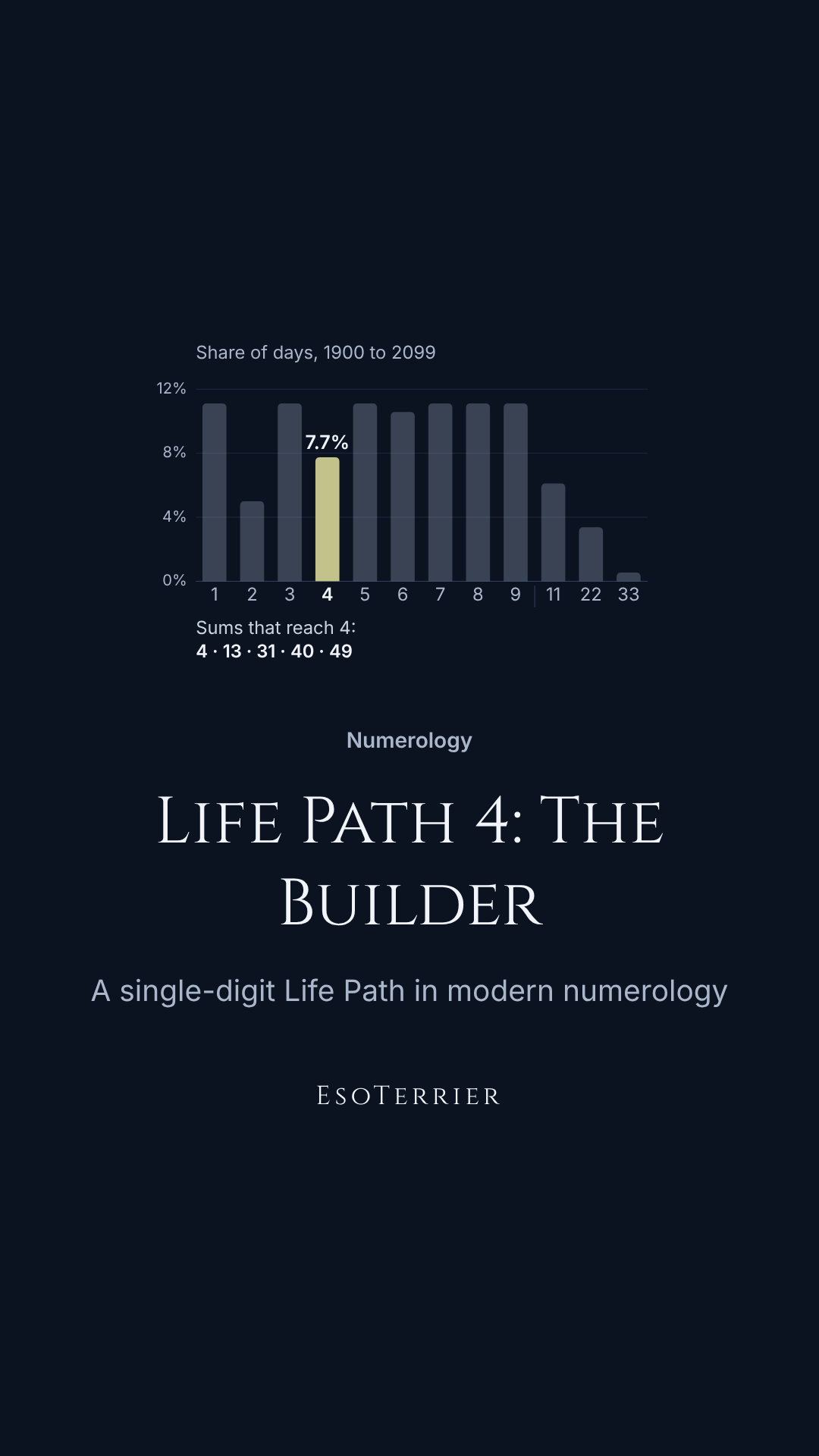
Five sums reach the 4: 4, 13, 31, 40 and 49. The sum 22 would reduce to 4 as well, but the school keeps it as the master number 22, which takes 3.4 percent of days on its own. That is why the 4 falls to fewer days than most digits: 5,656 in 73,049 from 1900 to 2099 (7.74 percent), and 2,926 in 36,525 from 1926 to 2025 (8.01 percent).
The 4 is the Life Path on which the school most often finds a karmic debt, because 13 is its commonest sum: 7 January 1985 gives 1 + 7 + 5 = 13, then 4. A total of 49, possible only with two 22s, as on 22 May 1993 (5 + 22 + 22 = 49), passes through 13 on its way down and carries the same debt. The school reads the debt 13 as a lesson about work done honestly and without shortcuts; we write 13/4, do not treat 13 as an ill omen, and take the debt as the school's belief.
A total of 4 itself is reached on dates such as 2 January 1990 (1 + 2 + 1 = 4); 31 needs a 22 in the day, as on 22 April 1985 (4 + 22 + 5 = 31).
The planet line, as history
Agrippa's remainder rule gives the Sun to four as well as to one, and Heydon and Sepharial kept that double Sun. Cheiro changed it: his 4 belongs to Uranus, a planet discovered in 1781, and his whole reading of the number follows from that choice. The Life Path itself has no planet in any of these books.
What this page leaves out
Cheiro gives each of his numbers favourable days of the week and periods of the year; we leave them out. The school reads a Life Path as a theme of a life.
Correspondences
Each item with how it stands: “sourced” is in the work cited, “our construction” is EsoTerrier’s own, and “disputed” means the sources disagree.
- Strengths (EsoTerrier)
- Reliability, Strong work ethic, Organization, Loyalty our construction
- Challenges (EsoTerrier)
- Rigidity, Resistance to change, Overwork, Narrow-mindedness our construction
- Decoz's reading, in our words
- Practical and methodical in Decoz's reading, committed, persevering and hard-working. sourced
- Cheiro (1920s), in our words
- Cheiro's people of the number 4, born on the 4th, 13th, 22nd or 31st, have a character of their own, see everything from the opposite side, rebel against rules and are drawn to reform. sourced
- Agrippa's number lore (1533)
- Four is the Pythagorean tetractys, the foundation and root of all other numbers: the square, solidity, the four letters of the divine name, the four elements, seasons, winds and corners of heaven. sourced
- Balliett's note and colour (1908)
- The note F; the colours blue and green. sourced
- Colour on modern sites
- A rainbow order (1 red, 2 orange and so on) circulates without a source; Balliett's own colours differ, and we use none disputed
How the schools read it
- Decoz and Goodwin
- The component method: month, day and year reduced apart, then added. Every total listed reduces to 4.
- Jordan (as reported); Millman
- Each part reduced to one digit first, or every digit added in a row: the same final digit on most dates, other compounds.
- Cheiro (1920s)
- No Life Path: he reads the day of birth by its digit and its compound, and the name on his own table, with no masters.
- Agrippa (1533)
- Number lore of the Pythagoreans and the Christian tradition, and a planet for the name's total by the remainder of nine; nothing about birth dates.
- Balliett (1905 to 1908)
- The first to read birth dates and names on the 1 to 9 table; each number has a note and a colour.
- EsoTerrier
- Read here as the person who likes method, measurable progress and a plan that holds, whose risk is hardening into rigidity.
Claims about it
-
The meaning of Life Path 4 goes back to Pythagoras.
falseWhat the record shows: Pythagoras wrote nothing and no early source mentions names or birth dates. The Life Path is twentieth-century American numerology, from Balliett (1905 to 1908) to Decoz.
-
The number 4 is ruled by Uranus, which gives it its nature.
unverifiedWhat the record shows: A European line from Agrippa (1533) through Heydon (1662) and Sepharial (1911) to Cheiro, not an ancient one; Sepharial himself called the planetary numbers unfounded. We attach no planet to a number.
-
A Life Path 13/4 pays for laziness in a past life.
falseWhat the record shows: The karmic debts are twentieth-century American numerology, not in Balliett or Taylor and in no ancient text. The school reads 13 as a lesson about work; a past life is its belief, not a fact.
-
The 4 and the 22 are the same number.
disputedWhat the record shows: Schools differ on master numbers. Decoz, whom we follow, keeps 22 as a master and reads it as a heightened 4; a calculator with no masters counts every 22 as a 4.
-
The Life Path is found by adding all the digits of the birth date in a row.
disputedWhat the record shows: A variant, not an error. It agrees with the component method on the final digit almost always and differs on the compound and on dates with a master in a part.
Elsewhere on EsoTerrier
- Life Path 22, the Master Builder its master form, the heightened 4
- Life Path 7, the Seeker Agrippa's seven, the four of the body and the three of the soul
- Tarot: the Emperor, IV trump 4 in Greer's birth cards, from a similar digit sum
- Psychomatrix the same birth-date digits, counted in a grid
- Gematria letter values older than Balliett's table