Meaning
The modern school reads the Life Path 5 as freedom: travel, variety, new people, the next idea, and a life learnt through change and through using liberty with some restraint. Adaptability, resourcefulness and quick thinking are the gifts it names; restlessness, impulsiveness and excess are the risks. Decoz's 5 is curious and outgoing; Cheiro's people born on the 5th, 14th and 23rd are quick, highly strung and impulsive, and, he says, on good terms with every other number.
For Agrippa, five is the meeting of two and three, the first even and the first odd number, which the Pythagoreans made the number of wedlock; it sits in the middle of ten and counts the five senses. The older lore pictures five as a joining; the modern school, as the urge to keep moving.
In our own words, the 5 wants room to move, variety and new people, and its risk is a restlessness that leaves things half begun.
How the number is reached
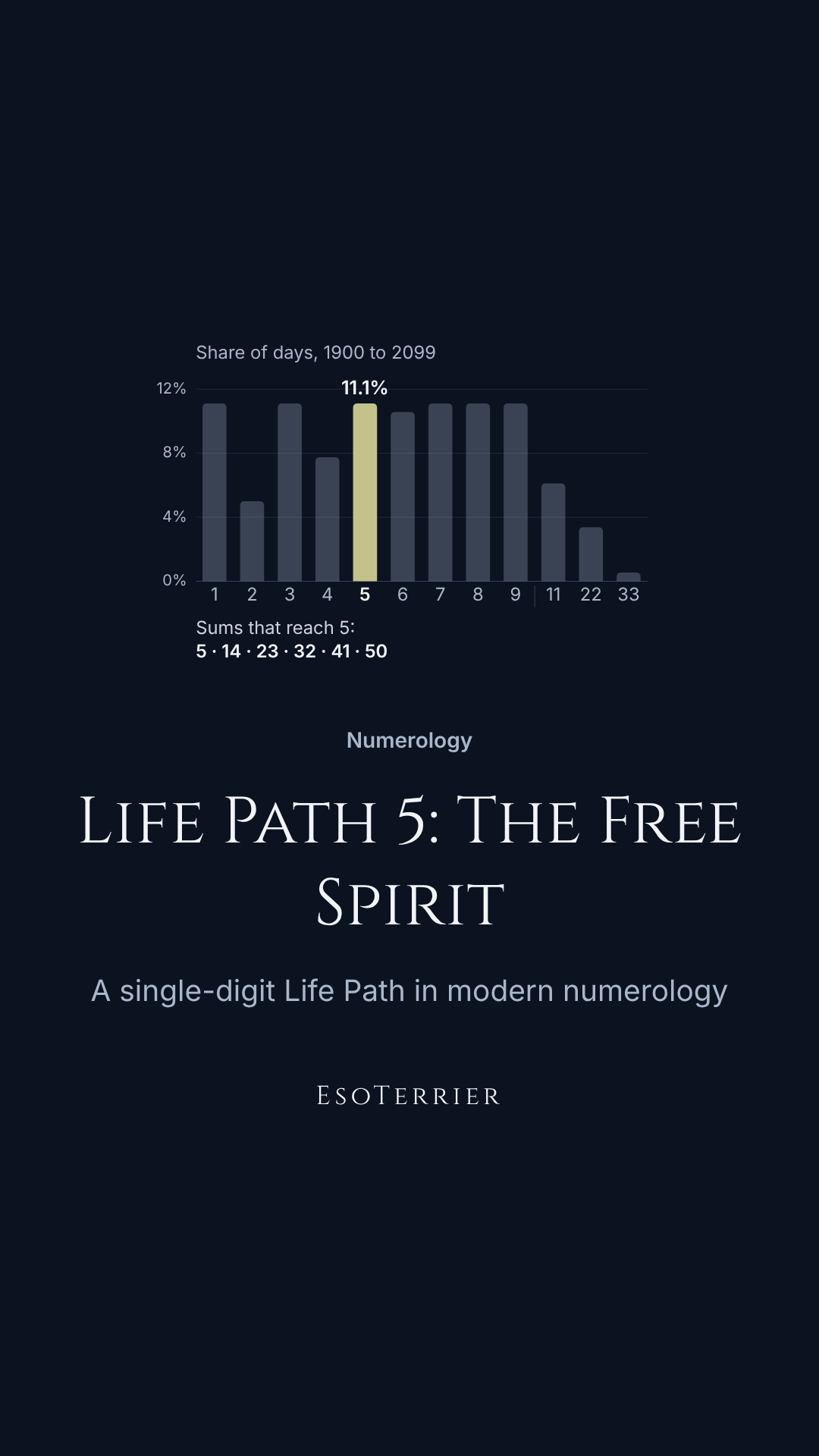
Six sums reach the 5: 5, 14, 23, 32, 41 and 50. The usual ones are 14 and 23, as on 8 January 1985 (1 + 8 + 5 = 14) or 11 July 1985 (7 + 11 + 5 = 23); 50 needs two 22s, as on 22 June 1993 (6 + 22 + 22 = 50). From 1900 to 2099 the 5 falls to 8,118 days in 73,049, 11.11 percent; from 1926 to 2025, to 4,060 in 36,525, 11.12 percent.
When the total is 14 the school writes 14/5 and reads the karmic debt 14 as a lesson about freedom used without excess. We read the debt, as Decoz does, only at this compound stage.
The digit-sum and unit methods reach the same 5 on most dates; they differ on dates where a master number stands in the month or the day.
The planet line, as history
Agrippa's remainder rule gives Mercury to five, and Heydon, Sepharial and Cheiro all kept Mercury; Agrippa also reports that the Pythagoreans gave five to fire among the elements. Cheiro's quick, nervous 5 follows from the planet. The Life Path has no planet in any of these sources, and we attach none.
What this page leaves out
Cheiro gives each of his numbers favourable days of the week and periods of the year; we leave them out. The school reads a Life Path as a theme of a life.
Correspondences
Each item with how it stands: “sourced” is in the work cited, “our construction” is EsoTerrier’s own, and “disputed” means the sources disagree.
- Strengths (EsoTerrier)
- Adaptability, Resourcefulness, Magnetism, Quick thinking our construction
- Challenges (EsoTerrier)
- Restlessness, Impulsiveness, Inconsistency, Overindulgence our construction
- Decoz's reading, in our words
- Freedom and adventure in Decoz's reading: curious, outgoing and quick to make friends. sourced
- Cheiro (1920s), in our words
- Cheiro's people of the number 5, born on the 5th, 14th or 23rd, are highly strung, quick in thought and decision, impulsive, and on good terms with every other number. sourced
- Agrippa's number lore (1533)
- Five joins the first even number and the first odd, female and male; it is the middle of ten, the Pythagoreans' number of wedlock and of justice, the count of the senses and of the wandering planets. sourced
- Balliett's note and colour (1908)
- The note G; the colour pink. sourced
- Colour on modern sites
- A rainbow order (1 red, 2 orange and so on) circulates without a source; Balliett's own colours differ, and we use none disputed
How the schools read it
- Decoz and Goodwin
- The component method: month, day and year reduced apart, then added. Every total listed reduces to 5.
- Jordan (as reported); Millman
- Each part reduced to one digit first, or every digit added in a row: the same final digit on most dates, other compounds.
- Cheiro (1920s)
- No Life Path: he reads the day of birth by its digit and its compound, and the name on his own table, with no masters.
- Agrippa (1533)
- Number lore of the Pythagoreans and the Christian tradition, and a planet for the name's total by the remainder of nine; nothing about birth dates.
- Balliett (1905 to 1908)
- The first to read birth dates and names on the 1 to 9 table; each number has a note and a colour.
- EsoTerrier
- Read here as the person who wants room to move and the next idea, whose risk is restlessness.
Claims about it
-
The meaning of Life Path 5 goes back to Pythagoras.
falseWhat the record shows: Pythagoras wrote nothing and no early source mentions names or birth dates. The Life Path is twentieth-century American numerology, from Balliett (1905 to 1908) to Decoz.
-
The number 5 is ruled by Mercury, which gives it its nature.
unverifiedWhat the record shows: A European line from Agrippa (1533) through Heydon (1662) and Sepharial (1911) to Cheiro, not an ancient one; Sepharial himself called the planetary numbers unfounded. We attach no planet to a number.
-
A Life Path 14/5 inherits excess from a past life.
falseWhat the record shows: The karmic debts are a twentieth-century American doctrine with no ancient or Vedic source. The school reads 14 as a lesson about freedom; it is a belief, not a fact about a person.
-
Fives are born speculators who make money fast.
unverifiedWhat the record shows: Cheiro wrote in this vein about his 5s.
-
The Life Path is found by adding all the digits of the birth date in a row.
disputedWhat the record shows: A variant, not an error. It agrees with the component method on the final digit almost always and differs on the compound and on dates with a master in a part.
Elsewhere on EsoTerrier
- Life Path 7, the Seeker another digit that can carry a karmic debt, 16
- Life Path 6, the Nurturer the next digit, Agrippa's perfect number
- Tarot: the Hierophant, V trump 5 in Greer's birth cards, from a similar digit sum
- Psychomatrix the same birth-date digits, counted in a grid
- Gematria letter values older than Balliett's table