Meaning
The modern school reads the 33 as the 6 of care raised to a calling: the teacher and carer who serves and guides, and who finds it hard to receive in return; burn-out and self-sacrifice are the risks it names. Decoz calls the 33 the master teacher. He accepts it as a master number, as most calculators do now, but the schools are not agreed: Goodwin and Jordan are reported to have used only 11 and 22, and Taylor's 1926 book names only those two.
The 33 has no old pedigree. Agrippa gives it no chapter or meaning of its own, and Balliett, who kept 11 and 22 whole, has no 33 at all. On Cheiro's Chaldean table it is a compound with the meaning of 24, which he reads as help from people of rank.
In our own words, the 33 is the person who teaches and cares at once, and whose risk is giving until nothing is left.
How the number is reached
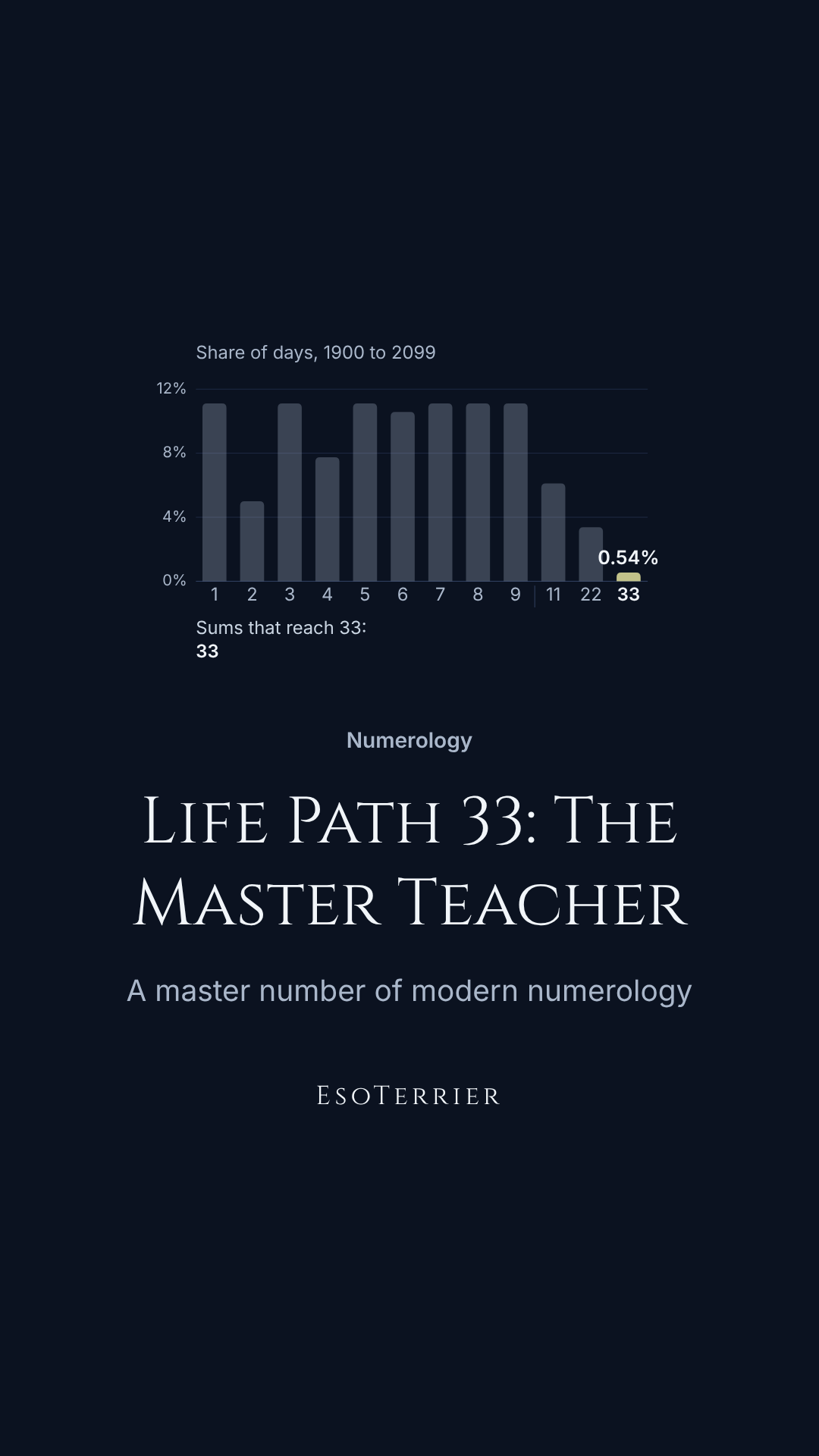
The 33 is the rarest result because the arithmetic rarely reaches it: the reduced month, day and year must add up to exactly 33. That almost always needs a 22 among the parts. Born on 22 June 1985, a person adds 6 + 22 + 5 = 33; born on 9 February 1984, 2 + 9 + 22 = 33, since 1984 reduces to 22. Of the 393 days from 1900 to 2099 that give a 33, 369 have a 22 among the parts; the other 24 are 11 + 11 + 11, the 11th or the 29th of November in a year that reduces to 11.
That is 0.54 percent of the 73,049 days from 1900 to 2099, and 284 of 36,525 days (0.78 percent) from 1926 to 2025. A calculator that keeps only 11 and 22 counts every one of these dates as a 6.
A master number of the later school
The first master numbers are Balliett's 11 and 22, called "free numbers" in 1908 and, in the 1917 printing of her first book, numbers that "are never added". Who first printed 33 as a master has not been established: it is not in Balliett or in Taylor's 1926 book, one bibliography credits a later book by Taylor, and the candidates are still in copyright. What is certain is that it is a modern addition, and that the schools still differ on it.
The planet line, as history
Divided by nine, 33 leaves 6, which Agrippa's remainder rule gives to Venus; Heydon, Sepharial and Cheiro kept Venus for 6. None of these sources knows a master number, and we attach no planet to the 33.
What this page leaves out
Cheiro gives each of his numbers favourable days of the week and periods of the year; we leave them out. The school reads a Life Path as a theme of a life.
Correspondences
Each item with how it stands: “sourced” is in the work cited, “our construction” is EsoTerrier’s own, and “disputed” means the sources disagree.
- Strengths (EsoTerrier)
- Deep nurturing capacity, Wise counsel, Caring presence our construction
- Challenges (EsoTerrier)
- Self-sacrifice, Burnout, Difficulty receiving in return our construction
- Decoz's reading, in our words
- The master teacher in Decoz's reading: compassionate, devoted to helping those in need. sourced
- Cheiro (1920s), in our words
- On Cheiro's Chaldean table 33 is not a master but a compound with the meaning of 24: a favourable number of help from people of rank. sourced
- Agrippa's number lore (1533)
- No meaning of its own in Agrippa; among the numbers near it he gives thirty-two, the number of the paths of wisdom. sourced
- Balliett's note and colour (1908)
- None: Balliett has no 33. sourced
- Colour on modern sites
- A rainbow order (1 red, 2 orange and so on) circulates without a source; Balliett's own colours differ, and we use none disputed
How the schools read it
- Decoz
- The component method: month, day and year reduced apart, then added; the total 33 is kept as the third master number. Goodwin, who teaches the same method, kept only 11 and 22.
- Jordan (as reported); Millman
- Each part reduced to one digit first, or every digit added in a row: the same final digit on most dates, other compounds, and fewer masters.
- Cheiro (1920s)
- No Life Path: he reads the day of birth by its digit and its compound, and the name on his own table, with no masters.
- Agrippa (1533)
- Number lore of the Pythagoreans and the Christian tradition, and a planet for the name's total by the remainder of nine; nothing about birth dates.
- Balliett (1905 to 1908)
- The first to read birth dates and names on the 1 to 9 table; each number has a note and a colour.
- EsoTerrier
- Read here as the teacher and carer who serves and guides and finds it hard to receive, whose risk is burning out.
Claims about it
-
The meaning of Life Path 33 goes back to Pythagoras.
falseWhat the record shows: Pythagoras wrote nothing and no early source mentions names or birth dates. The Life Path is twentieth-century American numerology, from Balliett (1905 to 1908) to Decoz.
-
Life Path 33 is the rarest and most spiritual of the numbers.
unverifiedWhat the record shows: Rare by arithmetic, about 0.5 percent of days; "most spiritual" is a ranking the school makes and we do not.
-
33 has always been a master number.
disputedWhat the record shows: Goodwin and Jordan are reported to have used only 11 and 22, and Taylor in 1926 names only those two. Decoz keeps 33; so do we.
-
The master number 33 is ancient.
falseWhat the record shows: It is the latest of the three, added after 1926; nothing before 1905 has master numbers at all.
-
The Life Path is found by adding all the digits of the birth date in a row.
disputedWhat the record shows: A variant, not an error. It agrees with the component method on the final digit almost always and differs on the compound and on dates with a master in a part.