How it works
Only the birth date goes in. It is written day, month, year, as eight digits: 15 June 1990 is 15061990.
The working numbers. Four numbers are worked out from the date. The first is the sum of its eight digits: for 15061990, 1 + 5 + 0 + 6 + 1 + 9 + 9 + 0 = 31. The second is the sum of the first number's digits: 3 + 1 = 4. The third is the first minus twice the first digit of the day: 31 − 2 × 1 = 29. A leading zero is skipped, so the 5th of a month counts as 5 and the 15th as 1. The fourth is the sum of the third number's digits, taken once: 2 + 9 = 11, not reduced again to 2. So 15 June 1990 gives 31, 4, 29 and 11, the example the Russian guides use. If the third number comes out at zero or below, which happens for some dates from 2000, its digits are counted without the minus sign and the result is noted.
The digits counted. The eight digits of the date and the digits of the four working numbers go into one pool, and every zero is left out. For 15 June 1990 that is 1, 5, 6, 1, 9, 9 from the date and 3, 1, 4, 2, 9, 1, 1 from the working numbers: thirteen digits. Over all dates from 1900 to 1999 a square holds 12.5 digits on average; from 2000 to 2099, 11.2.
The cells. The square has nine cells, one for each digit from 1 to 9, and each cell holds every copy of its digit: three 9s are written 999 in the ninth cell, and a digit that does not occur leaves its cell empty. Most Russian tools draw the square in columns, 1 2 3 down the left, 4 5 6 down the middle and 7 8 9 down the right, so that the top row reads 1 4 7; a few, Afisha among them, draw 1 2 3 across the top. We draw the usual layout so that squares can be compared.
| Cell | The tradition's name | Read by the school as |
|---|---|---|
| 1 | Character (характер) | will and self-assertion |
| 2 | Energy (энергия) | stamina, drive and charisma |
| 3 | Interest (интерес) | curiosity and the technical, analytical mind |
| 4 | Health (здоровье) | physical energy and stamina; a name, not a reading of health |
| 5 | Logic (логика) | reasoning and intuition |
| 6 | Labour (труд) | skill with the hands and physical work |
| 7 | Luck (удача) | chance and natural talent; the tradition's name |
| 8 | Duty (долг) | responsibility, kindness and honesty |
| 9 | Memory (память) | memory and intellect |
The names are the generic vocabulary of the Russian square sites; the one-word English forms are ours. Health and Luck stay as the tradition's names, labelled: the school reads cell 4 as physical energy and cell 7 as chance, and nothing in the square is a medical or financial statement.
The bands. A cell is read by its count on a scale whose shape is the tradition's: none, then one digit weak, two normal, three strong but unstable, four strong, five maximal, and six or more overload. Our readings for every count of every cell are written fresh in our own words; the Russian sites' readings paraphrase Alexandrov's books, which are in copyright, and are never translated here.
The lines. Each row, column and diagonal is read by the total number of digits in its three cells, and each has its own thresholds, taken from the Russian tools.
| Line | Cells | The tradition's name |
|---|---|---|
| Top row | 1, 4, 7 | Purposefulness (целеустремлённость) |
| Middle row | 2, 5, 8 | Family (семья) |
| Bottom row | 3, 6, 9 | Stability (стабильность) |
| Left column | 1, 2, 3 | Self-esteem (самооценка) |
| Middle column | 4, 5, 6 | Money and everyday life (быт, деньги), also called work capacity |
| Right column | 7, 8, 9 | Talent (талант) |
| Falling diagonal | 1, 5, 9 | Spirituality (духовность) |
| Rising diagonal | 3, 5, 7 | Temperament (темперамент) |
The eight lines are the Alexandrov school's addition to the bare square. The middle column's name is the tradition's too: we read its total as an attitude to practical work.
Births from 2000. A year beginning 20 brings fewer and smaller digits than one beginning 19, so twenty-first-century squares are sparser, and numerologists have not agreed what to do about it. We use the classic formula for every year. For a birth from 2000 the chart also offers the "+19" variant, in which the third working number is the first plus 19, as an option labelled as a practitioner convention; it is never the method.
What we do not compute. The school's transitions between cells, the comparison of two people's squares, the supplementary numbers some sites add, and the rest of Alexandrov's system (name analysis, forecasts by number and his "health schemes") are left out.
Origins and history
The name honours a Greek of the sixth century BCE; the method is Russian and was in print by 1999; the square of birth-date digits in the West is Australian, from 1940; and the 3 × 3 number square it is most often confused with is Chinese.
| When | Who | What happened |
|---|---|---|
| About 570 to 490 BCE | Pythagoras of Samos | Founds a way of life at Croton and writes nothing. About twenty early references survive; none mentions birth dates or a square of digits. |
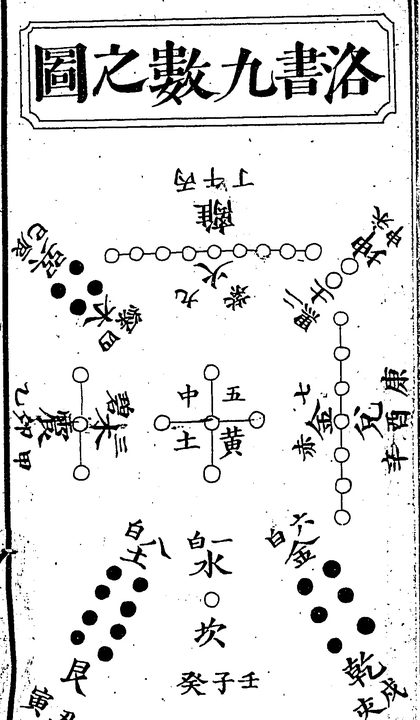
| By about 80 CE | Chinese authors of the Han | The Lo Shu, 4 9 2 / 3 5 7 / 8 1 6, every line making 15, is clearly referred to, with the legend of the turtle; explicit examples follow by about 570 CE. |
| 1514 | Albrecht Dürer, Nuremberg | Engraves a 4 × 4 magic square, every line 34, into Melencolia I. |
| 1940 and 1956 | Hettie Templeton, Sydney | Numbers and Their Influence, later A Philosophy of Numbers: a birth date's digits drawn into a 3 × 3 grid, its full lines named "arrows"; by her publisher's account, the origin of the Western birth chart. |
| 1980 and 1992 | David A. Phillips | Secrets of the Inner Self and The Complete Book of Numerology carry on Templeton's chart, with its planes and "arrows of Pythagoras". |
| 1990s | Unknown Russian practitioners | The "Pythagorean square" circulates in Russia with its working numbers and nine cells; nobody can say where it came from. Alexandrov's school says he met it in a short pamphlet. |
| 1999 | Aleksandr Alexandrov | His first book, Dates and destinies: the secret of the birthday, Ripol Klassik, Moscow: "figures, character, fate" and "a health scheme" in its subtitle. |
| 1999 to 2013 | Alexandrov | Retitled reprints, the Big Book of Numerology (2006) and a volume on relationships (2007): the square renamed Psychomatrix, the cells named, the eight lines, readings by count, the transitions, and the brand "digital psychoanalysis". |
| 2006 | A Novosibirsk teachers' conference | Papers on using psychomatrices in schools call Alexandrov a mathematician who had examined more than ten thousand people. |
| 2007 | An Alexandrov-school practitioner | Publishes the school's transition pairs, 11 to 8, 22 to 4, 4 to 22, 6 to 7, 7 to 6, 8 to 11, 99 to 5 and 55 to 9. |
| 2000s onward | Natalia Sidorova and others | A separate forecasting method, "Ideal", with the constants "+19 after 2000, −2 before", which some calculators carried over into the square. |
| 2013 onward | Alla Aleksandrova | After his death in 2013 his wife and co-author keeps the school going; the 2025 edition of the big book runs to 1,103 pages. |
| 2024 to 2026 | Lenta, T-J and the Russian press | Explainers name Alexandrov as the populariser, note the disagreement over births from 2000 and the Forer effect; Lenta calls the technique a twenty-first-century formulation, which the 1999 library record contradicts. |
| 2026 | EsoTerrier | The engine rebuilt: the derivation written out, the classic formula for every year with "+19" as an option, readings for every cell and line in our own words, after 55 test dates confirmed the arithmetic. |
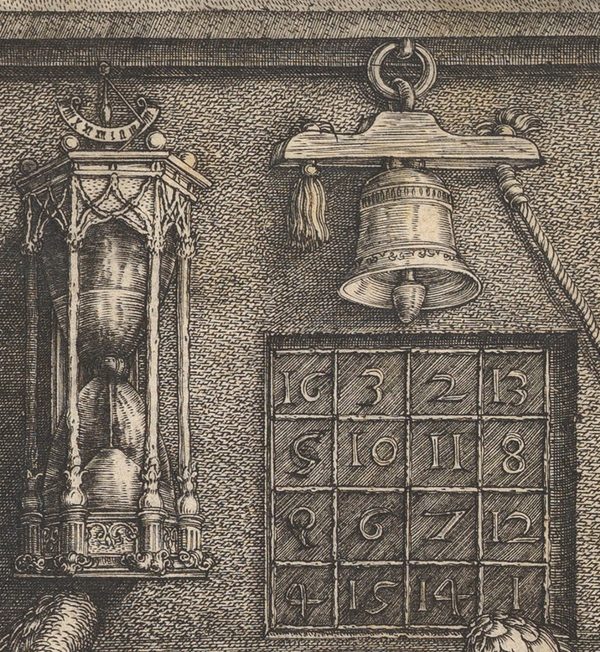
Three different 3 × 3 grids meet in this history, and most confusion about the Psychomatrix comes from mixing them up. The Lo Shu is a magic square: its numbers are fixed and every line adds up to 15. The Western birth chart of Templeton and Phillips counts a birth date's digits into a grid drawn 3 6 9 / 2 5 8 / 1 4 7, the Russian square turned upside down, and reads a line only when all three cells are full or all three empty. The Psychomatrix counts the date's digits and the digits of four working numbers into the layout 1 4 7 / 2 5 8 / 3 6 9 and reads every cell and line by its count. Only the last two have anything to do with a birth date, and none has anything to do with Pythagoras.
How the square reached Russia is unknown. T-J says its origin cannot be established. The Russian State Library holds nothing on it before Alexandrov's first book, and searches for a Soviet or samizdat source have found nothing; whether it descends from Templeton's grid or arose on its own is open. What is clear is that Alexandrov made it a system. In a run of books from 1999 he named the square Psychomatrix, fixed the names of its cells, added the eight lines, wrote readings for every count and taught that digits can move between cells. His school calls the whole "digital psychoanalysis", and his wife Alla Aleksandrova carries it on; its site today also sells courses that have nothing to do with our chart.
The nine cells and the eight lines
Each cell and each line has its own page: what the school reads in it, our own reading of each count or band, how often each count falls to a birth date in the twentieth century and in the twenty-first, and the claims made about it.
The nine cells · one for each digit
The eight lines · three rows, three columns, two diagonals
The counts are far from even. Every date from 1900 to 1999 has at least one 1 and at least one 9, because every such year begins with 19; cells 4 to 8 are empty in about four dates in ten. From 2000 the picture changes: every date then has a 2, about 7 in 100 have no 1, and 44 in 100 have no 9. The cell pages give the full spread for both centuries.
Variants and what we leave out
The practitioners disagree on several points. We describe them so that a different square from another calculator can be recognised, and say which we follow.
- Births from 2000. Some add 19 to the first number to make the third; some subtract 2 for births before 2000; some bring in 13 or the parents' squares. Alexandrov's own provision, as his followers summarise it, is a rule about reading the lines, and the school's own page states no rule. We use the classic formula and offer "+19" as a labelled option. The "+19 after, −2 before" constants come from Natalia Sidorova's separate forecasting method, which is the likeliest source of the convention.
- The layout. Most tools draw 1 4 7 across the top, a few 1 2 3. The cells and lines are the same either way.
- The leading zero and the fourth number. One open-source calculator counts the zero of a day such as 05, and some sites reduce the fourth number to one digit (29 to 2 instead of 11). The standard rule and the published worked examples do neither, and neither do we.
- Transitions. The school teaches that a surplus in one cell can move to another, and that a weak cell can be strengthened by effort. That is its doctrine; we compute nothing of it.
- Compatibility. Two forms are documented. Alexandrov matches partners' diagonals, temperament against spirituality, and compares spouses' squares with their parents'; Russian practitioners compare the eight lines and call a difference of 0 or 1 good. Scores, summed squares and rules by sex are the sites' own, and some go as far as reading relationship outcomes from a mismatch, which we do not repeat. One site frames the comparison as a neutral conversation about difference. We compute no comparison.
- Supplementary numbers. numeroscop.ru adds further numbers and readings for the "+19" square; recorded, not used.
- The Western birth chart. Templeton's and Phillips's grid of the date digits alone, with its arrows. A "date digits only" view may come later.
- The Lo Shu grid. The birth-date grid of Indian and Chinese numerology on the magic-square layout: a different method, not mixed in.
- The rest of Alexandrov's system. Name analysis, numerological forecasts, "health schemes" and the specialists' calculators for a couple's crisis periods are not computed, and the school's health courses have nothing to do with us.
Myths and disputed claims
What is said about the Psychomatrix, who says it, and what the record shows. The label is ours.
-
Pythagoras or the Pythagoreans devised the square.
falseWho says it: The method's own Russian name; the press, every calculator and the file our old page writer used.
What the record shows: Pythagoras wrote nothing, and none of the twenty or so early references to him mention a square of birth-date digits. The Russian press itself says nothing connects him to it. The name is a tribute, kept here only as the traditional name.
-
Pythagoras learnt the square from the priests of Egypt, and the spirit of that old practice lives on in it.
told as loreWho says it: Calculator sites and Russian popular histories.
What the record shows: The Egyptian studies of Pythagoras belong to the legend that grew up around him centuries later, and no Egyptian or Greek source has a digit square. Told as the tradition's origin story.
-
Alexandrov was a physicist who confirmed the matrix through twenty years of research on huge numbers of birth dates.
unverifiedWho says it: The file our old page writer used; some sites; a 2006 teachers' conference already called him a mathematician who had "examined more than 10 thousand people".
What the record shows: His retailer biography makes him a mathematics teacher by training (born 1962 in Nizhny Novgorod, died 2013); his school says he spent about twenty years building the system after meeting numerology in a pamphlet. No physics, no published data and no study.
-
The system is more than thirty years old and most modern numerology schools are built on it.
unverifiedWho says it: His publisher and retailers.
What the record shows: Roughly right for the books: his first is in the Russian State Library from 1999. That most schools build on it is publisher copy.
-
The square came into Russia through samizdat or Soviet magazines and was popular before Alexandrov.
unverifiedWho says it: A common assumption, ours included; no source states it.
What the record shows: Nobody has documented its earlier history. The Russian State Library has nothing on it before Alexandrov's 1999 book, and searches for a Soviet or samizdat origin found nothing. Open.
-
The cell names and the eight lines come from Pythagoras or from antiquity.
falseWho says it: Calculators that print the names without saying whose they are.
What the record shows: The names (character, energy, interest, health, logic, labour, luck, duty, memory) and the eight lines are the Russian tradition as Alexandrov's school fixed it, in print from 1999 on.
-
The "arrows of Pythagoras" of the Western birth chart are Pythagorean, or were rediscovered from him.
falseWho says it: Templeton's and Phillips's later editions, and Western numerology sites.
What the record shows: The grid of date digits with its arrows comes from Hettie Templeton in Sydney, 1940, by her own publisher's account, carried on by David Phillips. The name is a brand.
-
The Psychomatrix is a magic square, or the same thing as the Chinese Lo Shu.
falseWho says it: The file our old page writer used; Lo Shu grid sites.
What the record shows: In a magic square every line makes the same sum (15 in the Lo Shu). The Psychomatrix is a tally of digit counts in the layout 1 4 7 / 2 5 8 / 3 6 9 and sums nothing.
-
The Lo Shu grid reading of a birth date is thousands of years old.
unverifiedWho says it: Indian and Chinese numerology sites.
What the record shows: The Lo Shu square is referred to by about 80 CE; counting a birth date's digits into it has no early source that anyone has found.
-
The method is a science, "digital psychoanalysis", built on evidence.
falseWho says it: Alexandrov's school and publishers (titles and blurbs).
What the record shows: No controlled study of the square exists. The one large test of birth dates against personality found nothing. "Digital psychoanalysis" is the school's brand name.
-
Cell 4 shows a person's health, and the money column how they will fare with money.
unverifiedWho says it: The tradition's cell and line names, in every Russian tool.
What the record shows: "Health" and "money and everyday life" are names, and we keep them as names. Nothing in the square predicts illness, accidents or income.
-
Cell 7 measures a person's luck, and the column 7-8-9 fixes their talent.
unverifiedWho says it: The tradition: Alexandrov's school and the Russian tools.
What the record shows: The tradition's names and readings, given here as what the tradition reads, in our own words.
-
Energy moves between cells by fixed transitions (11 to 8, 22 to 4 and the rest) that obey a law of conservation.
unverifiedWho says it: Alexandrov's school; the file our old page writer used ("thermodynamic laws").
What the record shows: A doctrine of the school about how to read the square, with no test and no physics in it. We compute no transitions.
-
The square truly reveals itself only after the age of 35.
disputedWho says it: Practitioners quoted by T-J.
What the record shows: A rule added when a description does not fit, which makes the method impossible to test. Recorded as the practitioners' claim.
-
People born from 2000 are weaker or poorer in qualities, because their squares hold fewer digits.
falseWho says it: Implied by every reading scheme applied unchanged to dates after 1999.
What the record shows: An artefact of the arithmetic: a year beginning 20 has fewer and smaller digits than one beginning 19. The sparseness belongs to the date, not the person.
-
The "+19" rule for births from 2000 is Alexandrov's own, or the standard one.
falseWho says it: Several Russian calculators; the constants of Natalia Sidorova's separate forecasting method.
What the record shows: Alexandrov's provision for this century, as his followers summarise it, is a rule about reading the lines, not a change to the arithmetic, and numerologists have not agreed. We label "+19" a practitioner convention.
-
Our engine changes the constants of the third working number for births from 2000.
falseWho says it: Our own public page before 10 October 2026.
What the record shows: There was no such code and there is no agreed rule. The engine uses the classic formula for every year and offers "+19" as a labelled option.
-
The leading zero of a day such as 05 is counted, or the fourth working number must be reduced to one digit.
disputedWho says it: One open-source calculator; some pages.
What the record shows: The standard rule skips the leading zero and takes the third number's digit sum once (29 gives 11); the published worked examples and our 55 test dates agree.
-
Two people's squares can be compared for compatibility.
unverifiedWho says it: Alexandrov's relationship books; Russian compatibility calculators.
What the record shows: Documented methods exist: Alexandrov matches partners' diagonals and compares spouses' squares with their parents'; practitioners compare the eight lines. None has been tested. We compute no comparison.
-
A difference of 0 or 1 between two people's counts on a line means good compatibility.
unverifiedWho says it: numeroscop.ru, magya-online.ru and others.
What the record shows: A practitioners' rule of thumb, consistent across sites, not traced to Alexandrov's text.
-
In a couple the man should have the stronger purposefulness and the woman the stronger family line.
unverifiedWho says it: Several web calculators.
What the record shows: Gendered rules of the calculators, in no source traced to Alexandrov. We use no rule by sex.
-
Two squares give a compatibility percentage.
unverifiedWho says it: A few calculator sites.
What the record shows: No published method computes a score; the numbers are made by the sites.
-
Similar squares in a young couple and their parents show a doubling of fate.
unverifiedWho says it: Alexandrov's Big Book of Numerology (2016 printing).
What the record shows: The school's doctrine, with no test. Not computed.
-
The diagonals read a partner's carnal temperament against spirituality, and their ratio decides who suits whom.
unverifiedWho says it: Alexandrov's Big Book of Numerology (2016 printing); compatibility sites.
What the record shows: The founder's scheme for intimacy. We keep the diagonals' names, temperament and spirituality, and read nothing about anyone's sexuality or partners.
-
Two birth dates show a couple's periods of crisis and stability.
unverifiedWho says it: The school's paid calculator for specialists.
What the record shows: A timing forecast for a relationship by an unpublished method. Not computed.
Stories and lore
These are told as their tellers tell them.
The turtle of the Luo river. In the Chinese legend the sage-king Yu, taming the great flood, saw the pattern of the Lo Shu on the shell of a turtle that came out of the river. It is the oldest story attached to a 3 × 3 number square, and it belongs to the Lo Shu, not to the Psychomatrix.
Pythagoras in Memphis. The calculators tell that Pythagoras learnt the numerical nature of the person from the priests of Egypt, and that the spirit of that teaching survives in the square. The Russian press answers that nothing connects him to it.
The pamphlet. In his school's account, Alexandrov, a mathematics teacher from Nizhny Novgorod, came across a short pamphlet on numerology in the 1990s, found it wanting, and spent about twenty years building his own system; after his death in 2013 his wife turned it into a school.
Changing the square. Alexandrov taught that the square is not fixed: digits can move from a full cell to an empty one, and a weak cell can be built up by effort. Lenta calls this the "magic pill" that made the method attractive.
The lost nines. Everyone born from 1900 to 1999 has at least one 9 in the square, because the year begins with 19. Our recount over every date confirms it: no date of the twentieth century leaves cell 9 empty, while 44 in 100 dates from 2000 to 2099 do. A tradition built on twentieth-century squares suddenly met children with no memory cell, and its practitioners have argued ever since about how to patch the date rather than the reading.
The tradition's own tags. The Russian books and sites give some counts proverbial nicknames: praise for skilled hands when two 6s appear, and talk of a sixth sense when the centre or cell 7 is full. We give the ideas in our own words and leave the phrases to their authors.
Evidence and criticism
No test of the square exists. The only large controlled study that bears on birth-date systems, by Hartmann, Reuter and Nyborg in 2006, found no relation between date of birth and personality or intelligence in more than 15,000 people. T-J, the one evidence-minded Russian explainer, reports verification attempts that failed and explains the method's appeal by the Forer effect, people's readiness to accept vague descriptions written "for them", and by rules changed after the fact, such as the square "revealing itself" only after 35.
The arithmetic of the year 2000. The counts fall for everyone born after 1999 because the year's digits are fewer and smaller. The tradition's patches, +19, −2, 13 or the parents' squares, try to keep the old readings rather than to rescale them, and none has a source in Alexandrov's own provision, which concerns the lines.
The scale and the counts. On the thresholds we use, which are the Russian tools', the left column, self-esteem, is in its "overload" band for 79 in 100 dates of the twentieth century, and the falling diagonal for 52 in 100, because the 1s and 9s of a twentieth-century year, with the small digits of the working numbers, collect there. A band that most people fall into says more about the arithmetic than about a person. This is our own count, not a claim any practitioner makes.
Dudley's law of small numbers. The mathematician Underwood Dudley explains numerology's apparent hits by the certainty of coincidences among a handful of values. With nine cells and counts of 0 to 6, every square fits some pattern.
The practitioners disagree. On the year 2000, the layout, the leading zero, the fourth number, the lines' thresholds and the transitions, the Russian tools and the press record the disagreement, and the school's own page sidesteps it.
The name. Scholarship on Pythagoras has nothing to say about a digit square, because no early source mentions one.
Our own test. In October 2026 we checked the engine on 55 dates against the standard rule, eight published worked examples (from Komsomolskaya Pravda, Afisha, numerolog.ru and others) and two web calculators. The arithmetic agreed throughout. Our earlier public page had claimed that the engine adjusted constants for births from 2000; it never did, and the claim was withdrawn.
Copyright and credit. A method is free to use; the words of the books that teach it are not. Alexandrov's books, the school's site and the Russian explainers and calculators are in copyright and are used here for facts only, in our own words; their cell and line readings, which repeat Alexandrov's text, are not translated. The name "psychomatrix" carries no live trade mark that we could find.
Terms
- Psychomatrix
- Психоматрица: Alexandrov's name for the Pythagorean square and his school's reading of it, now the common Russian word for the chart. We use it descriptively, as the name of the method.
- Pythagorean square
- Квадрат Пифагора: the traditional Russian name of the square. It honours Pythagoras; nothing connects him with it.
- Working numbers
- Рабочие числа: the four numbers worked out from the date whose digits join the date's own in the square. The second is sometimes called the number of destiny.
- Pool
- Our word for the digits counted: the date's eight digits and the digits of the four working numbers, with every zero left out.
- Cell
- Ячейка: one of the nine compartments of the square, which holds every copy of one digit. Its count is the number of copies.
- Band
- The reading of a count on the tradition's scale: none, weak, normal, strong but unstable, strong, maximal, overload. A line's bands have their own thresholds.
- Line
- Линия: a row, column or diagonal of the square, read by the total number of digits in its three cells. The eight lines and their names are the Alexandrov school's.
- Traditional names
- Health (cell 4), Luck (cell 7) and Money and everyday life (the column 4-5-6): the tradition's names, which we keep as names.
- "+19" variant
- For births from 2000, some practitioners replace the third working number with the first plus 19. Our label for a practitioner convention, offered as an option; never the method.
- Transitions
- Переходы: the school's doctrine that digits can move from one cell to another (11 to 8, 22 to 4 and the rest). Taught by the school, not computed by us.
- Digital psychoanalysis
- Цифровой психоанализ: the school's brand for Alexandrov's whole system. It is not psychoanalysis, and we do not use it for our chart.
- Lo Shu grid
- A birth-date grid of Indian and Chinese numerology laid out on the Lo Shu magic square (4 9 2 / 3 5 7 / 8 1 6), with the date's digits only. A different method from the Psychomatrix.
- Birth chart (Western)
- The date-digit grid of Hettie Templeton (1940) and David Phillips (1980, 1992), drawn 3 6 9 / 2 5 8 / 1 4 7 with no working numbers, whose full or empty lines are called arrows.