Skip to content

Psychomatrix (Pythagorean square) · Line 2 of 8 · the middle row

The middle row, 2-5-8: family, or the pull toward a home

The middle row of the Psychomatrix is the line that joins cells 2, 5 and 8, Energy, Logic and Duty, and the school reads its total as family: how far a life is organised around a home and a partner. It is the only row that fills more after 2000, because the year brings a 2.

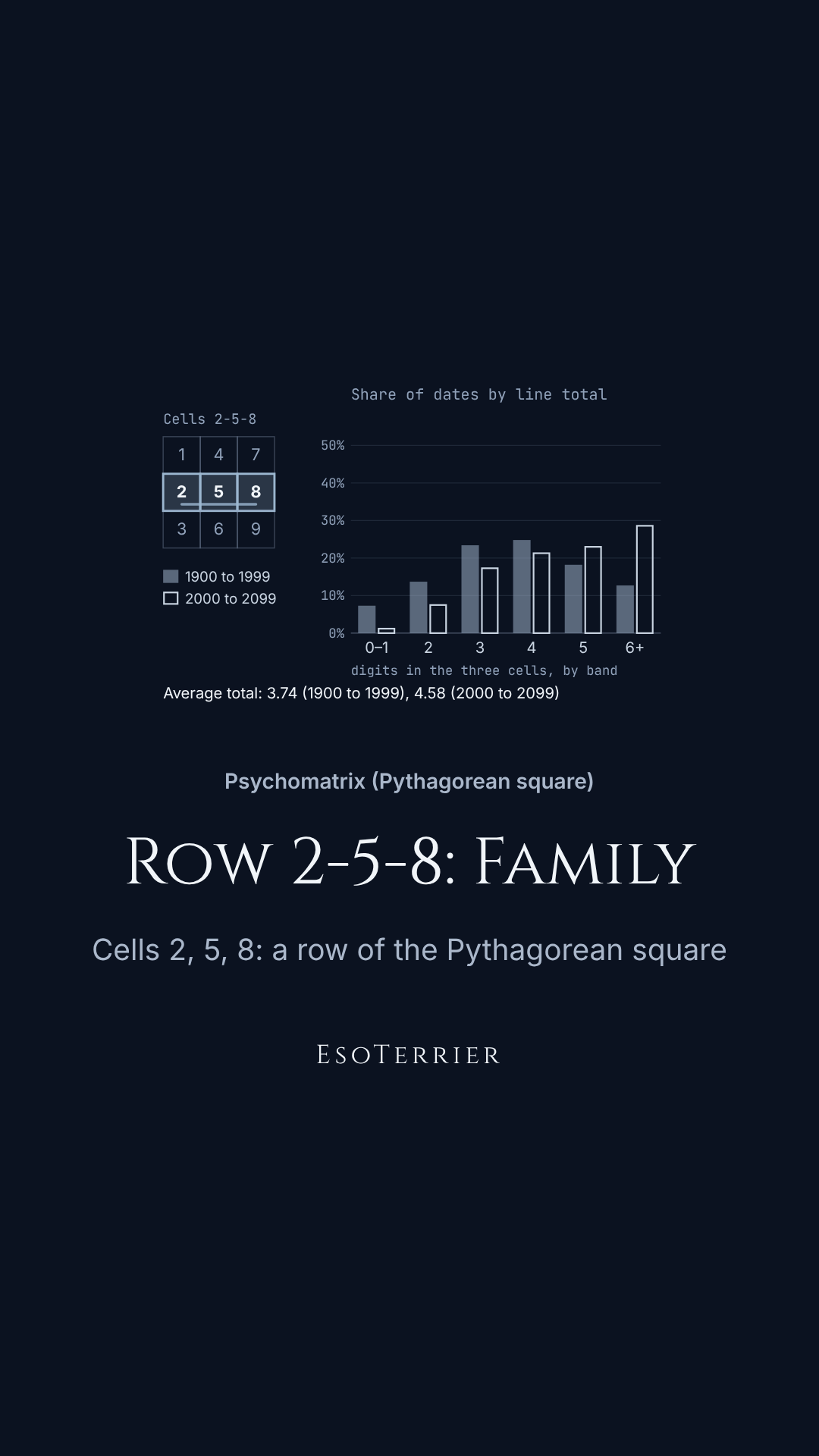
A 3 by 3 square drawn 1 4 7, 2 5 8, 3 6 9, with the middle row, cells 2, 5 and 8, marked and joined by a line. Beside it a bar chart of the share of dates in each band of the row's total: for 1900 to 1999 the total 4 is commonest; for 2000 to 2099 the bars shift right and 28.8 percent of dates reach 6 or more. Cells 2-5-8 1 4 7 2 5 8 3 6 9 1900 to 1999 2000 to 2099 Share of dates by line total 0% 10% 20% 30% 40% 50% 0–1 2 3 4 5 6+ Digits in the three cells, by band Average total: 3.74 (1900 to 1999), 4.58 (2000 to 2099)
The middle row in the square, and the share of dates in each band of its total over the twentieth century (filled) and the twenty-first (outlined): our own count under the classic formula, on the thresholds we use.

Facts

Cells
2, 5, 8: Energy, Logic, Duty
Kind of line
A row, the middle row, as drawn 1 4 7 / 2 5 8 / 3 6 9
The tradition's name
Family (семья)
What is counted
The number of digits in its three cells
Bands on our thresholds
0–1 weak; 2 normal; 3 strong but unstable; 4 strong; 5 maximal; 6+ overload
Average total
3.74 (1900 to 1999); 4.58 (2000 to 2099); at most 9 on any date
In the Western birth chart
Phillips's "arrow of Emotional Balance", read only when all three cells are full or all empty

Meaning

The middle row joins energy, logic and duty, and the school reads its total as family: how much a person's life turns on a home and a partner. Up to one digit is read as family not being the first priority, with work and the world outside coming first; two as family mattering when it is there; three as a strong but flexible pull toward home; four as family at the centre; five as family dominating, with high demands on a partner; and six or more as a standard no one can meet.

In our own words, the row describes where a person tends to put their weight, at home or outside it.

Every band, in our words

The line is read by the number of digits in its three cells, on thresholds of its own. Our reading of each band follows, with the share of dates that fall in it over every day of the twentieth century and of the twenty-first.

  • 0–1, weak. Family is not the first priority; work and the world outside come first. Dates: 7.3 percent of 1900 to 1999, 1.4 percent of 2000 to 2099.
  • 2, normal. Family matters when it is there. Dates: 13.7 percent of 1900 to 1999, 7.7 percent of 2000 to 2099.
  • 3, strong but unstable. A strong but flexible pull toward home. Dates: 23.4 percent of 1900 to 1999, 17.5 percent of 2000 to 2099.
  • 4, strong. Family at the centre. Dates: 24.8 percent of 1900 to 1999, 21.5 percent of 2000 to 2099.
  • 5, maximal. Family dominates, with high demands on a partner. Dates: 18.2 percent of 1900 to 1999, 23.2 percent of 2000 to 2099.
  • 6+, overload. A standard no one can meet. Dates: 12.7 percent of 1900 to 1999, 28.8 percent of 2000 to 2099.

What fills the line

Every date from 2000 to 2099 puts a 2 into the square, so this row, alone of the three, fills more in the twenty-first century: its average rises from 3.74 to 4.58, and the share of dates at six or more from 12.7 to 28.8 percent. On the tradition's scale a whole generation would read as more family-minded than its parents, which shows again that the counts follow the calendar.

What this page leaves out

The school compares two people's lines for compatibility and teaches transitions between cells; we compute neither. Births from 2000 are read on the classic formula, with the "+19" variant as a labelled option.

Correspondences

Each item with how it stands: “sourced” is in the work cited, “our construction” is EsoTerrier’s own, and “disputed” means the sources disagree.

Line name (Alexandrov school)
Family (семья); the English name is ours sourced
Thresholds
0–1 weak; 2 normal; 3 strong but unstable; 4 strong; 5 maximal; 6+ overload: the common Russian scheme; whether they match Alexandrov's own in every band is open disputed
Readings of each band (EsoTerrier)
Written fresh in our own words; the Russian sites' readings repeat Alexandrov's books and are not translated our construction
Arrow in the Western birth chart (Phillips, as summarised)
"Emotional Balance": the same three cells in a grid flipped top to bottom, date digits only sourced

How the schools read it

Alexandrov's school and the Russian tools
Add the digits in cells 2, 5, 8 and read the total on the line's own thresholds; the line is Family.
Afisha and a few others
The same cells, drawn with 1 2 3 across the top, so that this row is drawn as a column.
Practitioners of "+19"
For births from 2000 the digits counted change, and with them the total. A convention, offered by us only as a labelled option.
Templeton and Phillips
The "arrow of Emotional Balance": a strength when all three cells hold date digits, a weakness when all three are empty; no bands.
EsoTerrier
The row describes where a person tends to put their weight, at home or outside it.

Claims about it

  • The family line is Pythagorean.

    false

    What the record shows: Pythagoras wrote nothing and no early source has a digit square. The eight lines are the Alexandrov school's addition to the Russian square, in print from 1999.

  • The square's lines add up like those of a magic square.

    false

    What the record shows: In a magic square, such as the Lo Shu or Dürer's of 1514, every line makes the same sum. Here a line is the number of digits in three cells, and its total varies from date to date.

  • Phillips's "arrow of Emotional Balance" for these cells is an arrow of Pythagoras.

    false

    What the record shows: The grid of date digits with its arrows comes from Hettie Templeton in Sydney, 1940, carried on by David Phillips. Pythagoras is the brand, not the source.

  • In a couple the woman should have the stronger family row.

    unverified

    What the record shows: A gendered rule of web calculators, not traced to Alexandrov. We use no rule by sex.

  • Comparing two people's family rows shows whether a marriage will last.

    unverified

    What the record shows: Compatibility readings of the square have never been tested; personality similarity itself adds little to how satisfied couples are. We compare no squares.
Elsewhere on EsoTerrier

Sources

Primary texts (3)
  1. David A. Phillips, The Complete Book of Numerology. Hay House, 1992 (and 2005); known from a published summary; facts only. shortform.com/summary/the-complete-book-of-numerology-summary-david-a-phillips
  2. Hettie Templeton, Numbers and Their Influence. Sydney, 1940; reissued by Rockpool as Numerology: Numbers and Their Influence. Known from the publisher's description; facts only. simonandschuster.co.uk/books/Numerology/RoseMaree-Templeton/9781921295508
  3. Aleksandr F. Aleksandrov, with a preface by Alla Aleksandrova, Большая книга нумерологии. Цифровой анализ, 2025 edition: the publisher's description and the preface, as the retailer's record gives them. Facts only. litres.com/book/aleksandr-aleksandrov/bolshaya-kniga-numerologii-71501734
Studies and other sources (9)
  1. numeroscop.ru, the pages on the cells, rows, columns and diagonals of the Psychomatrix. numeroscop.ru/kvadrat_pifagora/psikhomatrica
  2. numerolog.ru, "Как рассчитать квадрат Пифагора" and "Расшифровка значений". numerolog.ru/pifagor/kak-rasschitat-kvadrat-pifagora.html
  3. "Numerology and the arrows of Pythagoras", chinesemedicinehistoryandphilosophy.blogspot.com, 2016 (a summary of Phillips's birth chart). chinesemedicinehistoryandphilosophy.blogspot.com/2016/07/numerology-and-arrows-of-pythagoras.html
  4. Afisha Daily, "Квадрат (матрица) Пифагора: что это, как рассчитать по дате рождения и как расшифровать". daily.afisha.ru/poleznye-stati/30489-kvadrat-matrica-pifagora-chto-eto-kak-rasschitat-po-date-rozhdeniya-i-kak-rasshifrovat
  5. yolkki.ru, "Расчёт матрицы Пифагора онлайн" (the "+19 constant" as a calculator states it). yolkki.ru/construction/raschet-matricy-pifagora-onlain-kak-rasschitat-kvadrat-pifagora-po-date
  6. Portia S. Dyrenforth, Deborah A. Kashy, M. Brent Donnellan and Richard E. Lucas, "Predicting relationship and life satisfaction from personality in nationally representative samples from three countries", Journal of Personality and Social Psychology 99 (2010), 690 to 702. doi.org/10.1037/a0020385
  7. inpot.ru, tayniymir.com, chronos.mg and phido.ru: eight-line pair texts with rules by sex. inpot.ru/?p=17468
  8. numeroscop.ru, "Совместимость по квадрату Пифагора" and "Совместимость по темпераменту". numeroscop.ru/sovmestimost/po_psikhomatrice
  9. numpif.blogspot.com (an Alexandrov-method practitioner), "Переходы энергий в психоматрице" (the transitions), September 2007. numpif.blogspot.com/2007/09/blog-post_5047.html
Our own research (3)
  1. EsoTerrier calculation engine, the Psychomatrix service and its documentation.
  2. EsoTerrier, numerology, Psychomatrix and gematria research, 10 to 13 October 2026, with the own-words readings of every cell and line.
  3. EsoTerrier, the count of every cell and line over every date from 1900 to 2099 under the classic formula (October 2026), recounted with separate code for these pages.

Your Psychomatrix reading, $3.99. Includes this system's raw data. Written for you by AI. Read a sample. Charts and the written text are free in every account.

By EsoTerrier. Written with AI assistance from our research and checked against its sources; last revised 20 October 2026. How we write these pages.

First published ; last revised . Corrections: support@esoterrier.com.