Meaning
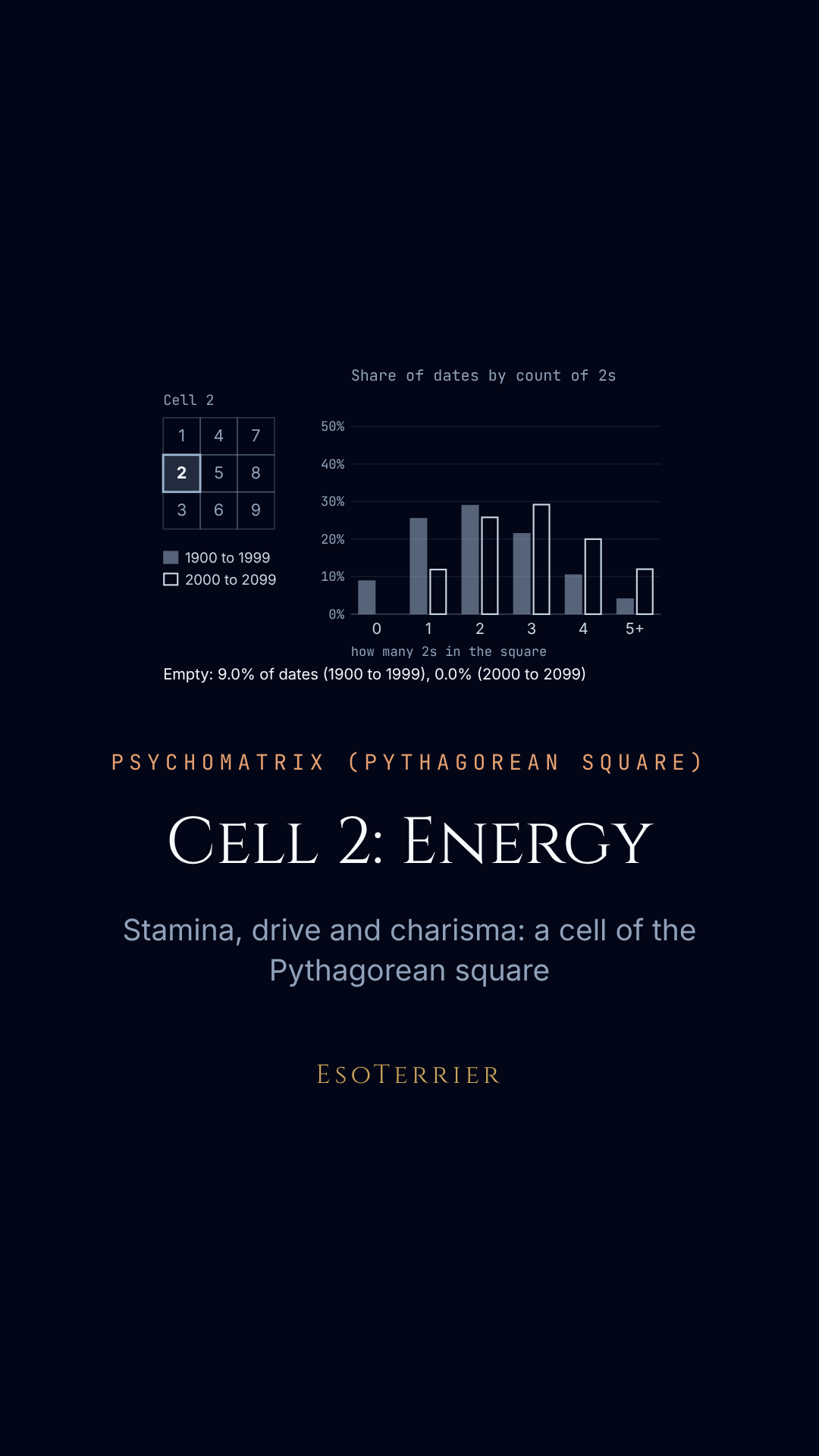
The second cell collects every 2, and the school reads it as energy: the stamina to act, the drive behind it and the charisma it lends. No 2 is read as a small reserve to be paced, one as enough for one thing at a time, two as a full and steady supply, three as strong but uneven, four as more than one person needs, and five or more as energy that runs the show. The school also speaks of people who give energy away and people who take it; that vocabulary is its own, and we do not apply it to anyone.
In our own words, the cell describes how a person spends effort: carefully from a small store, steadily from a full one, or in bursts that need an outlet. An empty cell is a pace, not a deficiency.
Every count, in our words
The tradition's scale for a cell runs from none to overload. Our reading of each count of twos follows, with the share of dates that have it, over every day of the twentieth century and of the twenty-first.
- 0. Little reserve to draw on: energy is spent with care, and pacing matters more than for most. Dates: 9.0 percent of 1900 to 1999, no date of 2000 to 2099.
- 1. Enough for one thing at a time; the person knows the store is small and spends it carefully. Dates: 25.6 percent of 1900 to 1999, 12.1 percent of 2000 to 2099.
- 2. A full, steady supply: enough to act, to carry others a little, and to start fresh each day. Dates: 29.1 percent of 1900 to 1999, 26.0 percent of 2000 to 2099.
- 3. Strong but uneven, with bursts that cannot always be summoned on demand. Dates: 21.6 percent of 1900 to 1999, 29.4 percent of 2000 to 2099.
- 4. More than one person needs, readily shared with others, and wasted if it has no outlet. Dates: 10.6 percent of 1900 to 1999, 20.2 percent of 2000 to 2099.
- 5. Energy that runs the show; stillness is hard, and others may find the pace tiring. Dates: 3.4 percent of 1900 to 1999, 9.5 percent of 2000 to 2099.
- 6 or more. Too much to channel: restlessness, scattered effort and a short fuse. Dates: 0.8 percent of 1900 to 1999, 2.7 percent of 2000 to 2099.
How often the cell fills
The count of 2s is where the turn of the century shows most plainly. A twentieth-century date has a 2 only from its day, its month or its working numbers, so 9.0 percent of dates from 1900 to 1999 have none and the average is 2.12. Every date from 2000 to 2099 has a 2 in its year, the average rises to 2.97, and no date leaves the cell empty; the commonest count moves from two to three.
The squares of this century are sparser overall, yet this one cell is fuller. That is why a reading that treats a sparse square as a lesser person cannot be right: the digits move with the calendar, not with people.
What this page leaves out
Alexandrov's school teaches transitions that touch this cell (22 to 4 and 4 to 22); we record them as the school's doctrine and compute none of them. Nothing here compares two people's squares. Births from 2000 are read on the classic formula, with the "+19" variant as a labelled option.
Correspondences
Each item with how it stands: “sourced” is in the work cited, “our construction” is EsoTerrier’s own, and “disputed” means the sources disagree.
- Cell name (Alexandrov school)
- Energy (энергия); the one-word English name is ours sourced
- What the count is read as
- stamina, drive and charisma sourced
- The bands
- none, weak, normal, strong but unstable, strong, maximal, overload, for 0 to 6 or more: the tradition's scale sourced
- Readings of each count (EsoTerrier)
- Written fresh in our own words; the Russian sites' readings repeat Alexandrov's books and are not translated our construction
- Western birth chart (Phillips, as summarised)
- The same digit in a grid of the date's digits only, drawn 3 6 9 / 2 5 8 / 1 4 7, with no working numbers sourced
- Transitions (Alexandrov school)
- 22 to 4 and 4 to 22: digits said to move between cells; the school's doctrine, not computed sourced
How the schools read it
- Alexandrov's school and the Russian tools
- Count the twos and read the count on the scale from none to overload; the cell is Energy.
- Afisha and a few others
- The same cell, drawn with 1 2 3 across the top instead of 1 4 7.
- Practitioners of "+19"
- For births from 2000, the third working number is the first plus 19, which changes the digits counted. A convention, offered by us only as a labelled option.
- Some calculators (variants)
- A leading zero of the day counted, or the fourth number reduced to one digit; both change the counts of 1s and 2s. Not the standard rule.
- Templeton and Phillips
- The Western birth chart counts only the date's digits and reads a line when its three cells are all full or all empty.
- EsoTerrier
- The cell describes how a person spends effort: carefully from a small store, steadily from a full one, or in bursts that need an outlet. An empty cell is a pace, not a deficiency.
Claims about it
-
The meaning of cell 2 goes back to Pythagoras.
falseWhat the record shows: Pythagoras wrote nothing, and no early source mentions a square of birth-date digits. The cell and its name come from the Russian tradition that Alexandrov's school fixed, in print from 1999.
-
The nine cell names come from antiquity.
falseWhat the record shows: The names character, energy, interest, health, logic, labour, luck, duty and memory are the Russian tradition as Alexandrov's school fixed them; calculators print them without saying whose they are.
-
Comparing two people's 2s shows who gives energy and who drains it.
unverifiedWhat the record shows: The school's vocabulary of energy donors and takers, used by compatibility sites. Nothing tests it; we compare no squares and call nobody either.
-
People born from 2000 are poorer in qualities because their squares hold fewer digits.
falseWhat the record shows: An artefact of the arithmetic: a year beginning 20 has fewer and smaller digits than one beginning 19. The sparseness belongs to the date, not the person.
-
The "+19" rule is Alexandrov's own correction for births from 2000.
falseWhat the record shows: His provision for this century, as his followers summarise it, concerns how the lines are read. "+19" is a practitioner convention, and we offer it only as a labelled option.