Meaning
The bottom row joins interest, labour and memory, and the school reads its total as stability: attachment to habit, routine and fixed ties. Up to one digit is read as a need for change and no routine; two as routine when it is useful; three as a strong but flexible attachment to habit; four as a person of rules and fixed ties; five as a life in which home, work and circle must not move; and six or more as rigidity.
In our own words, the row describes how much a person relies on the familiar. It does not say that anyone will keep or lose a job, a home or a relationship, and neither end of the scale is a fault.
Every band, in our words
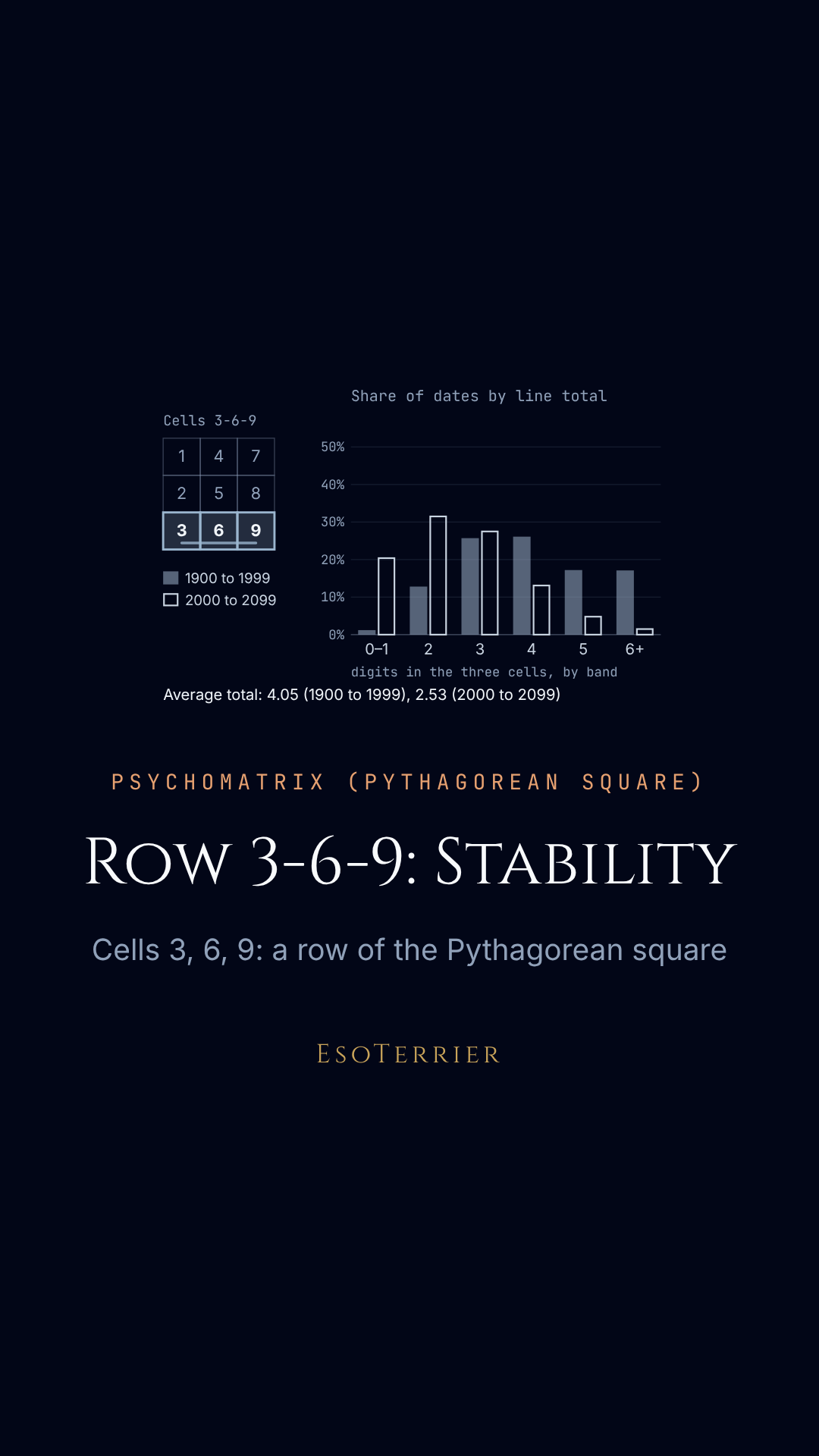
The line is read by the number of digits in its three cells, on thresholds of its own. Our reading of each band follows, with the share of dates that fall in it over every day of the twentieth century and of the twenty-first.
- 0–1, weak. A need for change, and no routine. Dates: 1.2 percent of 1900 to 1999, 20.6 percent of 2000 to 2099.
- 2, normal. Routine when it is useful. Dates: 12.8 percent of 1900 to 1999, 31.7 percent of 2000 to 2099.
- 3, strong but unstable. A strong but flexible attachment to habit. Dates: 25.7 percent of 1900 to 1999, 27.7 percent of 2000 to 2099.
- 4, strong. A person of rules and fixed ties. Dates: 26.1 percent of 1900 to 1999, 13.3 percent of 2000 to 2099.
- 5, maximal. Home, work and circle must not move. Dates: 17.2 percent of 1900 to 1999, 5.0 percent of 2000 to 2099.
- 6+, overload. Rigidity. Dates: 17.1 percent of 1900 to 1999, 1.7 percent of 2000 to 2099.
What fills the line
The 9 of a twentieth-century year falls in this row, so every date from 1900 to 1999 gives it at least one digit and only 1.2 percent of those dates total one or less. From 2000 the year's 9 is gone: the average falls from 4.05 to 2.53 and a fifth of dates, 20.6 percent, total one or less, the band the tradition reads as a need for change. No row shows the arithmetic of the year 2000 more clearly.
What this page leaves out
The school compares two people's lines for compatibility and teaches transitions between cells; we compute neither. Births from 2000 are read on the classic formula, with the "+19" variant as a labelled option.
Correspondences
Each item with how it stands: “sourced” is in the work cited, “our construction” is EsoTerrier’s own, and “disputed” means the sources disagree.
- Line name (Alexandrov school)
- Stability (стабильность); the English name is ours sourced
- Thresholds
- 0–1 weak; 2 normal; 3 strong but unstable; 4 strong; 5 maximal; 6+ overload: the common Russian scheme; whether they match Alexandrov's own in every band is open disputed
- Readings of each band (EsoTerrier)
- Written fresh in our own words; the Russian sites' readings repeat Alexandrov's books and are not translated our construction
- Arrow in the Western birth chart (Phillips, as summarised)
- "Intellect": the same three cells in a grid flipped top to bottom, date digits only sourced
How the schools read it
- Alexandrov's school and the Russian tools
- Add the digits in cells 3, 6, 9 and read the total on the line's own thresholds; the line is Stability.
- Afisha and a few others
- The same cells, drawn with 1 2 3 across the top, so that this row is drawn as a column.
- Practitioners of "+19"
- For births from 2000 the digits counted change, and with them the total. A convention, offered by us only as a labelled option.
- Templeton and Phillips
- The "arrow of Intellect": a strength when all three cells hold date digits, a weakness when all three are empty; no bands.
- EsoTerrier
- The row describes how much a person relies on the familiar. It does not say that anyone will keep or lose a job, a home or a relationship, and neither end of the scale is a fault.
Claims about it
-
The stability line is Pythagorean.
falseWhat the record shows: Pythagoras wrote nothing and no early source has a digit square. The eight lines are the Alexandrov school's addition to the Russian square, in print from 1999.
-
The square's lines add up like those of a magic square.
falseWhat the record shows: In a magic square, such as the Lo Shu or Dürer's of 1514, every line makes the same sum. Here a line is the number of digits in three cells, and its total varies from date to date.
-
Phillips's "arrow of Intellect" for these cells is an arrow of Pythagoras.
falseWhat the record shows: The grid of date digits with its arrows comes from Hettie Templeton in Sydney, 1940, carried on by David Phillips. Pythagoras is the brand, not the source.
-
People born from 2000 are poorer in qualities because their squares hold fewer digits.
falseWhat the record shows: An artefact of the arithmetic: a year beginning 20 has fewer and smaller digits than one beginning 19. The sparseness belongs to the date, not the person.
-
A difference of 0 or 1 between two people's totals on this line means good compatibility.
unverifiedWhat the record shows: A practitioners' rule of thumb across Russian compatibility sites, not traced to Alexandrov's text and never tested. We compare no squares.