Meaning
The seventh cell collects every 7 and carries the name the Russian tradition gives it, Luck (удача). The school reads the count as chance and natural talent: no luck to lean on at an empty cell, so that results come from effort; luck in one field at one 7; a fair wind at two; luck that can be steered at three; strong luck of the kind people call destiny at four; luck taken for granted at five; and at six or more a leaning on chance with little effort.
In our own words, the count describes an attitude: how far a person expects openings to come and how they meet them.
Every count, in our words
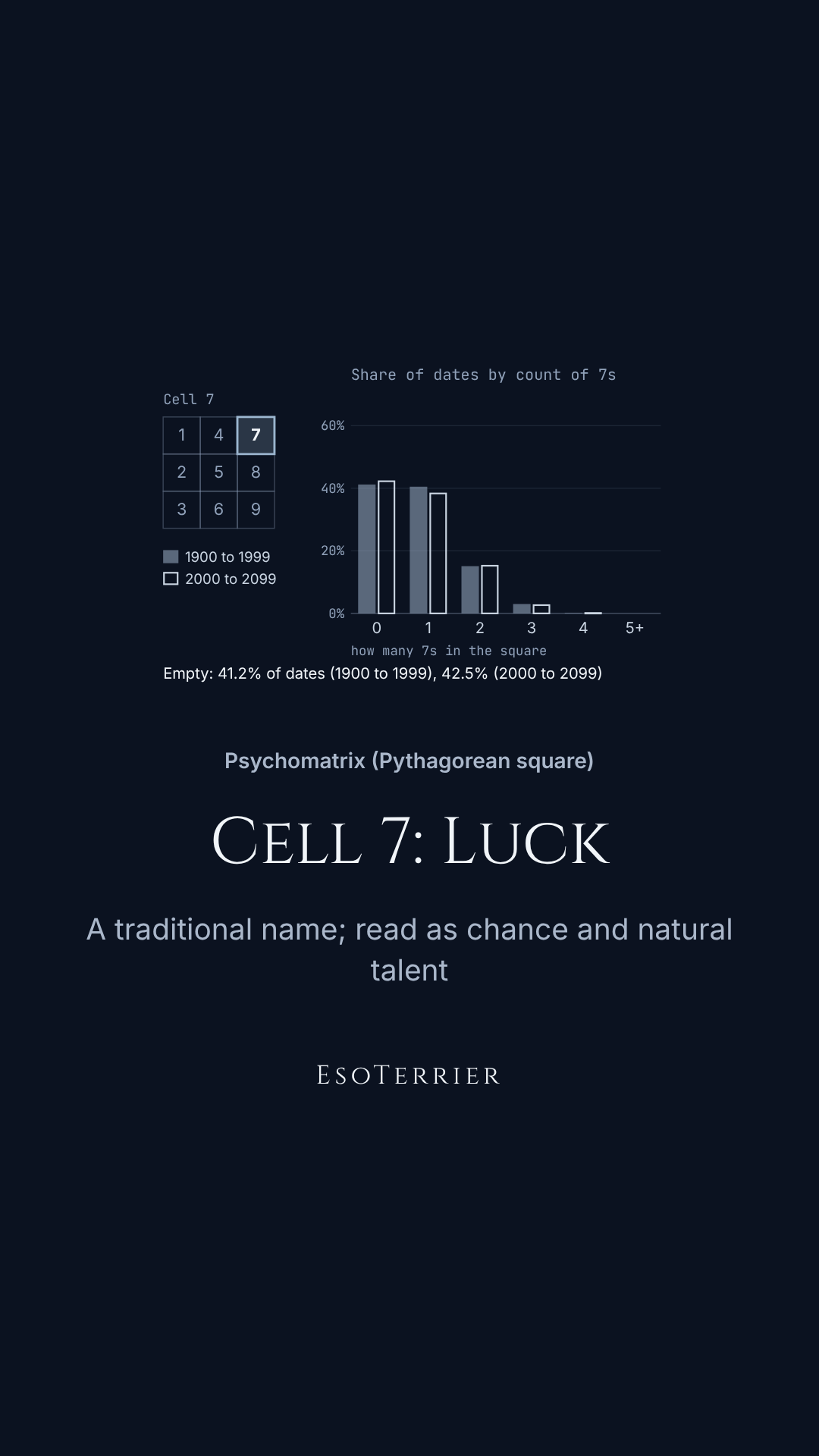
The tradition's scale for a cell runs from none to overload. Our reading of each count of sevens follows, with the share of dates that have it, over every day of the twentieth century and of the twenty-first.
- 0. The tradition reads no luck to lean on: results come from effort, and plans do better without counting on chance. Dates: 41.2 percent of 1900 to 1999, 42.5 percent of 2000 to 2099.
- 1. The tradition reads luck in one field, which the person does well to find and stay close to. Dates: 40.5 percent of 1900 to 1999, 38.6 percent of 2000 to 2099.
- 2. The tradition reads a fair wind: openings come along often enough to notice. Dates: 15.1 percent of 1900 to 1999, 15.5 percent of 2000 to 2099.
- 3. The tradition reads luck that can be steered: openings keep arriving. Dates: 3.0 percent of 1900 to 1999, 2.9 percent of 2000 to 2099.
- 4. The tradition reads strong luck here, of the kind people call destiny. Dates: 0.2 percent of 1900 to 1999, 0.4 percent of 2000 to 2099.
- 5. The tradition reads luck taken for granted, noticed less and wasted more. Dates: under 0.1 percent of 1900 to 1999, under 0.1 percent of 2000 to 2099.
- 6 or more. The tradition reads overload: leaning on chance, with little effort. Dates: no date of 1900 to 1999, no date of 2000 to 2099.
How often the cell fills
Sevens are as scarce as fours, fives and sixes: 0.81 on average for the twentieth century and 0.80 for the twenty-first, with 41.2 and 42.5 percent of dates leaving the cell empty. On the tradition's scale, then, four people in ten have "no luck to lean on", which says more about how rarely a 7 turns up in a date than about anyone's fortunes.
Why the name stays
As with the Health cell, we keep the tradition's name because every source uses it, and we label it each time it appears. The school pairs this cell with cell 6, teaching that 6s and 7s can turn into each other, effort into fortune and back; that is its doctrine, and we compute no transitions.
What this page leaves out
Alexandrov's school teaches transitions that touch this cell (6 to 7 and 7 to 6); we record them as the school's doctrine and compute none of them. Nothing here compares two people's squares. Births from 2000 are read on the classic formula, with the "+19" variant as a labelled option.
Health (cell 4), Luck (cell 7) and Money and everyday life (the column 4-5-6) are the tradition's names, kept as names: nothing in the square is a medical or financial statement or forecast, and nothing on this page is medical or financial advice.
Correspondences
Each item with how it stands: “sourced” is in the work cited, “our construction” is EsoTerrier’s own, and “disputed” means the sources disagree.
- Cell name (Alexandrov school)
- Luck (удача); the one-word English name is ours; kept as the tradition's name sourced
- What the count is read as
- chance and natural talent sourced
- The bands
- none, weak, normal, strong but unstable, strong, maximal, overload, for 0 to 6 or more: the tradition's scale sourced
- Readings of each count (EsoTerrier)
- Written fresh in our own words; the Russian sites' readings repeat Alexandrov's books and are not translated our construction
- Western birth chart (Phillips, as summarised)
- The same digit in a grid of the date's digits only, drawn 3 6 9 / 2 5 8 / 1 4 7, with no working numbers sourced
- Transitions (Alexandrov school)
- 6 to 7 and 7 to 6: digits said to move between cells; the school's doctrine, not computed sourced
How the schools read it
- Alexandrov's school and the Russian tools
- Count the sevens and read the count on the scale from none to overload; the cell is Luck.
- Afisha and a few others
- The same cell, drawn with 1 2 3 across the top instead of 1 4 7.
- Practitioners of "+19"
- For births from 2000, the third working number is the first plus 19, which changes the digits counted. A convention, offered by us only as a labelled option.
- Templeton and Phillips
- The Western birth chart counts only the date's digits and reads a line when its three cells are all full or all empty.
- EsoTerrier
- The count describes an attitude: how far a person expects openings to come and how they meet them.
Claims about it
-
The meaning of cell 7 goes back to Pythagoras.
falseWhat the record shows: Pythagoras wrote nothing, and no early source mentions a square of birth-date digits. The cell and its name come from the Russian tradition that Alexandrov's school fixed, in print from 1999.
-
The nine cell names come from antiquity.
falseWhat the record shows: The names character, energy, interest, health, logic, labour, luck, duty and memory are the Russian tradition as Alexandrov's school fixed them; calculators print them without saying whose they are.
-
The count of 7s measures a person's luck.
unverifiedWhat the record shows: The tradition's name and reading, given here as the tradition's, in our own words.
-
A full cell 7 means that money will come easily.
unverifiedWhat the record shows: Nothing in the square predicts income or fortune.
-
Digits move into and out of cell 7 by fixed transitions (6 to 7 and 7 to 6).
unverifiedWhat the record shows: A doctrine of Alexandrov's school, taught as a way of reading and strengthening the square, with nothing that tests it. We compute no transitions.