Meaning
The first cell collects every 1, and the school reads it as character: how firmly a person asserts themselves and holds a line. Its scale runs from a soft, accommodating nature at one 1, through a balance the school prizes at three, to a leader's will at four and a will that dominates at five; at six or more the school reads a will so overloaded that it circles back to weakness.
In our own words, the cell describes a style of asserting oneself, from yielding to insisting, and the extremes at either end are the costs of that style.
Every count, in our words
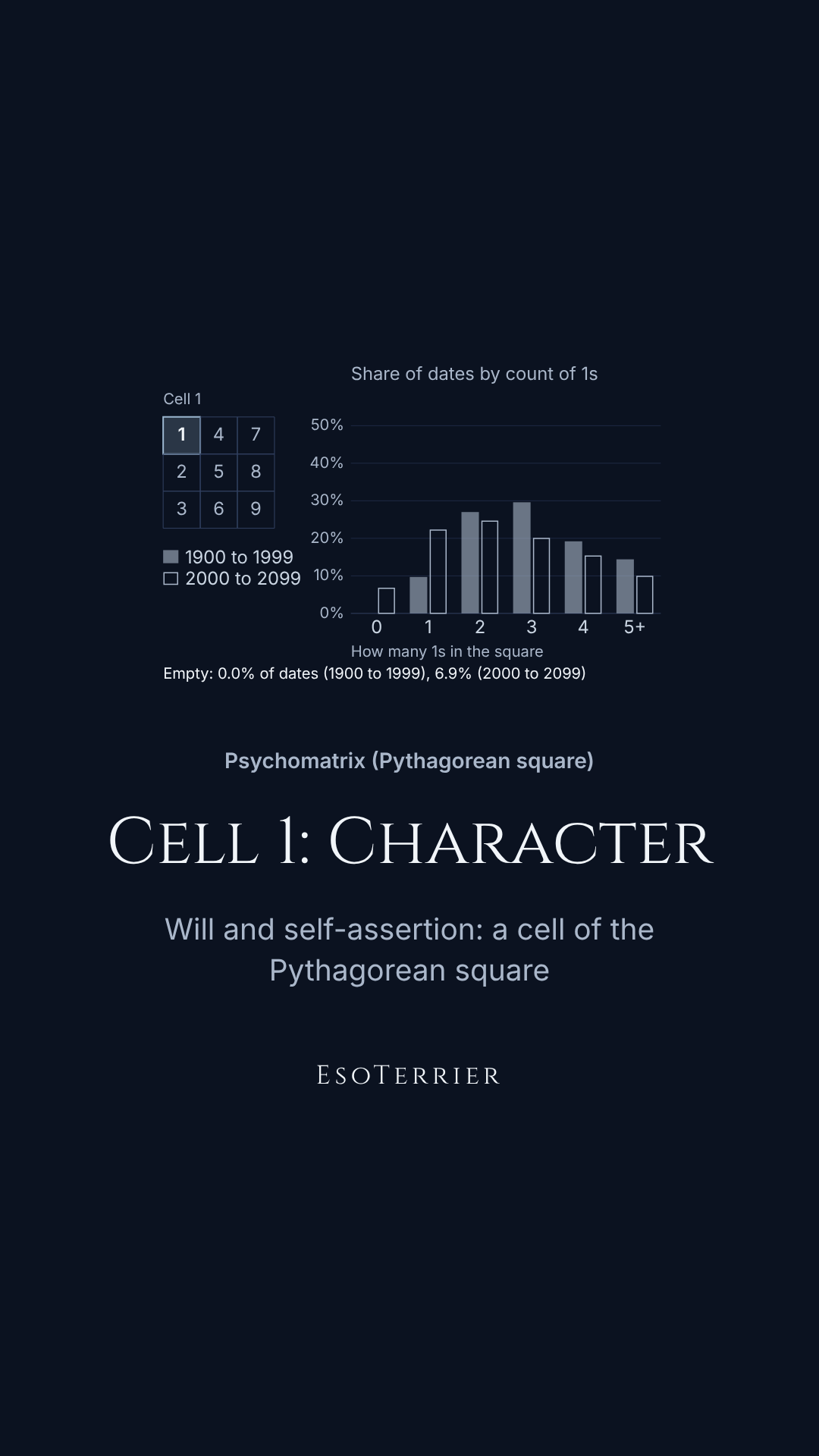
The tradition's scale for a cell runs from none to overload. Our reading of each count of ones follows, with the share of dates that have it, over every day of the twentieth century and of the twenty-first.
- 0. Will is not a native resource here; the tradition reads it as something to build, leaning at first on other people's certainty. Dates: no date of 1900 to 1999, 6.9 percent of 2000 to 2099.
- 1. A soft, accommodating character that doubts itself and prefers not to insist. Dates: 9.7 percent of 1900 to 1999, 22.4 percent of 2000 to 2099.
- 2. Pleasant and well liked, a little low on self-belief, glad of praise and stung by its absence. Dates: 27.0 percent of 1900 to 1999, 24.8 percent of 2000 to 2099.
- 3. The working balance: firm on principle, flexible on everything else, able to adapt without losing shape. Dates: 29.6 percent of 1900 to 1999, 20.2 percent of 2000 to 2099.
- 4. A natural lead, who sets the direction and expects others to follow; friction with equals is the cost. Dates: 19.2 percent of 1900 to 1999, 15.5 percent of 2000 to 2099.
- 5. A will that dominates: certainty is total, relationships become ranks, and compromise feels like defeat. Dates: 9.1 percent of 1900 to 1999, 7.6 percent of 2000 to 2099.
- 6 or more. A will in overload that circles back to weakness: large ambitions, little follow-through, and circumstances blamed. Dates: 5.3 percent of 1900 to 1999, 2.5 percent of 2000 to 2099.
How often the cell fills
No cell fills as easily. Every date from 1900 to 1999 has a 1 in its year, and the working numbers often add more, so the twentieth-century square holds 3.09 ones on average and never none; three is the commonest count. From 2000 the year brings a 2 and a 0 instead, the average falls to 2.48, and 6.9 percent of dates have no 1 at all. On the classic formula the most ones any date from 1900 to 2099 can hold is nine.
The leading zero of a day matters here. The standard rule skips it, so the 5th of a month gives 5 and the 15th gives 1 for the third working number; one open-source calculator counts the zero of a day such as 05 instead, and some sites reduce the fourth working number to one digit, which changes the count of 1s. We follow the standard rule and the published worked examples.
What this page leaves out
Alexandrov's school teaches transitions that touch this cell (11 to 8 and 8 to 11); we record them as the school's doctrine and compute none of them. Nothing here compares two people's squares. Births from 2000 are read on the classic formula, with the "+19" variant as a labelled option.
Correspondences
Each item with how it stands: “sourced” is in the work cited, “our construction” is EsoTerrier’s own, and “disputed” means the sources disagree.
- Cell name (Alexandrov school)
- Character (характер); the one-word English name is ours sourced
- What the count is read as
- will and self-assertion sourced
- The bands
- none, weak, normal, strong but unstable, strong, maximal, overload, for 0 to 6 or more: the tradition's scale sourced
- Readings of each count (EsoTerrier)
- Written fresh in our own words; the Russian sites' readings repeat Alexandrov's books and are not translated our construction
- Western birth chart (Phillips, as summarised)
- The same digit in a grid of the date's digits only, drawn 3 6 9 / 2 5 8 / 1 4 7, with no working numbers sourced
- Transitions (Alexandrov school)
- 11 to 8 and 8 to 11: digits said to move between cells; the school's doctrine, not computed sourced
How the schools read it
- Alexandrov's school and the Russian tools
- Count the ones and read the count on the scale from none to overload; the cell is Character.
- Afisha and a few others
- The same cell, drawn with 1 2 3 across the top instead of 1 4 7.
- Practitioners of "+19"
- For births from 2000, the third working number is the first plus 19, which changes the digits counted. A convention, offered by us only as a labelled option.
- Some calculators (variants)
- A leading zero of the day counted, or the fourth number reduced to one digit; both change the counts of 1s and 2s. Not the standard rule.
- Templeton and Phillips
- The Western birth chart counts only the date's digits and reads a line when its three cells are all full or all empty.
- EsoTerrier
- The cell describes a style of asserting oneself, from yielding to insisting, and the extremes at either end are the costs of that style.
Claims about it
-
The meaning of cell 1 goes back to Pythagoras.
falseWhat the record shows: Pythagoras wrote nothing, and no early source mentions a square of birth-date digits. The cell and its name come from the Russian tradition that Alexandrov's school fixed, in print from 1999.
-
The nine cell names come from antiquity.
falseWhat the record shows: The names character, energy, interest, health, logic, labour, luck, duty and memory are the Russian tradition as Alexandrov's school fixed them; calculators print them without saying whose they are.
-
Alexandrov, a physicist, established what the count of 1s means by twenty years of research on birth dates.
unverifiedWhat the record shows: His biography makes him a mathematics teacher who turned to numerology; his school speaks of twenty years building the system. No data and no study were published.
-
In a couple, the partner with more 1s should lead, and that should be the man.
unverifiedWhat the record shows: A gendered rule of several web calculators, in no source traced to Alexandrov. We use no rule by sex and compare no squares.
-
People born from 2000 are poorer in qualities because their squares hold fewer digits.
falseWhat the record shows: An artefact of the arithmetic: a year beginning 20 has fewer and smaller digits than one beginning 19. The sparseness belongs to the date, not the person.