Meaning
The sixth cell collects every 6, and the school reads it as labour: skill with the hands and the pull toward physical work. An empty cell is read as a person who works with the head, for whom chores need a reason; one 6 as capable hands when inspired; two as a natural gift for craft, cooking, repair or sport, which the Russian sites praise with a proverbial phrase of their own; three as physical drive strong enough to need an outlet; four as a capacity for hard work that finds fatigue satisfying; five or more as work for its own sake.
In our own words, the cell describes where a person's attention goes when they work, to the hands or to the head, and how much pleasure doing gives them.
Every count, in our words
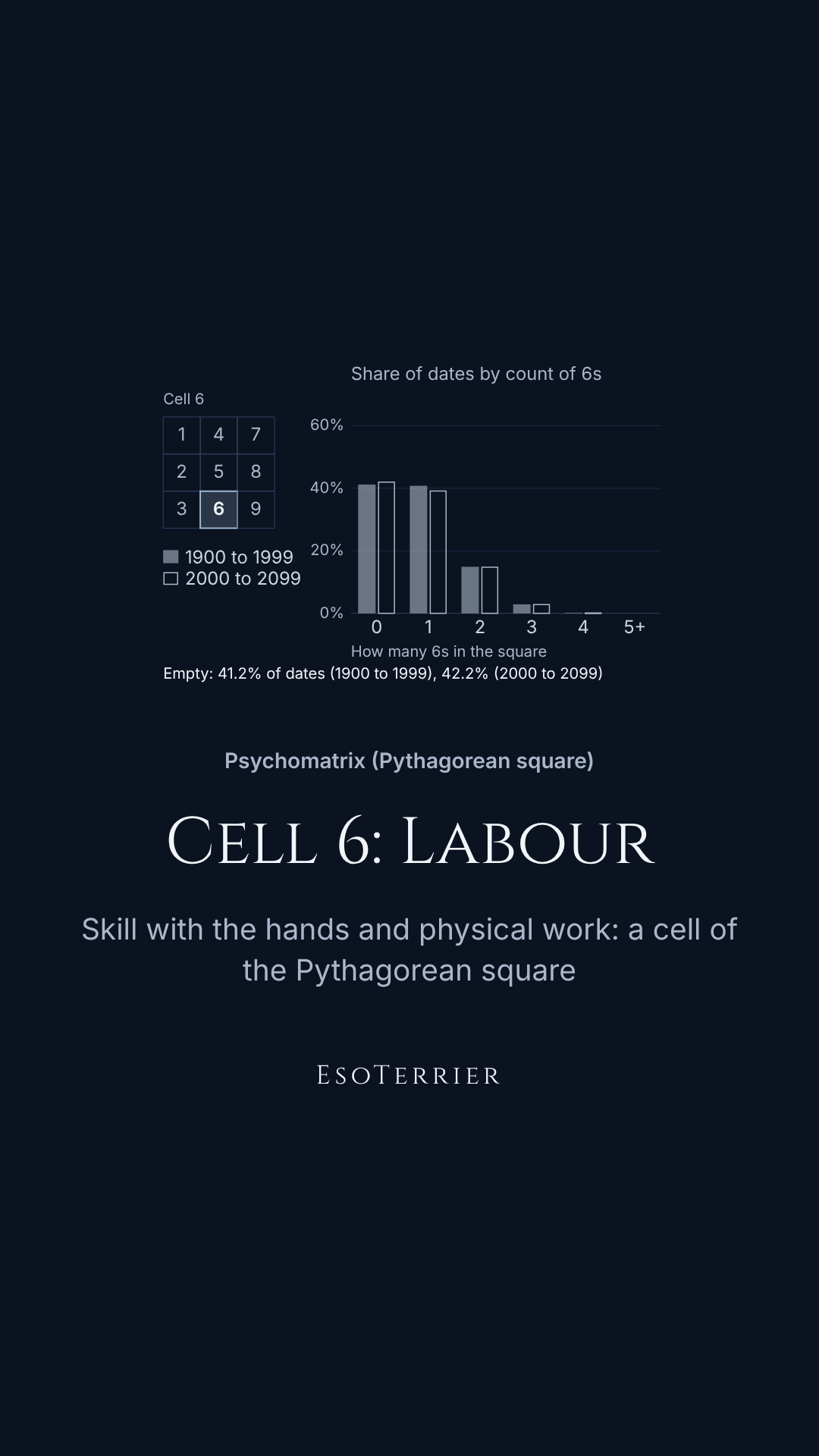
The tradition's scale for a cell runs from none to overload. Our reading of each count of sixes follows, with the share of dates that have it, over every day of the twentieth century and of the twenty-first.
- 0. No pull toward manual work; the head is the tool, and physical tasks need an outside reason. Dates: 41.2 percent of 1900 to 1999, 42.2 percent of 2000 to 2099.
- 1. Capable with the hands when inspired; routine chores grate. Dates: 40.8 percent of 1900 to 1999, 39.4 percent of 2000 to 2099.
- 2. Craft, cooking, repair or sport come naturally and give pleasure. Dates: 14.9 percent of 1900 to 1999, 15.0 percent of 2000 to 2099.
- 3. Physical drive strong enough to need an outlet, which the tradition finds in sport or hard work. Dates: 2.9 percent of 1900 to 1999, 3.1 percent of 2000 to 2099.
- 4. A capacity for hard work that moves mountains; fatigue is a satisfaction. Dates: 0.2 percent of 1900 to 1999, 0.4 percent of 2000 to 2099.
- 5. Work for its own sake, with little room for anything else. Dates: under 0.1 percent of 1900 to 1999, under 0.1 percent of 2000 to 2099.
- 6 or more. Overload: activity that cannot stop. Dates: no date of 1900 to 1999, no date of 2000 to 2099.
How often the cell fills
Sixes are scarce in both centuries: 0.80 on average, with 41.2 percent of twentieth-century dates and 42.2 percent of twenty-first-century dates leaving the cell empty. One 6 is the commonest count, two 6s fall to about 15 dates in 100, and three or more to about 3.
Six and seven
The school pairs this cell with the next: it teaches that a surplus of 6s can turn into a 7 and a 7 back into 6s, so that effort and fortune trade places. That is its doctrine, recorded here as the school's; we compute no transitions, and the count of 6s is read on its own.
What this page leaves out
Alexandrov's school teaches transitions that touch this cell (6 to 7 and 7 to 6); we record them as the school's doctrine and compute none of them. Nothing here compares two people's squares. Births from 2000 are read on the classic formula, with the "+19" variant as a labelled option.
Correspondences
Each item with how it stands: “sourced” is in the work cited, “our construction” is EsoTerrier’s own, and “disputed” means the sources disagree.
- Cell name (Alexandrov school)
- Labour (труд); the one-word English name is ours sourced
- What the count is read as
- skill with the hands and physical work sourced
- The bands
- none, weak, normal, strong but unstable, strong, maximal, overload, for 0 to 6 or more: the tradition's scale sourced
- Readings of each count (EsoTerrier)
- Written fresh in our own words; the Russian sites' readings repeat Alexandrov's books and are not translated our construction
- Western birth chart (Phillips, as summarised)
- The same digit in a grid of the date's digits only, drawn 3 6 9 / 2 5 8 / 1 4 7, with no working numbers sourced
- Transitions (Alexandrov school)
- 6 to 7 and 7 to 6: digits said to move between cells; the school's doctrine, not computed sourced
How the schools read it
- Alexandrov's school and the Russian tools
- Count the sixes and read the count on the scale from none to overload; the cell is Labour.
- Afisha and a few others
- The same cell, drawn with 1 2 3 across the top instead of 1 4 7.
- Practitioners of "+19"
- For births from 2000, the third working number is the first plus 19, which changes the digits counted. A convention, offered by us only as a labelled option.
- Templeton and Phillips
- The Western birth chart counts only the date's digits and reads a line when its three cells are all full or all empty.
- EsoTerrier
- The cell describes where a person's attention goes when they work, to the hands or to the head, and how much pleasure doing gives them.
Claims about it
-
The meaning of cell 6 goes back to Pythagoras.
falseWhat the record shows: Pythagoras wrote nothing, and no early source mentions a square of birth-date digits. The cell and its name come from the Russian tradition that Alexandrov's school fixed, in print from 1999.
-
The nine cell names come from antiquity.
falseWhat the record shows: The names character, energy, interest, health, logic, labour, luck, duty and memory are the Russian tradition as Alexandrov's school fixed them; calculators print them without saying whose they are.
-
Digits move into and out of cell 6 by fixed transitions (6 to 7 and 7 to 6).
unverifiedWhat the record shows: A doctrine of Alexandrov's school, taught as a way of reading and strengthening the square, with nothing that tests it. We compute no transitions.
-
Two 6s guarantee a gift for a trade, and three a violent temper.
falseWhat the record shows: The school's readings describe a temperament, and no study links a birth date to either. We read three 6s as drive that needs an outlet.
-
The "+19" rule is Alexandrov's own correction for births from 2000.
falseWhat the record shows: His provision for this century, as his followers summarise it, concerns how the lines are read. "+19" is a practitioner convention, and we offer it only as a labelled option.