Meaning
The modern school reads the Life Path 7 as the seeker: analysis, solitude, specialism and a search for what lies beneath the surface. Insight, an aptitude for research and an eye for what is false are the gifts it names; isolation, scepticism and emotional distance are the risks. Decoz's 7 is analytical and drawn to the spiritual; Cheiro's people born on the 7th, 16th and 25th are dreamers, independent in their religion. The school's 7 is a temperament, not a gift of second sight.
Agrippa gives seven one of his longest chapters. For the Pythagoreans, he reports, it is the vehicle of a human life, the four of the body joined to the three of the soul, and the number of rest; he gathers the sevens of nature and religion, from the planets to the ages of a life.
In our own words, the 7 looks beneath the surface and is content alone with a question, and its risk is drifting into a cool distance from other people's feelings.
How the number is reached
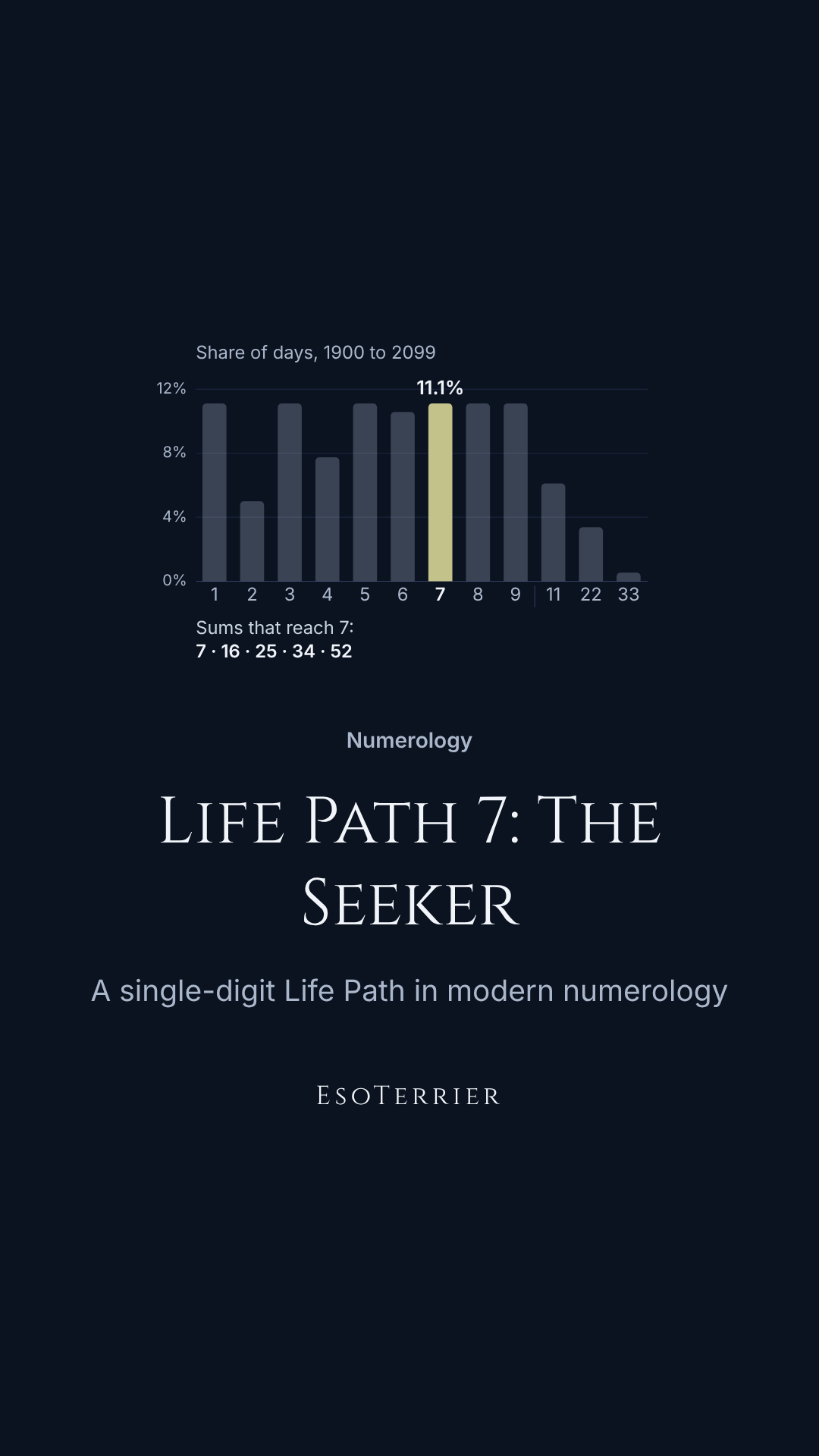
Five sums reach the 7: 7, 16, 25, 34 and 52. A total of 7 comes on dates such as 1 January 1985 (1 + 1 + 5 = 7); 25 often has an 11 in the day, as on 11 September 1985 (9 + 11 + 5 = 25); 52 needs two 22s (22 August 1993: 8 + 22 + 22 = 52). From 1900 to 2099 the 7 falls to 8,117 days in 73,049, 11.11 percent; from 1926 to 2025, to 4,058 in 36,525, also 11.11 percent.
When the total is 16, as on 9 February 1985 (2 + 9 + 5 = 16), the school writes 16/7 and reads the karmic debt 16 as a lesson about pride and about what is built too high. Cheiro's name for the compound 16 is "the Shattered Citadel", a tower struck by lightning. Both are readings of character, and the debt is the school's belief.
The planet line, as history
Agrippa's remainder rule gives the Moon to seven as well as to two, and Heydon and Sepharial kept the double Moon. Cheiro replaced it with Neptune, a planet found in 1846, and his dreamy, intuitive 7 follows from that choice. The Life Path has no planet in any of these books, and we attach none.
What this page leaves out
Cheiro gives each of his numbers favourable days of the week and periods of the year; we leave them out. The school reads a Life Path as a theme of a life.
Correspondences
Each item with how it stands: “sourced” is in the work cited, “our construction” is EsoTerrier’s own, and “disputed” means the sources disagree.
- Strengths (EsoTerrier)
- Deep insight, Research ability, Intuition, Independence of thought our construction
- Challenges (EsoTerrier)
- Isolation, Skepticism, Overthinking, Emotional distance our construction
- Decoz's reading, in our words
- A seeker in Decoz's reading: analytical, drawn to research and to the spiritual, good at solving problems. sourced
- Cheiro (1920s), in our words
- Cheiro's people of the number 7, born on the 7th, 16th or 25th, are independent in religion and dreamers, with a leaning to the mysterious and to intuition. sourced
- Agrippa's number lore (1533)
- Seven is the Pythagoreans' vehicle of human life, joining the body (four) and the soul (three); the number of rest; the seven planets and the seven ages of life. sourced
- Balliett's note and colour (1908)
- The note B; the colour steel, also brick and magenta. sourced
- Colour on modern sites
- A rainbow order (1 red, 2 orange and so on) circulates without a source; Balliett's own colours differ, and we use none disputed
How the schools read it
- Decoz and Goodwin
- The component method: month, day and year reduced apart, then added. Every total listed reduces to 7.
- Jordan (as reported); Millman
- Each part reduced to one digit first, or every digit added in a row: the same final digit on most dates, other compounds.
- Cheiro (1920s)
- No Life Path: he reads the day of birth by its digit and its compound, and the name on his own table, with no masters.
- Agrippa (1533)
- Number lore of the Pythagoreans and the Christian tradition, and a planet for the name's total by the remainder of nine; nothing about birth dates.
- Balliett (1905 to 1908)
- The first to read birth dates and names on the 1 to 9 table; each number has a note and a colour.
- EsoTerrier
- Read here as the person who looks beneath the surface and is content alone with a question, whose risk is distance.
Claims about it
-
The meaning of Life Path 7 goes back to Pythagoras.
falseWhat the record shows: Pythagoras wrote nothing and no early source mentions names or birth dates. The Life Path is twentieth-century American numerology, from Balliett (1905 to 1908) to Decoz.
-
The number 7 is ruled by Neptune, which gives it its nature.
unverifiedWhat the record shows: A European line from Agrippa (1533) through Heydon (1662) and Sepharial (1911) to Cheiro, not an ancient one; Sepharial himself called the planetary numbers unfounded. We attach no planet to a number.
-
A Life Path 16/7 pays for a past life of broken trust.
falseWhat the record shows: The karmic debts are twentieth-century American numerology, absent from the early books and from any ancient source. The school reads 16 as a lesson about pride; a past life is its belief.
-
The compound 16 behind a 7 warns of a coming collapse.
unverifiedWhat the record shows: Cheiro named 16 "the Shattered Citadel" as a warning. We give his name as his.
-
Research has confirmed that the Life Path describes personality.
falseWhat the record shows: The one large controlled study, of more than 15,000 people, found no relation between date of birth and personality or intelligence.
Elsewhere on EsoTerrier
- Life Path 4, the Builder the four of the body in Agrippa's seven
- Life Path 3, the Communicator the three of the soul in Agrippa's seven
- Tarot: the Chariot, VII trump 7 in Greer's birth cards, from a similar digit sum
- Psychomatrix the same birth-date digits, counted in a grid
- Gematria letter values older than Balliett's table