Meaning
The modern school reads the 22 as the 4 of the builder raised to the scale of institutions: the dreamer and the engineer in one person, able to turn a large vision into something that stands, and burdened by the weight of that ambition and by self-doubt. Decoz calls it the master builder, idealistic and visionary. He also calls it the most powerful of the Life Paths; we do not rank numbers, and give how often it occurs instead.
Agrippa's twenty-two is a number of wisdom, for the twenty-two letters of the Hebrew alphabet and the twenty-two books of the Old Testament as he counts them; the modern school did not have that in mind, but it is the number's oldest meaning in print. Cheiro's Chaldean 22 is a warning compound, "a Good Man blinded by the folly of others".
In our own words, the 22 is the person who can see a large plan and also how to build it, and whose risk is the pressure of their own expectations.
How the number is reached
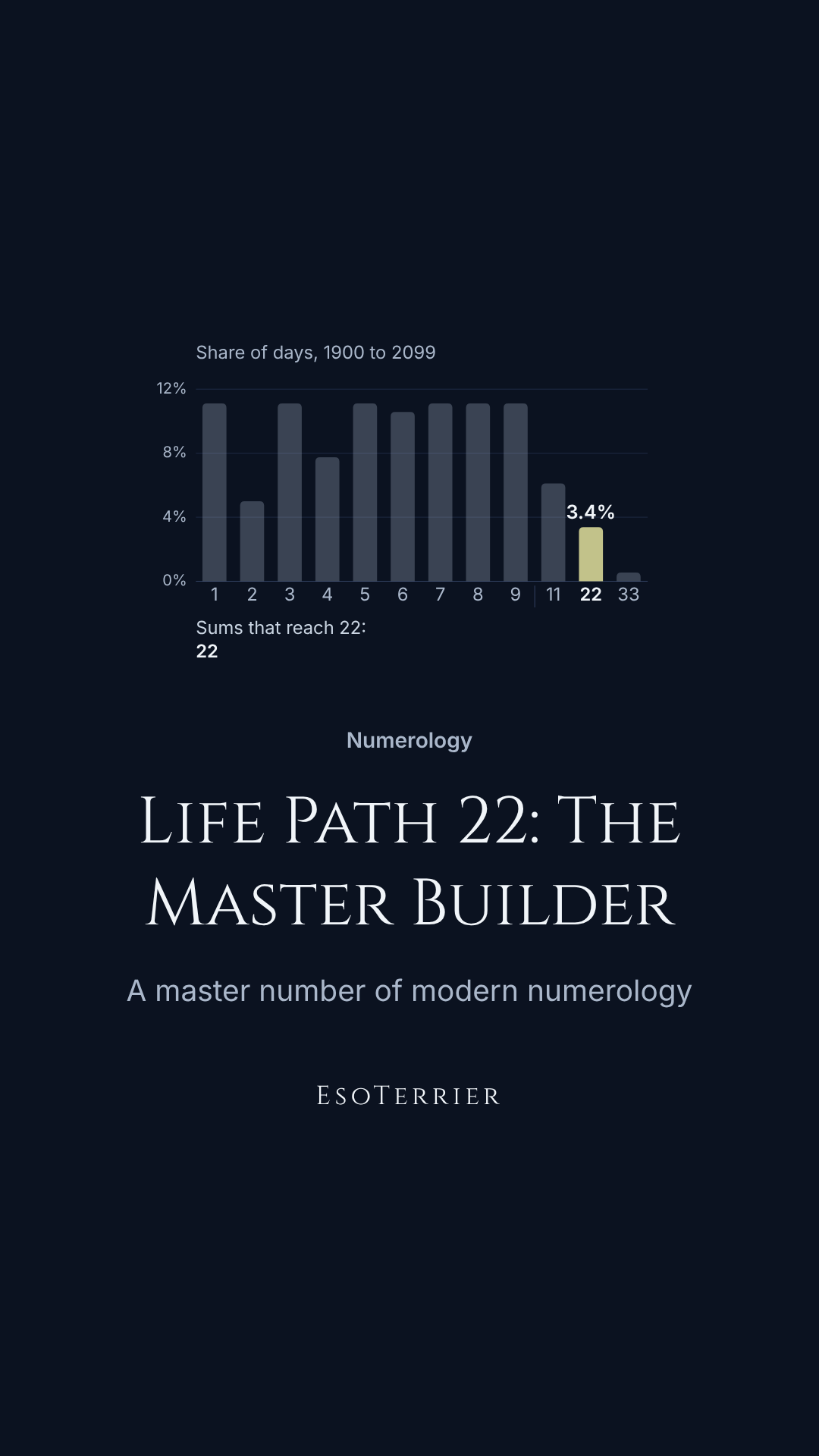
Under the component method only the exact total 22 reaches the 22: there is no larger sum that reduces to it and stops. Born on 11 June 1985, a person adds 6 + 11 + 5 = 22; born on 8 November 1983, 11 + 8 + 3 = 22. From 1900 to 2099 that happens on 2,463 days in 73,049 (3.37 percent), and from 1926 to 2025 on 1,133 in 36,525 (3.1 percent).
The rule decides the result. Adding every digit of 8 November 1983 in a row gives 31 and then 4; reducing November to 2 before adding gives 13 and then 4; some calculators keep the master only in the final sum and so find fewer 22s. All of them are in use. We follow Decoz, who keeps 11 and 22 already in the month and the day.
Where master numbers come from
Balliett kept 11 and 22 whole from her first books, calling them, with 8 and 9, "free numbers" in 1908; the 1917 printing of her first book says that 11 and 22 "are never added". Taylor's Numerology Made Plain (1926) still has only these two. The 33 came later. Nothing before 1905 knows a master number.
The planet line, as history
Divided by nine, 22 leaves 4, which Agrippa's remainder rule gives to the Sun; Heydon and Sepharial kept the double Sun, and Cheiro gave 4 to Uranus instead. On his Chaldean table 22 is only his warning compound. None of these sources knows a master number, and we attach no planet to the 22.
What this page leaves out
Cheiro gives each of his numbers favourable days of the week and periods of the year; we leave them out. The school reads a Life Path as a theme of a life.
Correspondences
Each item with how it stands: “sourced” is in the work cited, “our construction” is EsoTerrier’s own, and “disputed” means the sources disagree.
- Strengths (EsoTerrier)
- Turning big ideas into reality, Disciplined execution, Broad influence our construction
- Challenges (EsoTerrier)
- Pressure of high expectations, Self-doubt, Overextension our construction
- Decoz's reading, in our words
- The master builder in Decoz's reading: idealistic and visionary, able to carry out large plans. sourced
- Cheiro (1920s), in our words
- On Cheiro's Chaldean table 22 is not a master but a warning compound: "a Good Man blinded by the folly of others". sourced
- Agrippa's number lore (1533)
- Twenty-two signifies the fullness of wisdom: twenty-two are the letters of the Hebrew alphabet and twenty-two the books of the Old Testament. sourced
- Balliett's note and colour (1908)
- The octave of D; the colour cream. One of her "free numbers" of 1908. sourced
- Colour on modern sites
- A rainbow order (1 red, 2 orange and so on) circulates without a source; Balliett's own colours differ, and we use none disputed
How the schools read it
- Decoz and Goodwin
- The component method: month, day and year reduced apart, then added. The total is kept as a master number.
- Jordan (as reported); Millman
- Each part reduced to one digit first, or every digit added in a row: the same final digit on most dates, other compounds, and fewer masters.
- Cheiro (1920s)
- No Life Path: he reads the day of birth by its digit and its compound, and the name on his own table, with no masters.
- Agrippa (1533)
- Number lore of the Pythagoreans and the Christian tradition, and a planet for the name's total by the remainder of nine; nothing about birth dates.
- Balliett (1905 to 1908)
- The first to read birth dates and names on the 1 to 9 table; each number has a note and a colour, and 11 and 22 are kept whole.
- EsoTerrier
- Read here as the dreamer and the engineer in one person, whose risk is the weight of the ambition.
Claims about it
-
The meaning of Life Path 22 goes back to Pythagoras.
falseWhat the record shows: Pythagoras wrote nothing and no early source mentions names or birth dates. The Life Path is twentieth-century American numerology, from Balliett (1905 to 1908) to Decoz.
-
Life Path 22 outranks every other number in power.
unverifiedWhat the record shows: Decoz's ranking and that of most sites. We do not rank; the 22 falls on 3.4 percent of days from 1900 to 2099.
-
The 22 has been a master number since antiquity.
falseWhat the record shows: Balliett first kept 22 whole in 1905 to 1908. Agrippa's older lore of 22 is about the Hebrew letters, not a master number.
-
On the Chaldean table, as Cheiro invented it, 22 is a master number.
disputedWhat the record shows: Cheiro's table follows Sepharial's 1911 values for 23 of 26 letters, and it keeps no master numbers: 22 is a compound with a warning name.
-
The Life Path is found by adding all the digits of the birth date in a row.
disputedWhat the record shows: A variant, not an error. It agrees with the component method on the final digit almost always and differs on the compound and on dates with a master in a part.