Meaning
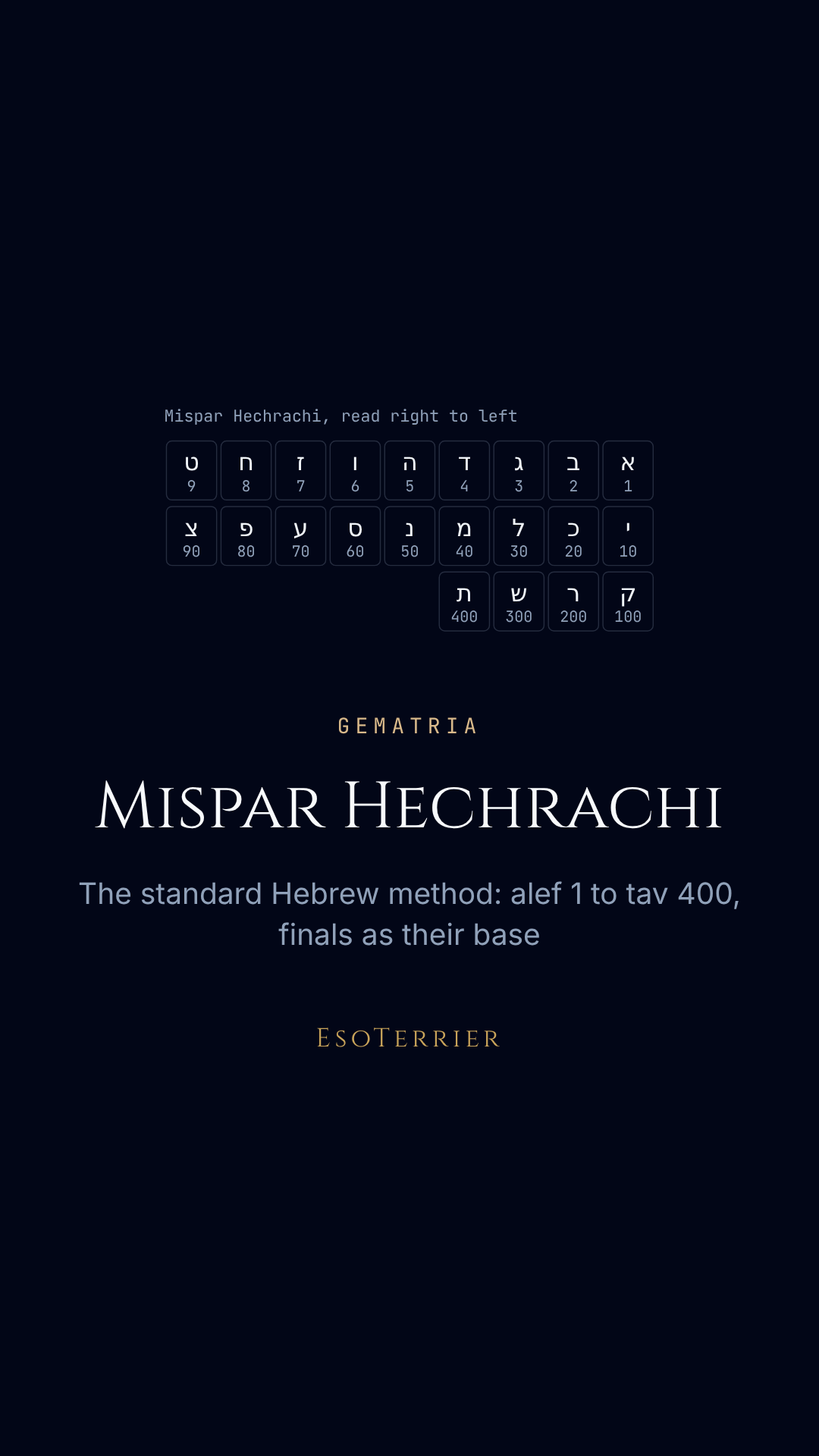
Mispar Hechrachi, "the absolute number", is the value of a Hebrew word in the ordinary sense: each letter counts as the numeral it was. Alef to tet are 1 to 9, yod to tsadi 10 to 90, qof to tav 100 to 400, and the five final forms count as their ordinary letters. The Hebrew letter numerals were modelled on the Greek in the last two centuries BCE; the earliest dated coins with them belong to that period.
Gematria is named in the Mishnah in the 2nd century CE, where Rabbi Eleazar Hisma calls it, with the reckoning of the equinoxes, a side dish of wisdom, and it is listed among the thirty-two rules for interpreting scripture attributed to Rabbi Eliezer ben Jose the Galilean. The classic example is Genesis 14:14: Abraham armed 318 servants, and אליעזר, Eliezer, the name of his one servant, makes 318. The Talmud uses such readings as an asmakhta, a support for a teaching already held; it plays on יין, wine, and סוד, secret, both 70. Medieval writers, above all the Hasidei Ashkenaz, used gematria far more, and in the Kabbalah it became one of the main tools of interpretation, while Ibn Ezra and Nahmanides limited what it could establish.
How it is counted
שלום, shalom, "peace": ש 300 + ל 30 + ו 6 + ם 40 = 376; reduced to 16, then to 7.
אמת, emet, "truth": א 1 + מ 40 + ת 400 = 441; reduced to 9.
אליעזר, Eliezer, Abraham's servant: א 1 + ל 30 + י 10 + ע 70 + ז 7 + ר 200 = 318; reduced to 12, then to 3. The chart takes text written in Hebrew script only; an English name has no Hebrew value until it is written as Hebrew speakers write it.
The number of the beast
Revelation 13:18 gives the number of the beast as 666, and some early manuscripts as 616. Since the 1830s critical scholars have usually read it as Nero Caesar written in Hebrew letters: נרון קסר makes 666, and the Latin spelling without the final nun, נרו קסר, makes 616. That is the usual scholarly reading, and it remains a reading. Irenaeus, writing about 180 CE, knew of no Nero solution; and the Greek word for "beast" written in Hebrew letters, תריון, also gives 666, and 616 without its nun.
Correspondences
Each item with how it stands: “sourced” is in the work cited, “our construction” is EsoTerrier’s own, and “disputed” means the sources disagree.
- The rabbis' view
- A support for a teaching (asmakhta), not its proof sourced
- Classic pairs
- Love and one 13; wine and secret 70; light and secret 207 sourced
- Nero Caesar
- נרון קסר 666 and נרו קסר 616: the usual reading of the number of the beast, not a proof disputed
- Counterparts
- Greek isopsephy and the Arabic abjad follow the same order and values up to 400 sourced
How the schools read it
- The Mishnah and the Talmud
- Name gematria and use it as a support, the 318 of Abraham read as Eliezer.
- Medieval commentators
- The Hasidei Ashkenaz use it widely; Ibn Ezra and Nahmanides limit what it can prove.
- Kabbalah
- One of the main tools of interpretation from the Middle Ages.
- Agrippa (1533)
- Prints the table for Christian readers of learned magic.
- EsoTerrier
- The default Hebrew method, for text written in Hebrew; never applied to a transliterated name.
Claims about it
-
Hebrew letters had number values in the time of Moses, so the Torah was written with gematria in mind.
falseWhat the record shows: The letter numerals appear between about 200 and 78 BCE, modelled on the Greek; gematria enters rabbinic teaching in the 2nd century CE.
-
The Kabbalists were the first to use gematria widely.
disputedWhat the record shows: The rabbis of the 2nd century come first; the Kabbalah expanded the practice greatly.
-
666 is proven to be Nero Caesar.
disputedWhat the record shows: Nero Caesar in Hebrew letters gives 666, and the Latin spelling 616: the usual scholarly reading since the 1830s. Irenaeus, about 180 CE, did not know it, and the Greek word for "beast" in Hebrew letters gives both numbers too.
-
An English name written letter for letter in Hebrew has a Hebrew value.
falseWhat the record shows: A mechanical swap gives spellings no speaker writes. A value needs the name as Hebrew speakers spell it.
-
Two Hebrew words with the same value are thereby linked.
falseWhat the record shows: The rabbis read such pairs together to support a teaching, and said explicitly that a gematria proves nothing on its own.