How it works
The chart joins two published systems, and the join is ours. One gives a person two tarot cards from the birth date; the other gives each tarot trump a path on the Tree. No published source puts the two together, Greer's books included, so every page here says that the combination is EsoTerrier's own.
The birth cards. Mary K. Greer's rule, which she learned from Angeles Arrien in 1977 and published with her permission in Tarot for Your Self (1984): add the month, the day and the four-digit year as whole numbers, then add the digits of the total while it is greater than 22. The result is the personality card, with 22 standing for the Fool; its digits added once more give the soul card. When the date reduces straight to a number from 1 to 9, one card plays both roles. A total of 19 goes on to 10 and then 1, and the 10 is what Greer later called the hidden factor, which our Tarot chart shows and this tree leaves out. For the sample person in Figure 1, born on 19 January 1989: 1 + 19 + 1989 = 2009, and 2 + 0 + 0 + 9 = 11, Justice; then 1 + 1 = 2, the High Priestess. That is all the arithmetic there is: a sum and a lookup, with no frequencies and no geography.
The paths. Each card goes on the path the Hermetic Order of the Golden Dawn gave its trump, with the trumps numbered as on Pamela Colman Smith's 1909 deck: Strength VIII on Teth, path 19, and Justice XI on Lamed, path 22. The Fool is looked up by its trump number, 0; until 11 October 2026 our engine looked it up as 22 against a table that had no 22 and drew an empty tree for about one birth date in twenty. The personality card's path is drawn solid and the soul card's dashed; for 60.6 per cent of birth dates between 1900 and 2030 they are two different paths.
Two optional layers. This year's card adds the month and day of birth to the current calendar year and reduces the total the same way, as Greer does for a year. The Sun card is the trump of the Sun's sign in the tropical zodiac, taken at local noon when no birth time is known and marked uncertain on a day the Sun changes sign. Both stay off until you turn them on.
The tree and its tables. The tree is Kircher's arrangement as the Golden Dawn used it: ten sephiroth in three pillars, the Pillar of Mercy on the viewer's right, the Pillar of Severity on the left and the Middle Pillar between, and the 22 paths numbered 11 to 32 after the ten sephiroth, with the letters in alphabetical order down the tree. There is no Da'at. Every sphere and path carries its tables, compiled from public-domain sources and checked field by field: Agrippa's English of 1651, Mathers (1887), Westcott's Sepher Yetzirah and Thirty-Two Paths (1887 and 1893), Kircher's engraving and 777 (1909). Divine names are given in Latin letters only, and only on the sphere's own page. The keyword lines and the readings are our own words; where a Golden Dawn attribution has a rival, the page for that path or sphere says so.
What a reading is, and is not. A path is the tradition's picture, read in plain words: what the letter, the trump and the attribution suggest together.
How we checked it. On 62 dates the personality card, soul card, chain, year card and hidden factor agree with an independent implementation of Greer's rule; the paths' endpoints, letters, trump numbers and signs agree with Kircher's engraving and 777 on all 22 paths, and with a modern transcription of 777.
Origins and history
A Jewish diagram, a Christian engraving, a French card legend and a London order's tables: the Tree as we draw it was assembled over seven centuries.
| When | Who | What happened |
|---|---|---|
| 2nd to 9th century (debated) | Anonymous, in Hebrew | The Sefer Yetzirah, the "Book of Formation", names thirty-two paths of wisdom: the ten sefirot, here numbers, and the 22 letters, which it sorts into three mothers, seven doubles and twelve simples. Liebes argues for an early date, Hayman and Wasserstrom for a late one. It describes no diagram. |
| 10th century | Saadia Gaon and others | The first commentaries; the text survives in short, long and Saadia versions. |
| About 1174 | Anonymous, Provence | The Bahir, the first book to treat the sefirot as divine attributes and powers flowing from God. |
| 1280s | Moses de Leon; Joseph Gikatilla, Castile | The Zohar, written on most scholars' view by de Leon, though it presents itself as a second-century teaching; Gikatilla's Gates of Light. |
| 14th century | Kabbalists | The earliest tree drawings (ilanot), which vary from manuscript to manuscript. |
| 1486 to 1517 | Pico della Mirandola, Johann Reuchlin | Christian Kabbalah: the sefirot and the letters enter Latin learning, read as witnesses to Christian doctrine. |
| 1516 | Paulus Ricius, Augsburg | Portae Lucis, his Latin translation of Gikatilla, prints the first image of the sefirot: a man holding a tree of ten circles joined by 17 lines, with no letters. |
| 1533; English 1651 | Heinrich Cornelius Agrippa | Three Books of Occult Philosophy: the "Scale of the Number Ten" gives each sefirah a divine name, an order of angels, an archangel and a planetary sphere, the table every later Hermetic table descends from. |
| 1548 to 1572 | Moses Cordovero; Isaac Luria and Chaim Vital, Safed | The Safed systems. Vital records Luria's teaching as Etz Chaim, "Tree of Life"; Cordovero counts Keter among the ten, Luria's school counts Da'at instead. |
| 1642 | Johann Stephan Rittangelius | A Latin Sefer Yetzirah printed with a short separate text, the Thirty-Two Paths of Wisdom, which calls each path an "Intelligence". |
| 1652 to 1654 | Athanasius Kircher, Rome | Oedipus Aegyptiacus: the engraved tree the Hermetic tradition still draws, ten circles in three columns and 22 channels with the letters in alphabetical order, from Aleph at the top to Tav at the foot. |
| 1677 to 1684 | Christian Knorr von Rosenroth | Kabbala denudata, the Latin translations through which Christian Europe read Kabbalah; Mathers translates part of it in 1887. |
| 18th century | Elijah of Vilna, the Gra | A version of the Sefer Yetzirah named after him; the Gra tree puts the mothers on the horizontal paths, the doubles on the verticals and the simples on the diagonals. |
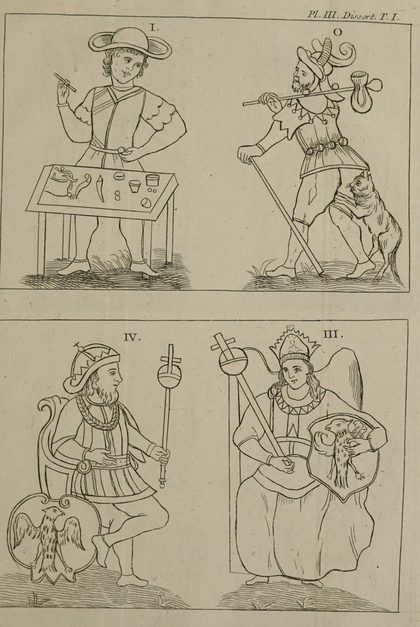
| 1781 | Antoine Court de Gébelin; the Comte de Mellet | Monde primitif, volume VIII, declares the tarot, an Italian card game, an Egyptian book; de Mellet first pairs the 22 trumps with the 22 Hebrew letters. |
| 1854 to 1856 | Éliphas Lévi | Dogme et rituel de la haute magie: the Magician on Aleph, the Fool on Shin, the World on Tav. |
| 1887 | Mathers; Westcott | The Kabbalah Unveiled, and Westcott's English Sepher Yetzirah with the Thirty-Two Paths. Westcott decodes the Cipher Manuscripts, sixty folios on paper watermarked 1809. |
| 1888 | Westcott, Mathers and W. R. Woodman, London | The Hermetic Order of the Golden Dawn founded. Its tables put the Fool on Aleph, Strength on Teth with Leo and Justice on Lamed with Libra, and give every path and sphere its planets, signs and colours. |
| 1904 | Aleister Crowley, Cairo | The Book of the Law, with the verse behind his later swap of the Emperor and the Star. |
| 1909 | Crowley; Pamela Colman Smith and A. E. Waite | 777 prints the Golden Dawn's tables for the first time; Smith's deck numbers Strength VIII and Justice XI. |
| 1933 | Paul Foster Case | His course on tarot divination, the earliest record we found of Uranus on the Fool, Neptune on the Hanged Man and, with a question mark, Pluto on Judgement. |
| 1935 | Dion Fortune | The Mystical Qabalah, the most widely read account of the Hermetic Tree. |
| 1937 to 1940 | Israel Regardie | The Golden Dawn, the order's papers in four volumes. |
| 1938 to 1944 | Crowley and Lady Frieda Harris | The Thoth deck painted and The Book of Thoth published: the Emperor and the Star swapped, Strength renamed Lust (XI), Justice renamed Adjustment (VIII). |
| 1977 to 1987 | Angeles Arrien; Mary K. Greer | Greer learns the birth-card technique from Arrien, publishes it with her permission in 1984 and adds the hidden factor in 1987. |
| 1983 | Dolores Ashcroft-Nowicki | The Shining Paths makes "pathworking", a guided imaginative journey along a path, a standard term. |
| 2022 | J. H. Chajes | The first full study of the Jewish tree diagrams. |
| 2026 | EsoTerrier | The chart rebuilt: the Fool fixed, both birth cards placed, the tables recompiled from public-domain sources, 62 dates verified. |
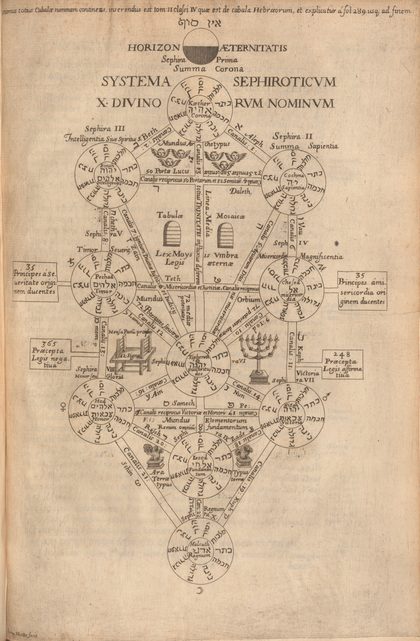
Two traditions, one diagram. The Tree of Life comes from Kabbalah, a Jewish mystical tradition, in which the sefirot are attributes of God and the trees differ from manuscript to manuscript. Kabbalah uses no tarot and arranges the letters differently. Everything tarot and astrological on our chart belongs to the Hermetic Qabalah of the nineteenth-century occult revival, and its arrangement of the letters goes back not to a Jewish manuscript but to a Jesuit's engraving of the 1650s. We write sephirah and sephiroth for the chart and sefirah and sefirot when we speak of Kabbalah, and we do not present the chart as Jewish practice.
The sephiroth and the paths
The ten sephiroth are numbered from Kether at the top to Malkuth at the foot; the 22 paths follow as 11 to 32, the numbering of the Thirty-Two Paths of Wisdom, which the Golden Dawn kept. Each has its own page: the names and pillar of a sphere, or the letter, trump and attribution of a path; the Golden Dawn's tables with their rivals; how the Sefer Yetzirah, the Hermetic writers and Crowley read it; our reading; and the claims made about it.
The ten sephiroth
The twenty-two paths
- Path 11: Kether to Chokmah (The Fool)
- Path 12: Kether to Binah (The Magician)
- Path 13: Kether to Tiphareth (The High Priestess)
- Path 14: Chokmah to Binah (The Empress)
- Path 15: Chokmah to Tiphareth (The Emperor)
- Path 16: Chokmah to Chesed (The Hierophant)
- Path 17: Binah to Tiphareth (The Lovers)
- Path 18: Binah to Geburah (The Chariot)
- Path 19: Chesed to Geburah (Strength)
- Path 20: Chesed to Tiphareth (The Hermit)
- Path 21: Chesed to Netzach (Wheel of Fortune)
- Path 22: Geburah to Tiphareth (Justice)
- Path 23: Geburah to Hod (The Hanged Man)
- Path 24: Tiphareth to Netzach (Death)
- Path 25: Tiphareth to Yesod (Temperance)
- Path 26: Tiphareth to Hod (The Devil)
- Path 27: Netzach to Hod (The Tower)
- Path 28: Netzach to Yesod (The Star)
- Path 29: Netzach to Malkuth (The Moon)
- Path 30: Hod to Yesod (The Sun)
- Path 31: Hod to Malkuth (Judgement)
- Path 32: Yesod to Malkuth (The World)
Variants and what we leave out
The Tree has been drawn, lettered and read in many ways. We describe the ones you will meet, and say what our chart does with them.
- The Jewish arrangements of the letters. The Gra and Ari trees of Jewish Kabbalah follow the Sefer Yetzirah's classes: mothers on the three horizontal paths, doubles on the verticals, simples on the diagonals. On Kircher's tree the letters run in alphabetical order instead. The tarot attributions exist only on Kircher's tree, so that is the one we draw.
- Lévi's attribution (1854 to 1856): the Magician on Aleph and the Fool on Shin, the 21st letter; Papus and the French school kept versions of it. Our Tarot service and the Golden Dawn put the Fool on Aleph.
- Marseille numbering and 777's. The Marseille decks number Justice VIII and Strength XI, and 777 prints the same numbers on the Golden Dawn's paths. We always match a card by its trump, not by its number, and the pages for paths 19 and 22 give the other numbers.
- Crowley's Thoth deck. The Emperor on Tzaddi (path 28) and the Star on Heh (path 15), each keeping its sign; Lust XI and Adjustment VIII; and new names for six more cards. We note it on the four paths it touches and do not adopt it; one live calculator already mixes the two schemes under a "Golden Dawn" label.
- The planets of the double letters. The Sefer Yetzirah's short, long and Saadia versions give Beth Saturn, Gimel Jupiter, Daleth Mars, Kaph Sun, Peh Venus, Resh Mercury and Tav Moon, as the Warsaw Hebrew of 1884 does; the Gra version gives Beth the Moon; Kircher gives Beth the Sun. Westcott printed two of these orders, called both wrong and kept the order's own secret. The Golden Dawn's order (Beth Mercury, Gimel Moon, Daleth Venus, Kaph Jupiter, Peh Mars, Resh Sun, Tav Saturn) first appeared in 777 in 1909, and it is the one we use and label.
- The outer planets on the three mother letters (Uranus, Neptune, Pluto), first found in Case's 1933 course and taught by his school: a labelled footnote on paths 11, 23 and 31, never the attribution.
- Archangels and choirs. Mathers' table of 1887 gives Michael to Tiphareth and Raphael to Hod; Agrippa, 777, the Golden Dawn and Fortune give the reverse. Agrippa also gives Jophiel to Chokmah and Metatron to Malkuth. We follow Agrippa, 777 and the Golden Dawn and give each variant on its sphere's page.
- Da'at, the "hidden" sphere of the Lurianic count and the Hermetic Abyss: no path and no trump, so it is not drawn; it is named on the page for path 13, which crosses the Abyss.
- The colour scales and the elemental grades. 777 gives four colour scales for every sphere and path, and the Golden Dawn's grades pair the lower spheres with the elements. We record both in our research and use neither: colour alone cannot carry a meaning on the chart, and the grades are a course of study, not a sphere's nature.
- The Minor Arcana on the sephiroth. In the Golden Dawn's tables each sephirah takes the four cards of its number, the four Aces on Kether down to the four Tens on Malkuth. Each sphere's page gives this in one line; the chart does not use it.
- Qliphoth, demons and planetary spirits. Mathers lists an order of Qliphoth and Agrippa planetary intelligences and spirits. They are talismanic material with no place in a personal chart, and our old columns that tried to hold them were wrong throughout.
- The Four Worlds, the four levels of creation that later Kabbalah and the Golden Dawn set over the Tree, with their elements and tarot suits. Named here, not drawn.
- Other birth-card rules. Summing every digit of the date changes the personality card on 51.7 per cent of dates; the century-split rule taught in one course gives our synthetic test person 13 Death, then 4, where Greer gives 4 with 13 as the hidden factor. All the rules agree on the soul card. We follow Greer's published rule and name it.
- Other ways onto the Tree. The Sun, Moon and rising signs on their sign paths need a time and place; planets on the sephiroth are a different chart; a name or a date reduced to 1 to 10 as "your sephirah" is modern numerology; one app asks for a mother's maiden name. We take the Sun card as an optional layer and leave the rest out.
Myths and disputed claims
What is said about the Tree and our chart, who says it, and what the record shows. The label is ours.
-
The chart is Kabbalah: the tarot and the astrology on the paths belong to the Jewish tradition.
falseWho says it: Our own pages before October 2026, and most tarot-on-the-Tree apps and sites.
What the record shows: The Tree comes from Kabbalah, a Jewish mystical tradition that uses no tarot, draws the letters differently and treats the sefirot as divine attributes. The tarot and the astrology are the Hermetic Qabalah of the nineteenth-century occult revival.
-
The Sefer Yetzirah is the founding text of the Tree: it describes the diagram, its 22 paths and the tarot's foundation.
falseWho says it: Our own page until October 2026, and many tarot websites.
What the record shows: It names thirty-two paths of wisdom, the ten sefirot and the 22 letters, and sorts the letters into classes, but describes no diagram and no tarot. Tree drawings begin in fourteenth-century manuscripts; one letter on each of 22 paths is Kircher's arrangement of 1652.
-
The diagram and its tarot attributions are ancient, from Abraham, Egypt or the Temple.
falseWho says it: Popular Kabbalah and tarot sites, app marketing, and our old page.
What the record shows: The doctrine of the sefirot is medieval (the Bahir about 1174, the Zohar in the 1280s), the drawn tree no older than the fourteenth century, the letters on the paths from 1652, the tarot attributions from 1781 to 1888.
-
Placing the birth cards on the paths is a traditional practice, and the card names the one path a person walks in this life.
unverifiedWho says it: Our own pages before October 2026; one tarot school advertises an unpublished version inside a paid course.
What the record shows: No published source, Greer's books included, does it. Our chart joins two published systems and says so, and no tradition gives anyone a path for life.
-
The planets of the seven double letters (Beth Mercury, Gimel Moon, Daleth Venus and so on) are the Sefer Yetzirah's own.
disputedWho says it: Most tarot books and websites, and our old page.
What the record shows: The Sefer Yetzirah's versions give the planets in at least two other orders, and Kircher a third. This order is the Golden Dawn's, first printed in 777 in 1909; we use it and label it.
-
Uranus, Neptune and Pluto belong to the Fool, the Hanged Man and Judgement in the Golden Dawn's tables.
disputedWho says it: Paul Foster Case's 1933 course, most modern correspondence tables, and our old engine.
What the record shows: The Golden Dawn and 777 give these three mother letters the elements Air, Water and Fire, nothing more. The outer planets are a twentieth-century addition; we show them as a labelled footnote.
-
On this tree the three mother letters lie on the horizontal paths, the doubles on the verticals and the simples on the diagonals.
falseWho says it: Our old page, describing the Jewish arrangement as if it were ours.
What the record shows: True of the Gra and Ari trees of Jewish Kabbalah. On Kircher's tree the horizontals carry Daleth, Teth and Peh, and the mothers sit on paths 11, 23 and 31.
-
The tarot is the Egyptian Book of Thoth, and the Tree, the tarot and astrology ran side by side for centuries before the Golden Dawn joined them.
falseWho says it: Court de Gébelin (1781), then Lévi, Papus, Crowley and most popular tarot writing; our old page.
What the record shows: The tarot is a fifteenth-century Italian card game with no recorded esoteric use before 1781; the Egyptian origin is a legend of that decade.
-
The Cipher Manuscripts are an old document, and the Golden Dawn's synthesis is a timeless one.
falseWho says it: Popular Golden Dawn histories and some orders' own accounts; our old page.
What the record shows: The manuscripts are written on paper watermarked 1809, and their pairing of tarot and letters comes after Lévi's of the 1850s. The synthesis is Victorian.
-
Crowley's swap of the Emperor and the Star is the correct attribution.
unverifiedWho says it: Crowley (1944), after the Book of the Law; Thelemic writers; calculators that mix the two schemes.
What the record shows: A claim of revelation, not a finding. We keep the Golden Dawn's table and note his swap on paths 15 and 28.
-
There is one correct birth card for each date, and calculators that give another are wrong.
disputedWho says it: Implied by every calculator that shows one answer.
What the record shows: The rules differ by convention: summing every digit changes the first card on 51.7 per cent of dates, and splitting the century changes it too. All agree on the soul card. We follow Greer's rule and name it.
-
Your name or birth date reduced to a number from 1 to 10 gives your sephirah.
unverifiedWho says it: Web calculators and apps.
What the record shows: A modern numerology. In the Golden Dawn's scheme the numbers 1 to 10 reach the sephiroth through the Minor Arcana, the Aces to the Tens, never through the trumps.
-
The chart is pathworking, an old practice of the tradition.
falseWho says it: Our own catalog name and page until October 2026.
What the record shows: Pathworking is a twentieth-century practice of guided imaginative journeys, named so in Ashcroft-Nowicki's book of 1983. The chart shows where the cards sit and does nothing more.
-
The sephiroth are Jungian archetypes and states of the psyche.
unverifiedWho says it: Twentieth-century Hermetic and psychological writers, and our old pages.
What the record shows: A modern reading. Jewish Kabbalah treats the sefirot as divine attributes; we label the Hermetic readings as such and state no psychology as fact.
-
Da'at is an eleventh, hidden sphere of the Tree.
disputedWho says it: Many Hermetic diagrams, and the count of Isaac Luria's school.
What the record shows: Some schools count it and others do not. It has no path and no trump, so our tree leaves it out.
-
Our old tables were right: Binah's archangel, Kether's choir, and a demon and an "intelligence" for every sephirah.
falseWho says it: EsoTerrier's own engine and pages before 11 October 2026.
What the record shows: Every source gives Tzaphkiel for Binah and the Holy Living Creatures for Kether; the demon and intelligence columns matched no Golden Dawn list. All were deleted.
Stories and lore
These are told as their tellers told them.
The adept in Germany. Westcott told that a German adept, Fräulein Anna Sprengel, chartered the order by letter after he decoded the Cipher Manuscripts. In 1892 Mathers, newly settled in Paris, announced that he had reached the order's Secret Chiefs himself and wrote the rituals of its inner order on their authority; when he initiated Crowley against the London adepts' refusal, they looked into his claims and expelled him in 1900. No trace of Sprengel has ever been found.
The attribution that was not printed. Westcott, publishing the Sefer Yetzirah in 1887 and again in 1893, printed two ways of giving the planets to the double letters, called both wrong and withheld the order's own. It stayed a secret of initiates until Crowley printed it in 777 in 1909.
Cairo, April 1904. Crowley wrote that over three days in a Cairo flat a being he called Aiwass dictated a book to him, an hour each day, after his wife Rose had told him in a trance that Horus was waiting for him. One verse, "Tzaddi is not the Star" (The Book of the Law, I:57), became his reason, forty years later, for swapping the Emperor and the Star.
Five years of painting. Lady Frieda Harris agreed to paint the Thoth deck in about six months and worked from 1938 to 1943, repainting cards to Crowley's instructions. The Book of Thoth came out in 1944 in 200 copies; the deck itself was not printed until 1969, when both of them were dead.
The Jesuit's tree. Kircher, who believed he had deciphered the Egyptian hieroglyphs, set his tree of the sefirot inside a vast work on the wisdom of Egypt. The Golden Dawn took his arrangement of the letters, so every tarot tree descends from an engraving made in Rome in the early 1650s.
Enoch and Elijah. In 3 Enoch the patriarch Enoch, taken up alive, is turned to fire and becomes Metatron, the archangel the Hermetic tables set over Kether; later lore makes Sandalphon, the archangel of Malkuth, his twin, and some sources say he was the prophet Elijah. Angel lore, from late antique and medieval Jewish texts.
The books' own authors. The Sefer Yetzirah is ascribed to Abraham, the Bahir opens in the voice of Nehunya ben HaKanah and the Zohar presents itself as the teaching of Shimon bar Yochai in the second century. Scholars date them to late antiquity, to Provence about 1174 and to Castile in the 1280s.
The game that became a book. Court de Gébelin wrote that he recognised the tarot as an Egyptian book the first time he saw the game played, and his volume began two centuries of Egyptian tarot; the Comte de Mellet's essay in it gave the trumps their first Hebrew letters.
Evidence and criticism
The tarot's history is settled. Decker, Depaulis and Dummett showed that the tarot was a fifteenth-century Italian card game, that its occult reading began with Court de Gébelin in 1781, and that the Golden Dawn's attributions, the switch of Strength and Justice among them, were the order's own design.
So is the order's pedigree. Howe's documentary history of 1972 showed the Sprengel letters to be forgeries and the order's claimed lineage to be Westcott's invention; the Cipher Manuscripts' pairing of tarot and letters comes after Lévi's.
The Jewish diagram is its own subject. Chajes traces the Jewish tree drawings from the thirteenth and fourteenth centuries, shows how much they vary, and separates them from Kircher's. The date of the Sefer Yetzirah is still open, between the second and the ninth century.
Scholars of Kabbalah on the Hermetic version. Gershom Scholem dismissed the occultists' Kabbalah of Lévi, Waite and Crowley as a misrepresentation, while treating the Christian Kabbalah of the Renaissance as part of its history; later scholars have questioned how sharply that line can be drawn. Either way, the chart says "Hermetic Qabalah" and names Kabbalah as the source of the Tree, nothing more.
Readers notice. In the app-store reviews we read in October 2026, the complaint that tarot-and-Tree apps are not Kabbalah, because Kabbalah has no tarot or astrology, was a recurring one-star theme for the best-known app.
The tradition argues with itself. Westcott against Kalisch and Kircher on the planets, and the Sefer Yetzirah's versions against each other; Mathers against Agrippa on the archangels; Crowley against the Golden Dawn on Tzaddi and Heh; Cordovero against Luria on counting Da'at. Each sphere and path page gives the disagreement where it falls.
The method makes no testable claim. The placement is a digit sum and a table lookup. We know of no study of birth cards, of the Tree's paths or of the two together; our own checks are of arithmetic and tables only, against an independent implementation and the public-domain sources.
Rights and names. We quote only works in the public domain: Agrippa's English of 1651, Mathers, Westcott, 777, Case's 1933 course, The Book of the Law and the Jewish Encyclopedia. Crowley's Book of Thoth, Regardie, Fortune, Greer and the modern scholars are used for facts only, and no Thoth card is shown. "The Hermetic Order of the Golden Dawn" is a registered trade mark of present-day groups in several countries; we use it only for the historical order of 1888, and name no feature after it.
Terms
- Kabbalah, Qabalah, Cabala
- Kabbalah is the Jewish mystical tradition; Qabalah, or Hermetic Qabalah, the occult revival's system built on its tree; Cabala the Renaissance Christian writers' reading. We use the first two and keep them apart.
- Sephirah, sephiroth
- One of the ten spheres of the Tree, in the Hermetic spelling. When we speak of Jewish Kabbalah we write sefirah, sefirot.
- The ten names
- Kether (Crown), Chokmah (Wisdom), Binah (Understanding), Chesed (Mercy), Geburah (Severity), Tiphareth (Beauty), Netzach (Victory), Hod (Splendour), Yesod (Foundation), Malkuth (Kingdom): the Golden Dawn's spellings, with the modern forms Keter, Chokhmah, Gevurah, Tiferet and Malkhut on each page.
- Path
- One of the 22 lines joining the spheres, each with a Hebrew letter; the Hebrew word is netivot (singular nativ). Numbered 11 to 32, after the ten sephiroth, as in the Thirty-Two Paths of Wisdom.
- Mother, double and simple letters
- The Sefer Yetzirah's three classes of the 22 letters: three mothers (Aleph, Mem, Shin) with the elements Air, Water and Fire; seven doubles with the planets; twelve simples with the signs of the zodiac.
- Letter value
- The number each Hebrew letter stands for: 1 to 9, then the tens to 90, then the hundreds to 400.
- The three pillars
- The Pillar of Mercy (Chokmah, Chesed, Netzach) on the viewer's right, the Pillar of Severity (Binah, Geburah, Hod) on the left, and the Middle Pillar (Kether, Tiphareth, Yesod, Malkuth), which the Golden Dawn called the Pillar of Mildness.
- Trump
- One of the 22 picture cards of the tarot, the Major Arcana. We number them as on Pamela Colman Smith's 1909 deck, with Strength VIII and Justice XI.
- Attribution
- The Golden Dawn's pairing of a path with its trump and with an element, planet or sign, or of a sphere with its planet, archangel and other correspondences. A convention of one school, not a fact about the Tree.
- Personality card and soul card
- Mary K. Greer's two birth cards: the date's sum reduced to 22 or less, and that number's digits added again. When the date reduces straight to 1 to 9, one card is both.
- Year card
- Greer's card for a year: the birth month and day added to that calendar year, reduced the same way.
- The Thirty-Two Paths of Wisdom
- A short text first printed in 1642 beside the Sefer Yetzirah, though not part of it, which names the ten sephiroth and the 22 paths as thirty-two "Intelligences". We quote its titles from Westcott's English.
- Da'at
- Knowledge, a sphere some schools count and others do not, drawn by some Hermetic diagrams in the Abyss below the top three. It has no path and no trump; our tree leaves it out.
- Etz Chaim
- Hebrew for "tree of life", and the title of Chaim Vital's record of Isaac Luria's teaching.
- Pathworking
- A twentieth-century practice of guided imaginative journeys along a path of the Tree. Our chart does none; it shows where the cards sit.