Meaning
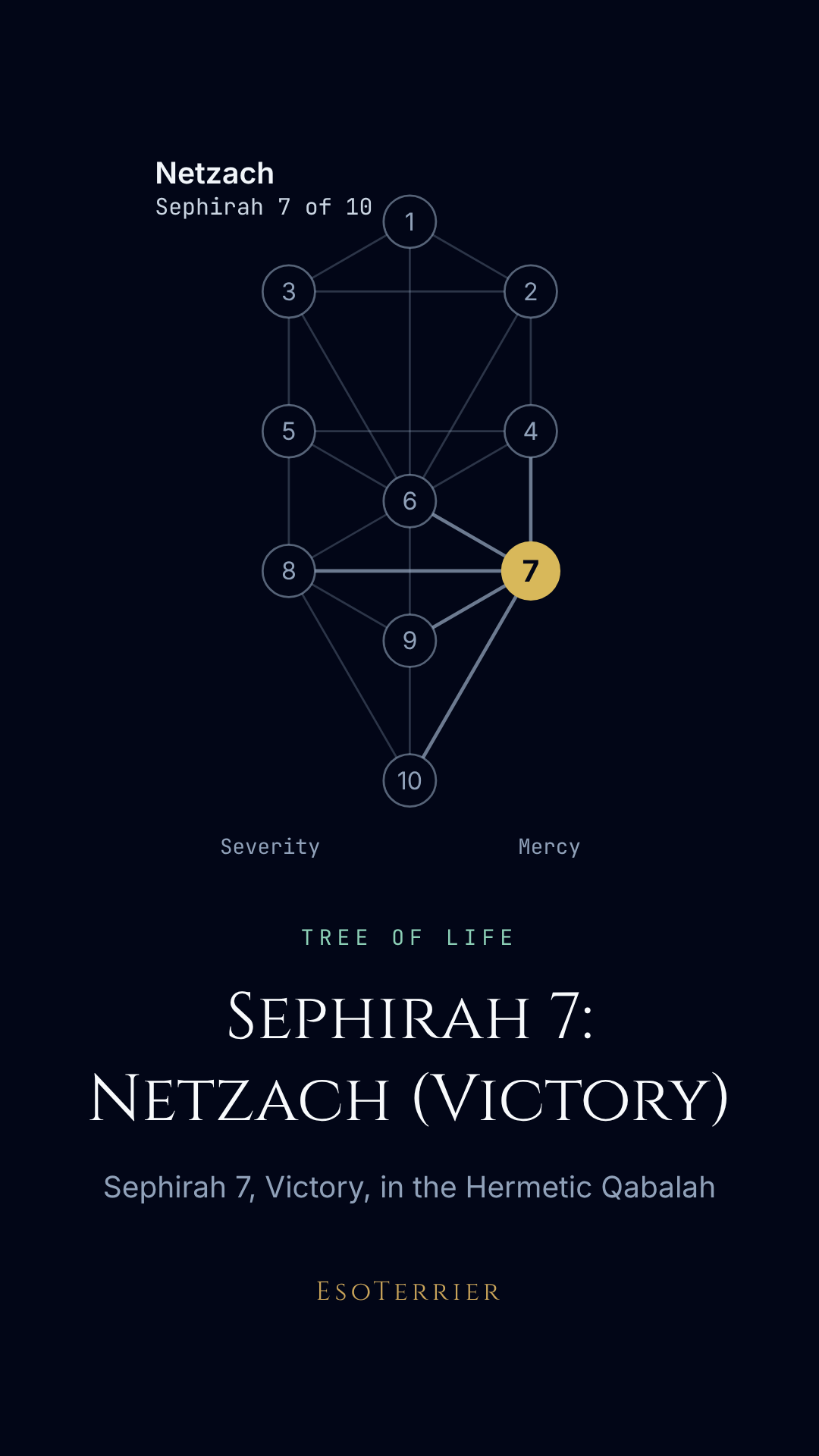
Netzach is the sphere of feeling, attraction and the drive that keeps going; its name means victory, or endurance. With Venus as its sphere, the Hermetic writers place the arts and the emotions here and read it as the warm counterpart to Hod, the sphere of thought across the Tree. Some modern writers read it as a level of the mind; that is their reading, labelled as such. In our own words, Netzach is feeling that lasts: the stamina of wanting something and the pleasure of making it.
On the Tree
Netzach stands at the foot of the Pillar of Mercy, on the viewer's right, below Chesed. Five paths meet here: Kaph down from Chesed, the path of the Wheel of Fortune; Nun from Tiphareth, Death's path; Peh across to Hod, the Tower's; Tzaddi down to Yesod, the Star's; and Qoph down to Malkuth, the Moon's. One of those, Tzaddi, is the letter Crowley gave to the Emperor in his Thoth deck; on our tree, as in the Golden Dawn's, it carries the Star. The Golden Dawn ties Netzach to the four Sevens of the Minor Arcana, never to a trump.
The Thirty-Two Paths of Wisdom calls it "the Occult Intelligence" in Westcott's English. Until 14 October 2026 our engine added words of its own to that title; it now quotes Westcott exactly.
The names and the tables
The Golden Dawn's tables give Netzach the divine name YHVH Tzabaoth, "the Lord of Hosts", the archangel Haniel and the choir of the Elohim, the Gods, which the Christian orders call the Principalities. Mathers adds the Tarshishim as a second choir, and our old engine followed him; the variant is noted, not adopted. The names stay in Latin letters.
Jewish Kabbalah, where the Tree comes from, reads Netzach as eternity or endurance and links it with Moses. Venus, the archangels and the tarot are the Hermetic Qabalah's.
Correspondences
Each item with how it stands: “sourced” is in the work cited, “our construction” is EsoTerrier’s own, and “disputed” means the sources disagree.
- Archangel
- Haniel sourced
- Divine name (Latin letters only)
- YHVH Tzabaoth, “the Lord of Hosts” sourced
- Angelic choir
- Elohim, Gods (Principalities); Mathers adds the Tarshishim disputed
- Tarot trumps
- None of its own: the trumps belong to the paths. The trumps of the paths that meet here are Wheel of Fortune, Death, the Tower, the Star, the Moon. sourced
- Our keywords
- Feeling, desire, endurance our construction
How the schools read it
- Jewish Kabbalah
- Netzach, eternity or victory: endurance, the first of the pair below Chesed and Gevurah; linked with Moses.
- Agrippa (1533; English 1651)
- The divine name, the archangel Haniel, the Elohim and the sphere of Venus.
- The Golden Dawn (1888; *777*, 1909)
- Venus (Nogah), the archangel Haniel and the Elohim, the Gods; the four Sevens.
- Mathers (1887)
- Adds a second choir here, the Tarshishim, beside the Elohim.
- EsoTerrier
- Feeling that lasts: attraction, art and the stamina of wanting something, the warm counterpart to Hod.
Claims about it
-
Netzach and the attributions on this page are Kabbalah.
falseWhat the record shows: The Tree comes from Kabbalah, a Jewish mystical tradition, which has no tarot and its own ways of drawing and reading it. The tables here are the Hermetic Qabalah's, compiled by Agrippa, Mathers and the Golden Dawn.
-
A birth card belongs to the sephirah of its number, so card 7 belongs to Netzach.
falseWhat the record shows: A category error in the Golden Dawn's scheme: the numbers 1 to 10 reach the sephiroth through the Minor Arcana, while the trumps belong to the 22 paths.
-
Netzach has a tarot suit, an element, a demon and an "intelligence" of its own.
falseWhat the record shows: So our old tables said, compiled from a modern web table. In the Golden Dawn every sephirah takes the four cards of its number in all four suits; the other columns had no source and were deleted on 11 October 2026.
-
Netzach stands on the left of the Tree.
disputedWhat the record shows: Some diagrams mirror the Tree. Mathers, Kircher and the Golden Dawn draw the Pillar of Mercy on the viewer's right and the Pillar of Severity on the left, as we do.
-
Netzach is a Jungian archetype or a fixed level of the psyche.
unverifiedWhat the record shows: A twentieth-century Hermetic reading, not a fact about the Tree. Jewish Kabbalah treats the sefirot as divine attributes; we label every reading with whose it is.
-
Netzach's Intelligence title is part of the Sefer Yetzirah.
disputedWhat the record shows: The titles come from a separate short text, the Thirty-Two Paths of Wisdom, first printed with the Sefer Yetzirah in 1642; its date and author are uncertain.