Meaning
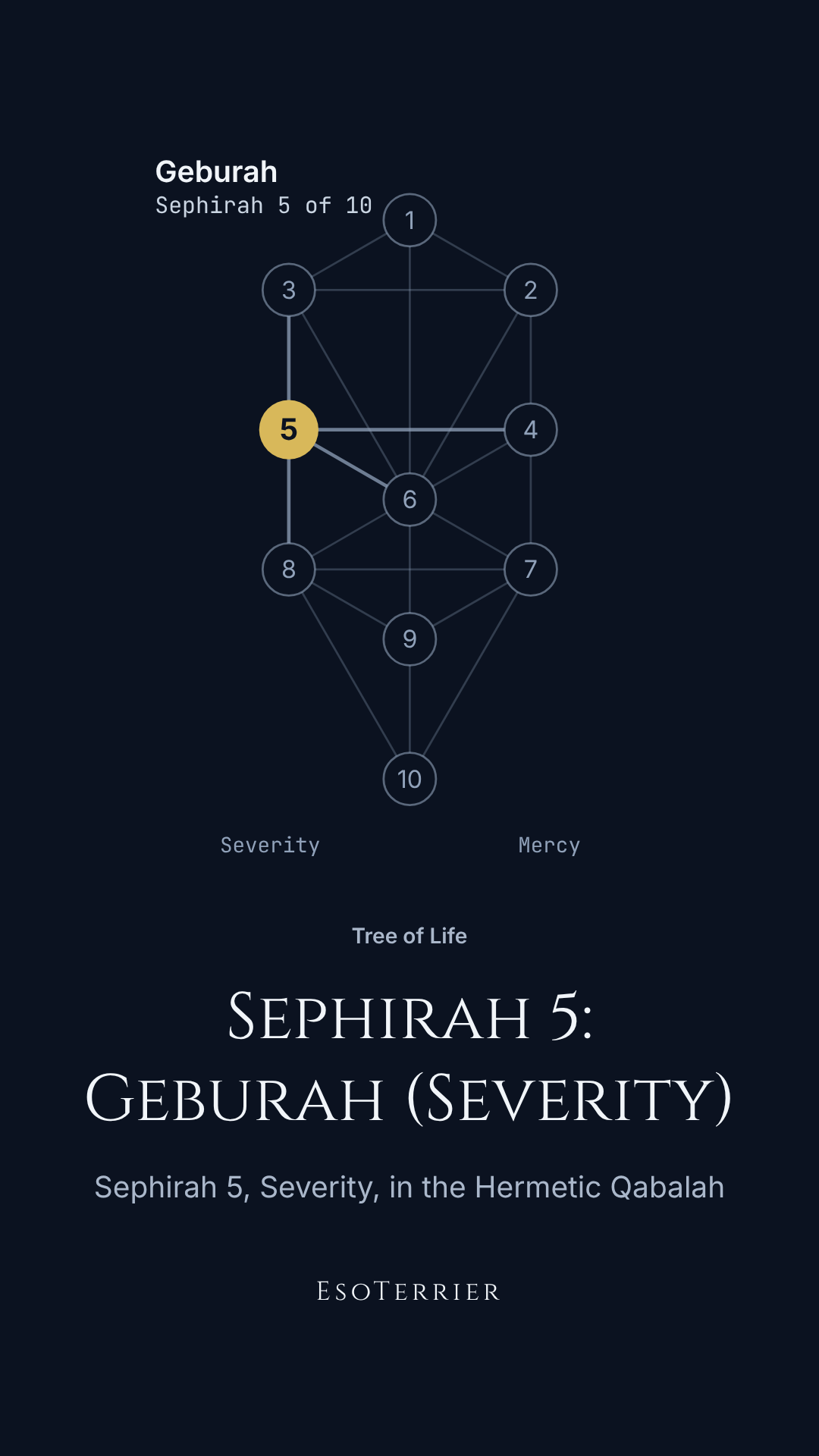
Geburah answers Chesed across the Tree. Where Mercy gives, Severity measures, cuts away and defends; with Mars as its sphere, it is the Hermetic picture of force used to set a limit. The tradition does not read it as cruelty: the two spheres are a pair, and each needs the other. In our own words, Geburah is the strength that keeps kindness from turning into excess, the clear refusal that protects what matters.
On the Tree
Geburah sits in the middle of the Pillar of Severity on the viewer's left, below Binah and above Hod. Four paths meet here: Cheth down from Binah, the Chariot's path; Teth across from Chesed, the path of Strength; Lamed down to Tiphareth, the path of Justice; and Mem down the pillar to Hod, the Hanged Man's. Two of those paths carry the cards whose numbers the Golden Dawn switched, Strength and Justice, so that Leo and Libra fall in the zodiac's order. No card belongs to Geburah itself; the Golden Dawn gives it the four Fives.
The Thirty-Two Paths of Wisdom calls it "the Radical Intelligence" in Westcott's English, from the short text printed beside the Sefer Yetzirah in 1642.
The names and the tables
The Golden Dawn's tables give Geburah the divine name Elohim Gibor, "God of Might", the archangel Khamael, whom Agrippa calls Camael, and the Seraphim, the Burning Ones. Mathers adds that the sphere is also called Strength or Justice, and Pachad, Fear. The names stay in Latin letters.
In Jewish Kabbalah, where the Tree comes from, Gevurah is the power of restraint and judgement, Din, and is linked with Isaac. The planet, the angels and the cards are the Hermetic Qabalah's.
Correspondences
Each item with how it stands: “sourced” is in the work cited, “our construction” is EsoTerrier’s own, and “disputed” means the sources disagree.
- Archangel
- Khamael; variants: Camael (Agrippa 1651) sourced
- Divine name (Latin letters only)
- Elohim Gibor, “God of Might” sourced
- Angelic choir
- Seraphim, Burning Ones (Powers) sourced
- Tarot trumps
- None of its own: the trumps belong to the paths. The trumps of the paths that meet here are the Chariot, Strength, Justice, the Hanged Man. sourced
- Our keywords
- Strength, judgement, necessary limits our construction
How the schools read it
- Jewish Kabbalah
- Gevurah, strength, also Din, judgement, and Pachad, fear: the power of restraint that sets limits to giving; linked with Isaac.
- Agrippa (1533; English 1651)
- The divine name Elohim Gibor, the archangel Camael, the Seraphim and the sphere of Mars.
- The Golden Dawn (1888; *777*, 1909)
- Mars (Madim), the archangel Khamael and the Seraphim, the Burning Ones; the four Fives.
- EsoTerrier
- The power to cut away, refuse and defend: not cruelty, but the strength that keeps kindness from turning into excess.
Claims about it
-
Geburah and the attributions on this page are Kabbalah.
falseWhat the record shows: The Tree comes from Kabbalah, a Jewish mystical tradition, which has no tarot and its own ways of drawing and reading it. The tables here are the Hermetic Qabalah's, compiled by Agrippa, Mathers and the Golden Dawn.
-
A birth card belongs to the sephirah of its number, so card 5 belongs to Geburah.
falseWhat the record shows: A category error in the Golden Dawn's scheme: the numbers 1 to 10 reach the sephiroth through the Minor Arcana, while the trumps belong to the 22 paths.
-
Geburah has a tarot suit, an element, a demon and an "intelligence" of its own.
falseWhat the record shows: So our old tables said, compiled from a modern web table. In the Golden Dawn every sephirah takes the four cards of its number in all four suits; the other columns had no source and were deleted on 11 October 2026.
-
Geburah stands on the left of the Tree.
disputedWhat the record shows: Some diagrams mirror the Tree. Mathers, Kircher and the Golden Dawn draw the Pillar of Mercy on the viewer's right and the Pillar of Severity on the left, as we do.
-
Geburah's Intelligence title is part of the Sefer Yetzirah.
disputedWhat the record shows: The titles come from a separate short text, the Thirty-Two Paths of Wisdom, first printed with the Sefer Yetzirah in 1642; its date and author are uncertain.