Meaning
Richmond's chapter on “the King's Jester” is half dismissal and half wonder. The card, he says, had been invented a few years before for certain games, caught on with few players and is usually thrown away; its presence in a test book “will invalidate every calculation”; “in serious affairs this joker counted as nothing”, “His solar value being zero”. And yet the brotherhood, he goes on, “begins to see a hidden meaning to this court fool”: by its four suits it stands for the four quarters, and by its court value for the centre, five points in all.
We read the Joker as the card outside the deck. The tradition sees people born on its day as adaptable and inventive, able to play many parts, and finds that their own centre matters more to them than a place in the order.
Outside the spreads
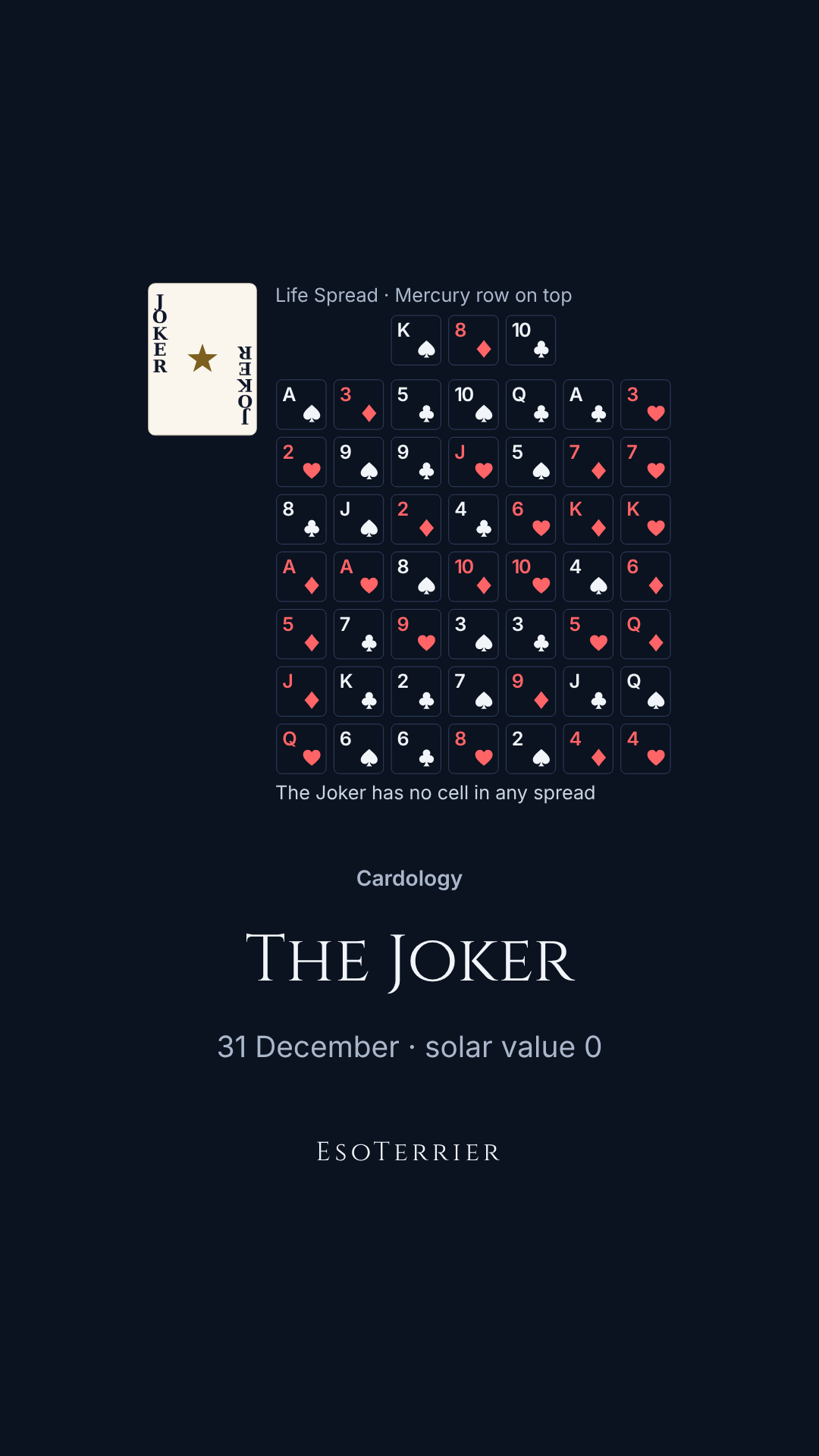
Richmond deals 52 cards. The Joker is not among them, so it has no cell in the Life Spread or in any of the ninety spreads that follow, and everything read from a cell is missing: no life path, no ruling card, no karma cards, no yearly cards and no periods. Camp's own calculator gives a Joker the same answer. One teacher reads a 31 December birth as the Ace of Hearts before noon and the King of Spades after; that is a single source, and we never offer it.
The formula, 55 − (2 × 12 + 31), gives 0 on 31 December and on no other day. 30 December is the Ace of Hearts, 1 January the King of Spades and 29 February the Nine of Clubs; a leap year does not touch the Joker. Its single birthday does not set it apart either: the Ace and Two of Hearts and the Queen and King of Spades have one date each.
The Jester's day
Richmond's arithmetic of the year runs through the Joker. The spots of the 52 cards add up to 364, the 52 cards times the seven planets; add the Jester, counted as five-fourths of a day, and the total is 365¼, the days of a year. “It is a remarkable fact that on the 31st of December the Jester rules supreme, even the Members of the Court bow to him.” That five-fourths is a count of days, not the Joker's solar value, which he gives as zero; our old page confused the two. The card itself had been added to the euchre pack in the 1850s as the game's highest trump, about thirty years before Richmond wrote.
Richmond links the Jester to no tarot card. Camp links it to the tarot's unnumbered trump, and many sites follow him; we record that as his view and make no tarot reading of the Joker.
Correspondences
Each item with how it stands: “sourced” is in the work cited, “our construction” is EsoTerrier’s own, and “disputed” means the sources disagree.
- Solar value (Richmond 1893, p. 35)
- 0: “His solar value being zero” sourced
- Its day (Richmond 1893, p. 40)
- 31 December: “the Jester rules supreme, even the Members of the Court bow to him” sourced
- The Jester (Richmond 1893, pp. 34 to 36)
- A recent invention for games, counted “as nothing” in serious affairs, yet by its four suits and its court value an emblem of the four quarters and the centre sourced
- Five-fourths of a day (p. 40)
- The Jester counted as five-fourths so that the 364 spots of the pack make 365¼: a count of days, not a solar value sourced
- Card of the day (Richmond 1896, p. 290)
- The Joker is everyone's card of the day on 31 December sourced
- Our keyword line (2026)
- The card outside the deck. our construction
- The tarot's unnumbered trump
- Linked to the Joker by Camp; Richmond links the Jester to no tarot card disputed
How the schools read it
- Olney H. Richmond (1893)
- “Joker” or “Jester”, “this court fool”: outside the test book, of solar value zero, the ruler of the last day of the year (pp. 34 to 36, 40).
- Randall and Campbell, Lein, Camp (1947 onward)
- No life path cards or yearly spreads, as Camp's calculator says; Camp links the card to the tarot's unnumbered trump and gives it a nickname, which we do not use.
- One teacher (2026 survey)
- Reads a 31 December birth before noon as the Ace of Hearts and after noon as the King of Spades. A single source, never offered here.
- Our own engine until October 2026
- Gave the Joker to 22 September and to 29 February. Corrected: the Joker is 31 December only, and 29 February the Nine of Clubs.
- EsoTerrier
- Read here as the card outside the deck: adaptable and inventive, finding its own centre rather than a place in the order.
Claims about it
-
The Joker is the rarest birth card, because it has only one birthday.
falseWhat the record shows: Four other cards also have a single birthday: the King of Spades (1 January), the Queen of Spades (2 January), the Two of Hearts (29 December) and the Ace of Hearts (30 December). The Joker's real distinction is that it stands outside the spreads.
-
The Joker is also the card of 30 December in leap years.
falseWhat the record shows: 30 December is always the Ace of Hearts and 31 December always the Joker. A leap year changes only 29 February, which is the Nine of Clubs.
-
The Joker has a solar value of one and a quarter.
falseWhat the record shows: Richmond gives the Joker a solar value of zero (“His solar value being zero”, p. 35). He counts the Jester as five-fourths only in a different sum, the spots of the whole pack, which makes 365¼ (p. 40).
-
The Joker is the tarot's unnumbered trump under another name.
unverifiedWhat the record shows: Richmond links the Jester to no tarot card, and says only that someone invented it a few years before 1893 for certain games (p. 35). We record the link as Camp's.
-
Each card has a traditional nickname.
disputedWhat the record shows: The nicknames are Camp's coinages, or Randall and Campbell's, not Richmond's; taken as a set they mark a text as derived from his. We use none of them.
Elsewhere on EsoTerrier
- King of Spades the card of 1 January, the day after, and the last card of the pack
- Ace of Hearts the card of 30 December, the day before, and the first card of the pack
- Nine of Clubs the card of 29 February: leap years do not touch the Joker
- Tarot Birth & Year Cards birth cards from the tarot, whose unnumbered trump is a different card