Meaning
Oak is long-lived, broad and deep-rooted, and shelters a great deal of other life. The kenning of its letter is "highest of bushes", in Calder's translation, and the Auraicept says simply: "Higher than bushes is an oak".
Our reading takes slow, lasting strength from the tree: people born in this month are read as dependable and protective, the kind others lean on, with a generosity that comes from deep roots. The reading is ours.
The letter
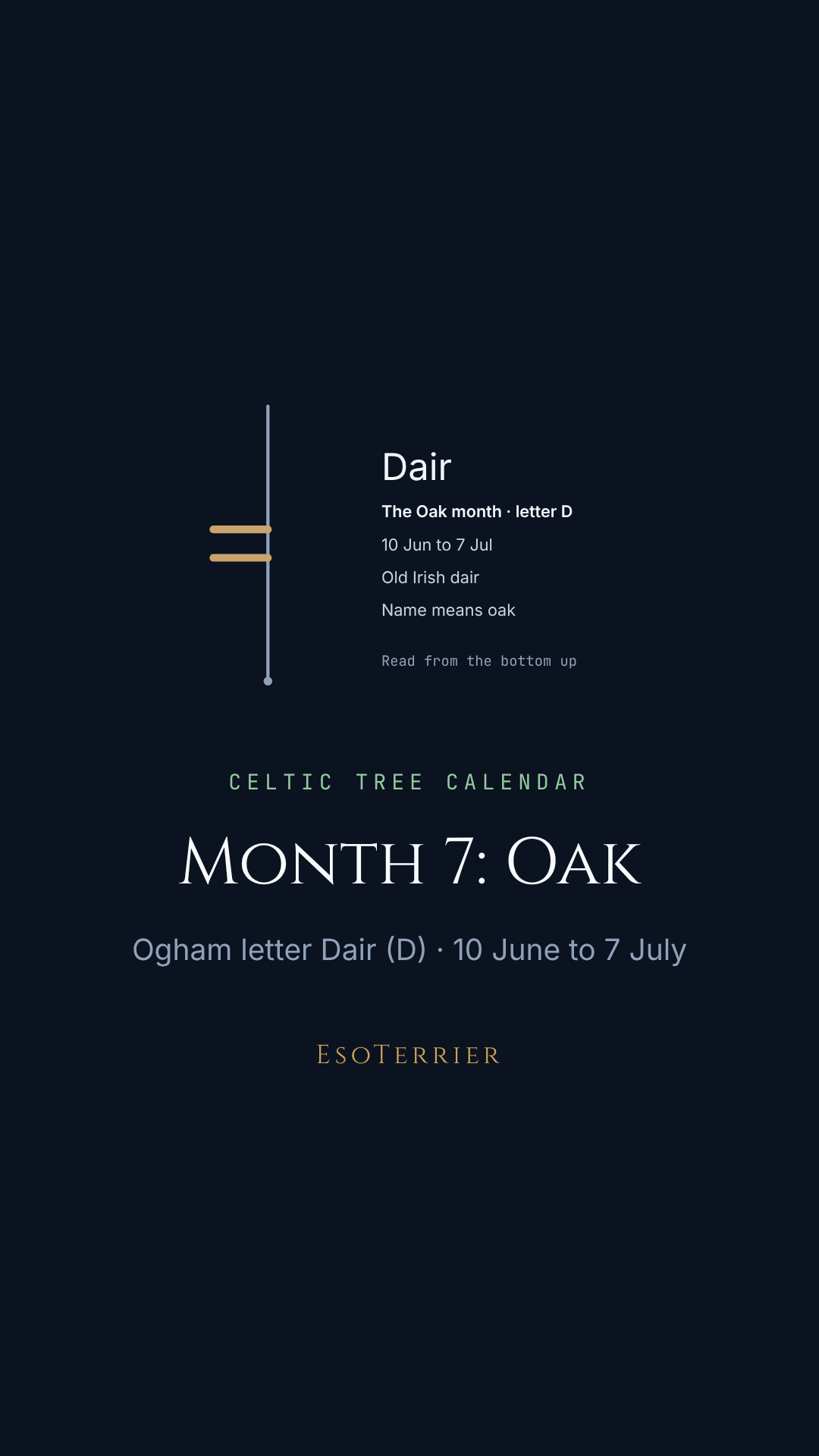
Dair is the second letter of the second group: two strokes to the left of the stemline. Its Old Irish name dair genuinely means oak; the word goes back to the old Indo-European word for tree and oak, like Welsh derw, Greek drys and Sanskrit dāru, "wood". A door is a different word from a different root, Irish doras; the reading of the oak as a doorway is Graves'. The Auraicept glosses the letter as oak. O'Flaherty's list of 1685, oddly, glosses it with the holly, cuileann, and the Latin ilex. Graves spells it Duir; the Irish name is Dair.
Oak, druids and mistletoe
The word druid is usually read by scholars as "oak-knower", from words for oak and for knowing; it is an etymology, not evidence of oak groves. Pliny, the only ancient writer to link Druids with mistletoe, says they held nothing more sacred than the mistletoe and the tree that bears it, if that tree is an oak, and cut it on a set day of the Moon. The idea that they saw the mistletoe as the oak's life is J. G. Frazer's theory of 1890.
In Graves' year
Oak runs from 10 June to 7 July, the same in every list, so it holds the June solstice. Graves pairs the oak with Jupiter among his trees of the week, as Culpeper's herbal had for the plant; the planets, gemstones and animals of tree-sign websites are modern and are not used here.
Correspondences
Each item with how it stands: “sourced” is in the work cited, “our construction” is EsoTerrier’s own, and “disputed” means the sources disagree.
- The Auraicept's explanation
- "Higher than bushes is an oak" (Calder 1917, p. 91) sourced
- The Ogam Tract's gloss
- the same tree (Calder 1917, p. 277) sourced
- O'Flaherty's gloss (1685)
- Duir, glossed with holly (cuileann) and the Latin ilex, not oak (Ogygia, 1685, p. 235) sourced
- How the letter is tied to the tree
- The name means the tree sourced
- Colour and bird words for the letter (a medieval curiosity)
- Colour: dub, "black"; bird: droen, "wren". Words that begin with the letter, like the tract's lists of churches; not the tree's colour or animal sourced
- Our reading
- Long-lived and deep-rooted: dependable and protective, the kind others lean on, generous from deep roots. our construction
How the schools read it
- The medieval tracts
- The kenning "highest of bushes"; the Auraicept glosses the letter oak.
- O'Flaherty, 1685
- Duir, glossed with holly (cuileann) and the Latin ilex, not oak (Ogygia, 1685, p. 235).
- Graves, 1948
- The seventh month, 10 June to 7 July.
- Ogham scholarship
- dair is one of the few letter names that genuinely names a tree.
- Tree-sign websites
- The same dates; a planet, gemstone, animal and personality title, all modern. Not used here.
- EsoTerrier
- Long-lived and deep-rooted: dependable and protective, the kind others lean on, generous from deep roots.
Claims about it
-
The oak's letter name comes from an old word for a door.
falseWhat the record shows: Dair goes back to the Indo-European word for tree and oak, like Welsh derw, Greek drys and Sanskrit dāru, "wood". Words for a door come from another root (Irish doras). The door reading is Graves'.
-
The word druid means the wise ones of the oak grove, and that is settled.
disputedWhat the record shows: Most scholars derive it from words for oak (or "strong") and "know", so "oak-knower" is the usual reading. It says nothing certain about groves.
-
The Druids saw the mistletoe as the life of the oak.
unverifiedWhat the record shows: A theory of J. G. Frazer's, from 1890, not a belief any ancient source records.
-
The Oak month belongs to an old Celtic calendar that the Druids kept.
falseWhat the record shows: No ancient or medieval source has a tree calendar or a tree for each birthday. The thirteen months are Robert Graves', set out in 1948.