Meaning
Alder grows with its roots in water, and its timber lasts when it is kept wet, which is why it was used for piles and foundations. The kenning of its letter is "shield of warrior-bands", in Calder's translation, and the Auraicept says why: "The van of the warrior-bands, that is, alder, for thereof are the shields".
Our reading takes steadiness under pressure from this: people born in this month are read as good at holding a line for others, with a strength that does its work out of sight. The reading is ours.
The letter
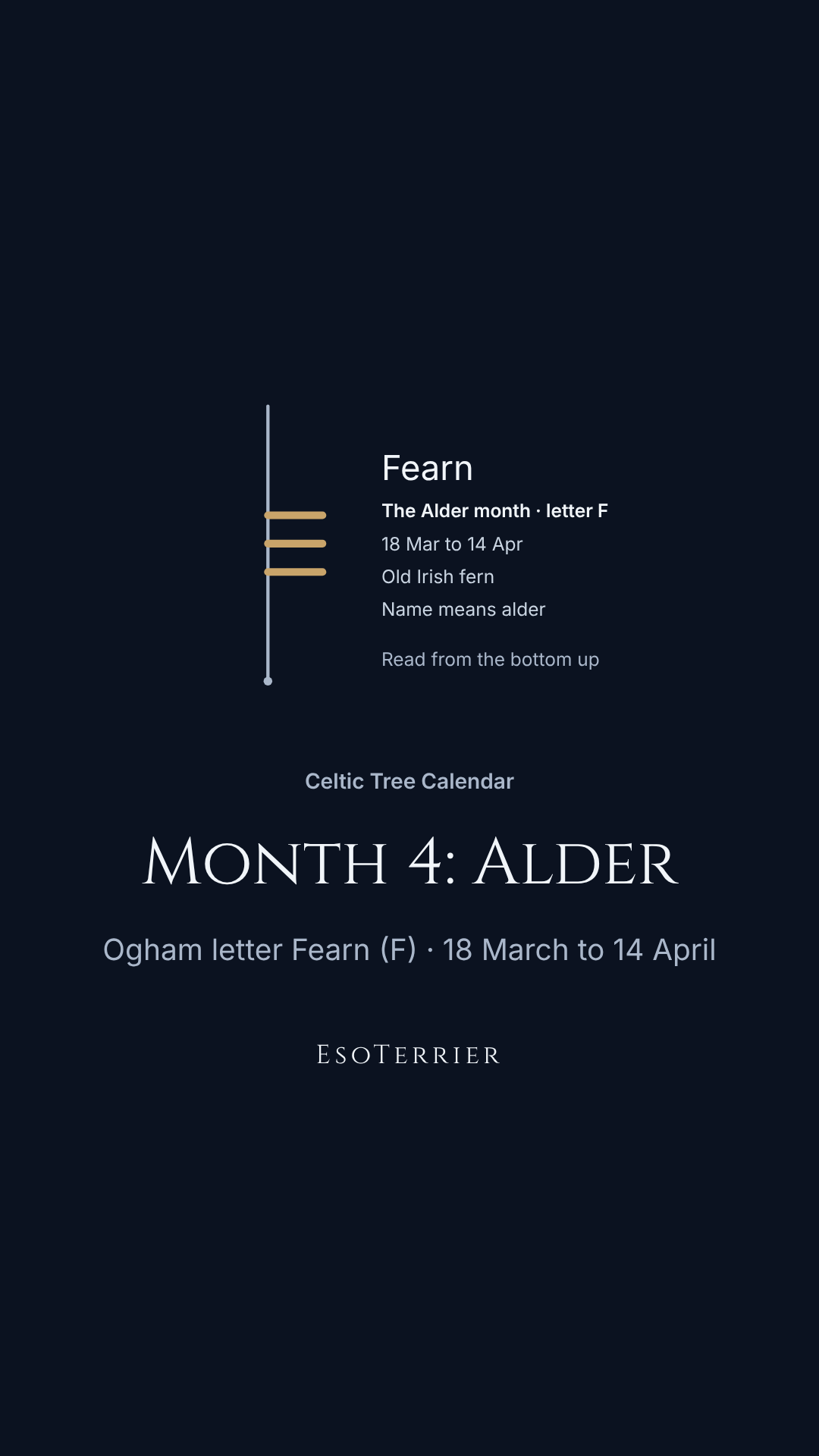
Fearn is the third letter of the stones: three strokes to the right of the stemline. Graves' calendar moves it to fourth place, behind Nion. Its Old Irish name fern genuinely means alder, one of the few letter names that is a tree. Both medieval tracts gloss it as alder, and O'Flaherty in 1685 adds that shields are made of it.
The alder shield
Here the medieval gloss and the archaeology meet. The National Museum of Ireland holds the one surviving Irish Iron Age shield, found at Clonoura, County Tipperary, and it is made of alder. That supports what the tract says. It does not show that alder was the main wood of shields everywhere, as some pages claim.
In Graves' year
Alder runs from 18 March to 14 April, the same in every list of the tree months. In another chapter Graves pairs the alder with Saturn among his trees of the week, and Paterson gives it a different planet; tree-sign websites add a gemstone, an animal and a personality title. All of this is modern, and we leave it out.
Correspondences
Each item with how it stands: “sourced” is in the work cited, “our construction” is EsoTerrier’s own, and “disputed” means the sources disagree.
- The Auraicept's explanation
- "The van of the warrior-bands, that is, alder, for thereof are the shields" (Calder 1917, p. 91) sourced
- The Ogam Tract's gloss
- the same tree (Calder 1917, p. 277) sourced
- O'Flaherty's gloss (1685)
- Fearn, the alder, of which shields are made sourced
- How the letter is tied to the tree
- The name means the tree sourced
- Colour and bird words for the letter (a medieval curiosity)
- Colour: flann, "red"; bird: faelinn, "gull". Words that begin with the letter, like the tract's lists of churches; not the tree's colour or animal sourced
- Our reading
- A tree with its roots in water: holding a line for others, with strength that works out of sight. our construction
How the schools read it
- The medieval tracts
- The kenning "shield of warrior-bands"; the Auraicept glosses the letter alder.
- O'Flaherty, 1685
- Fearn, the alder, of which shields are made.
- Graves, 1948
- The fourth month, 18 March to 14 April.
- Ogham scholarship
- fern is one of the few letter names that genuinely names a tree.
- Tree-sign websites
- The same dates; a planet, gemstone, animal and personality title, all modern. Not used here.
- EsoTerrier
- A tree with its roots in water: holding a line for others, with strength that works out of sight.
Claims about it
-
Alder was the chief wood of Celtic shields.
unverifiedWhat the record shows: What is documented: the medieval tract says shields were made of alder, and the one surviving Irish Iron Age shield, from Clonoura, is alder. "Chief" goes beyond that.
-
The Alder month belongs to an old Celtic calendar that the Druids kept.
falseWhat the record shows: No ancient or medieval source has a tree calendar or a tree for each birthday. The thirteen months are Robert Graves', set out in 1948.
-
The Alder month has a traditional personality title.
falseWhat the record shows: The thirteen titles come from one website of the 2000s and were copied widely; nothing in Graves, Paterson or the medieval tracts supports them. We never use them.
-
The Alder month has a traditional planet, element, gemstone and animal.
falseWhat the record shows: Modern additions: the planets are Helena Paterson's (1992), the rest come from later web lists that disagree with one another. None is medieval or in Graves as a set.