Meaning
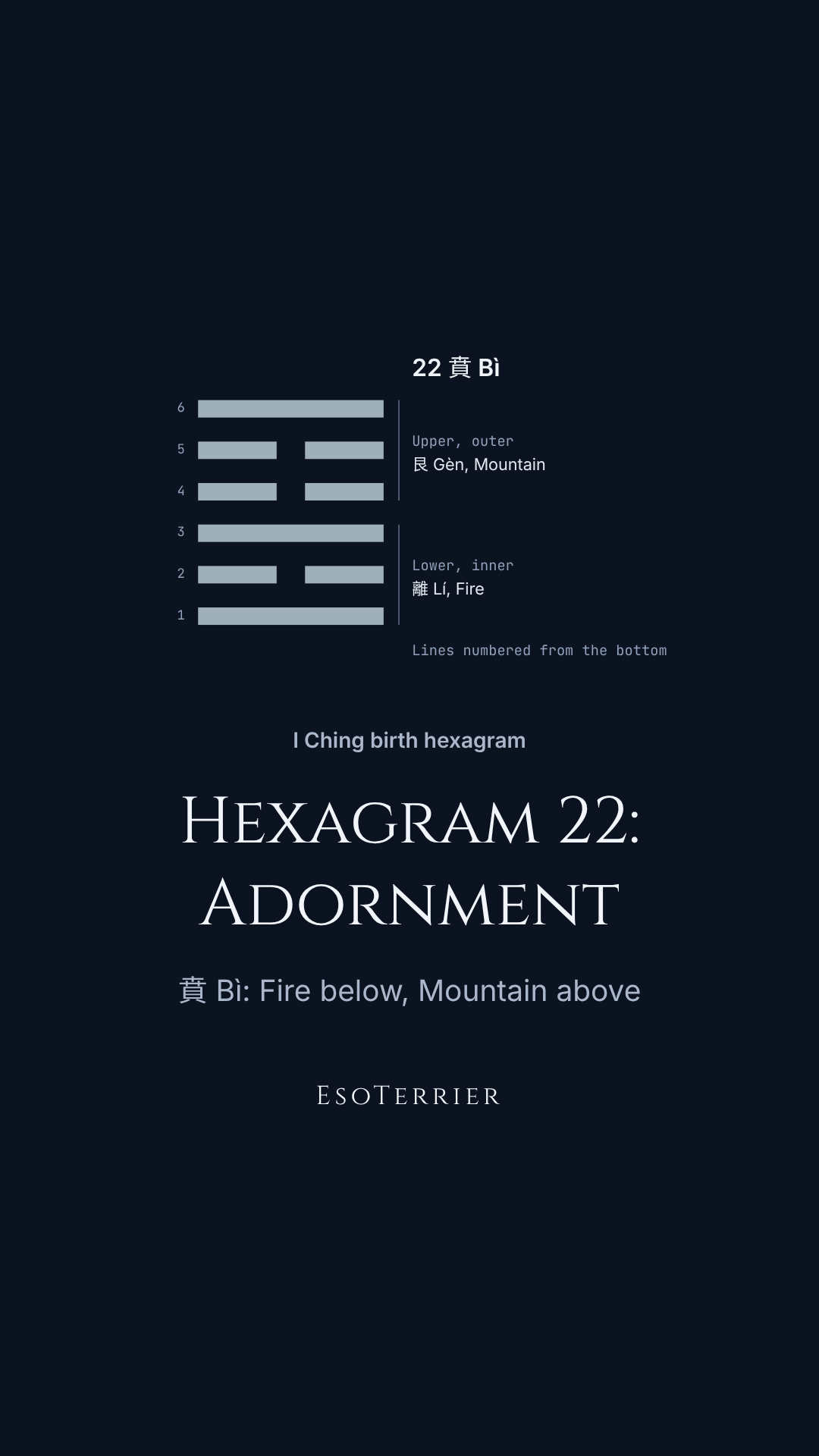
A fire below a mountain lights its slopes and shows their shape; it does not light the whole country. That is the hexagram's image, and 賁, ornament or elegance of form, is its subject. The Judgment grants adornment free course and limits it at once: there is little advantage if it is allowed to go first and lead. Legge's romanised name for it, Pî, is the same as his name for hexagram 8; the characters and tones, 比 bǐ and 賁 bì, tell them apart.
The Image is precise about where form belongs. The superior man may make his administration clear and graceful, but he does not decide criminal cases by it: appearances are not grounds for judgement. In our own reading, 賁 values beauty and is honest about what it cannot do. Form finishes substance; it does not replace it.
The lines
The lines adorn a figure from the ground up. The first adorns its feet and leaves the carriage to walk; the second adorns its beard, an ornament that moves with what is beneath it. The third shines as if bedewed and is told to keep firm; the fourth is adorned only in white and rides a white horse as if winged, to meet a suitor. The fifth brings a small, plain roll of silk to the gardens on the heights and looks mean, and ends well. The top line has "white as his (only) ornament", in Legge's words: decoration gives way to simplicity.
Its pair is 噬嗑, hexagram 21; within it lies 解, hexagram 40, and every line flipped gives 困, hexagram 47.
In the birth cast
The time cast arrives at 賁 when the year, month and day leave 7 on eight, which puts 艮 mountain above, and the same total with the hour added leaves 3, which puts 離 fire below. Which line moves depends on what the whole total leaves on six, and each line turns the figure into a different hexagram:
- Line 1 (初九) moving: becomes 52 艮 Gèn, Stopping
- Line 2 (六二) moving: becomes 26 大畜 Dà Xù, Great Restraint
- Line 3 (九三) moving: becomes 27 頤 Yí, Nourishment
- Line 4 (六四) moving: becomes 30 離 Lí, Brightness
- Line 5 (六五) moving: becomes 37 家人 Jiā Rén, The Household
- Line 6 (上九) moving: becomes 36 明夷 Míng Yí, Brightness Wounded
Lines 2 to 5 give the hexagram within, 40 解 Xiè, Release. Everyone born in the same lunar day and double hour has the same cast, so the figure describes a moment, not a person.
Correspondences
Each item with how it stands: “sourced” is in the work cited, “our construction” is EsoTerrier’s own, and “disputed” means the sources disagree.
- Trigram virtues (Shuogua, chapter 7)
- 離 bright, attached below; 艮 stopping, at rest above, in our English sourced
- Trigram family places (Shuogua)
- middle daughter below, youngest son above sourced
- Trigram body and animal images (Shuogua)
- eyes and pheasant below; hands and dog above sourced
- Trigram phases (a classical correspondence: the Plum Blossom text's table)
- Fire below, Earth above. The Han assignment of 梅花易數, book 1, also used by Jing Fang; not stated as such in the Zhouyi sourced
- Inverse and opposite
- Upside down: 21 噬嗑 Shì Kè, Closing the Jaws; every line flipped: 47 困 Kùn, Confinement sourced
- Human Design gate
- Gate 22, from 347° to 352.625° of the tropical zodiac on Ra Uru Hu's wheel (1987): a modern placing, not the I Ching's sourced
- Our English title
- Adornment: EsoTerrier's own, from the sense of 賁 our construction
How the schools read it
- The Zhouyi, in Legge's translation (1882)
- “Pî indicates that there should be free course (in what it denotes). There will be little advantage (however) if it be allowed to advance (and take the lead).”
- The Image (大象), one of the Wings, in our paraphrase
- Fire at the foot of a mountain; the superior man brightens his government but does not decide criminal cases by it.
- The Plum Blossom method (Ming)
- A figure reached by numbers: 艮 above when the year, month and day leave 7 on eight, 離 below when the same total with the hour leaves 3.
- Human Design (Ra Uru Hu, 1987)
- Takes the number for its gate 22 and puts it on the zodiac; its own reading, which we do not quote.
- EsoTerrier
- Fire at the foot of the mountain: light that gives things their form and finish; adornment pleases and does not decide, and the text ends with plain white, beauty that needs no ornament.
Claims about it
-
Gate 22 of Human Design, at 347° to 352.625° of the zodiac, is where the I Ching itself places hexagram 22.
falseWhat the record shows: The wheel is Shao Yong's circle rotated by Ra Uru Hu in 1987 to 1989 so that hexagram 41 starts at 2° Aquarius. No Chinese source we found puts the hexagrams on degrees of the zodiac.
-
Being born under 賁 Bì fixes a person's character.
unverifiedWhat the record shows: A modern reading with no source in the tradition. The Zhouyi has no birth hexagram; the cast reads a figure, not a person, and everyone born in the same lunar day and double hour shares it.