Meaning
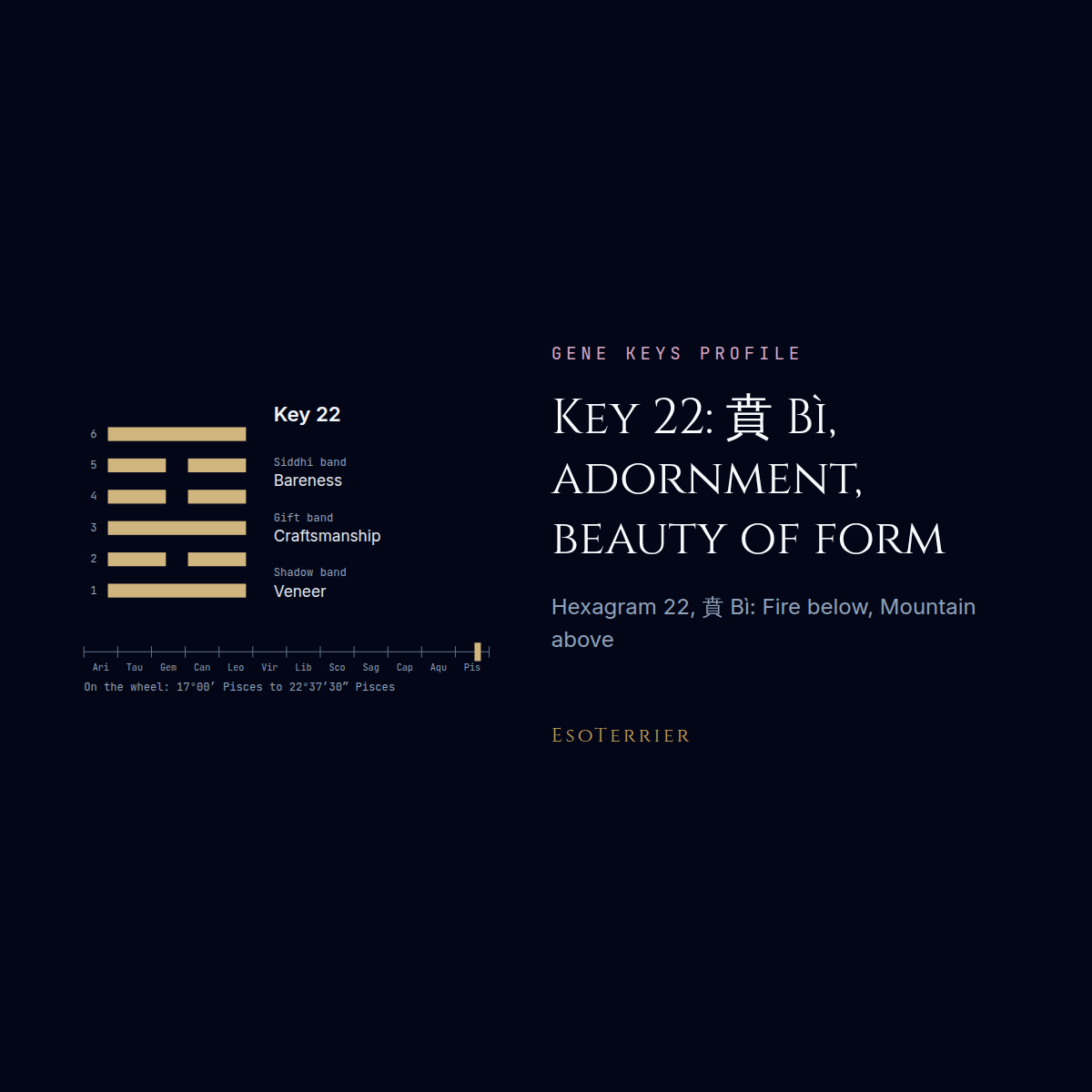
賁 is ornament, decoration, the shaping of form. The figure puts fire at the foot of a mountain, light falling on the slope and showing its shape. Strong and yielding lines alternate, which the tradition reads as pattern, the beauty of things in good order. The statement of the hexagram is modest: success, but small advantage in going ahead. Adornment serves; it should not lead. Our gloss is adornment, beauty of form. The text is on the hexagram 22 page.
Key 22 pairs with key 21, the same figure turned over; its opposite on the wheel is key 47.
The three bands
The Shadow band, Veneer, is the second line, 賁其須: adorning the beard, the surface only, polish laid over what may not be sound. The Gift band, Craftsmanship, is the third line, 賁如濡如, 永貞吉: adorned and glossy, and lasting firmness brings good fortune. It is care for the finish because the finish honours the thing. The Siddhi band, Bareness, is the top line, 白賁: white adornment, the plain undyed thing, which the text says is without error. Beauty that no longer needs ornament.
So the key moves from surface to craft to simplicity, three relations between a thing and its look.
In a profile
Key 22 belongs to no particular row. It stands in a profile wherever one of the thirteen bodies stood between 17°00′ Pisces and 22°37′30″ Pisces at birth or at the design moment, and so it can fill any of the thirteen rows or the three further tags.
The Sun passes through it each year from about 8 to 12 March. People born then have key 22 as their Life's Work and its opposite, key 47, as their Evolution, the Earth's place. For people born about three months later, from about 6 to 11 June, it is the Radiance, where the Sun stood at the design moment.
Each of its six lines is 56′15″ wide. A position from 17°00′ Pisces is in line 1, read by our theme Foundation; one from 21°41′15″ Pisces is in line 6, Overview. Every key's lines take the same six themes of ours, and the line of a fast body like the Moon depends on the birth time to the hour.
Correspondences
Each item with how it stands: “sourced” is in the work cited, “our construction” is EsoTerrier’s own, and “disputed” means the sources disagree.
- Hexagram and number
- 賁 Bì, hexagram 22 in the received (King Wen) order of the Zhouyi; Legge (1882) writes the name Pî sourced
- Trigram images
- Fire below, Mountain above, as the Shuo Gua names them sourced
- Our gloss
- adornment, beauty of form: EsoTerrier's own, the same in our I Ching chart, not a translator's title our construction
- Our words for the three bands
- Veneer, Craftsmanship and Bareness, written in October 2026 from the hexagram's own texts; none is one of Rudd's words our construction
- Opposite on the wheel
- Key 47, 180° round the wheel, with every line reversed; Rudd calls it the programming partner sourced
- Pair in the received order
- Key 21, 噬嗑 Shì Kè: the same six lines turned upside down, next to it in the received order sourced
- Within and upside down
- Lines 2 to 5 give 40 解 Xiè; the figure turned upside down gives 21 噬嗑 Shì Kè sourced
- Codon ring (Rudd)
- Rudd groups this key in his Ring of Divinity, which he ties to proline: his grouping and his choice of amino acid, not a finding of genetics sourced
- Place on the wheel
- Gate 22 of Ra Uru Hu's wheel (1987 to 1989), 17°00′ Pisces to 22°37′30″ Pisces (347° to 352.625° of tropical longitude): a modern placing, not the I Ching's sourced
How the schools read it
- The Zhouyi, after Legge (1882)
- Free course; little advantage if it is allowed to advance and take the lead. The text in full is on the hexagram 22 page.
- Human Design (Ra Uru Hu, 1987 onward)
- Gate 22, in the Solar Plexus centre. The parent system gives the gate its own name and reading, which are Jovian Archive's and which we do not give here.
- Richard Rudd, The Gene Keys (2009)
- Key 22, read at three bands he calls the Shadow, the Gift and the Siddhi, each with a word of his own, under a chapter title of his own; we reproduce neither. He names key 47 its programming partner.
- EsoTerrier
- Form and finish: it lays polish over what is not sound, cares for the finish because it honours the thing, and at its peak lets the plain thing stand with no ornament at all.
Claims about it
-
Key 22 is a code held in the genes, and contemplating it changes how they are expressed.
unverifiedWhat the record shows: The central metaphor of Rudd's system, given by its author, not a finding. The profile is the positions of thirteen bodies at two moments, read on a 64-part wheel; no gene, codon or measurement of the body enters it.
-
Key 22 belongs to the Ring of Divinity, a chemical family in the body tied to proline.
unverifiedWhat the record shows: Rudd's grouping. His ring sizes follow the real number of codons per amino acid in the genetic code, but which hexagram goes with which codon is his own choice, and nothing in genetics links a hexagram to an amino acid.
-
The place of key 22 on the zodiac, 17°00′ Pisces to 22°37′30″ Pisces, is an old I Ching teaching.
falseWhat the record shows: The wheel is Ra Uru Hu's, fixed between 1987 and 1989 by turning Shao Yong's 11th-century circle of the hexagrams so that hexagram 41 begins at 2° Aquarius. No Chinese source we know ties the hexagrams to degrees of the zodiac.
Elsewhere on EsoTerrier
- Hexagram 22: Adornment the I Ching text this key is read from
- Key 47: 困 Kùn, confinement, hemmed in its opposite on the wheel
- Key 21: 噬嗑 Shì Kè, closing the jaws on what blocks its pair in the received order
- Key 40: 解 Xiè, release, the knot untied the hexagram within it, lines 2 to 5
- Human Design gate 22 the same place in the system the profile is calculated by