Meaning
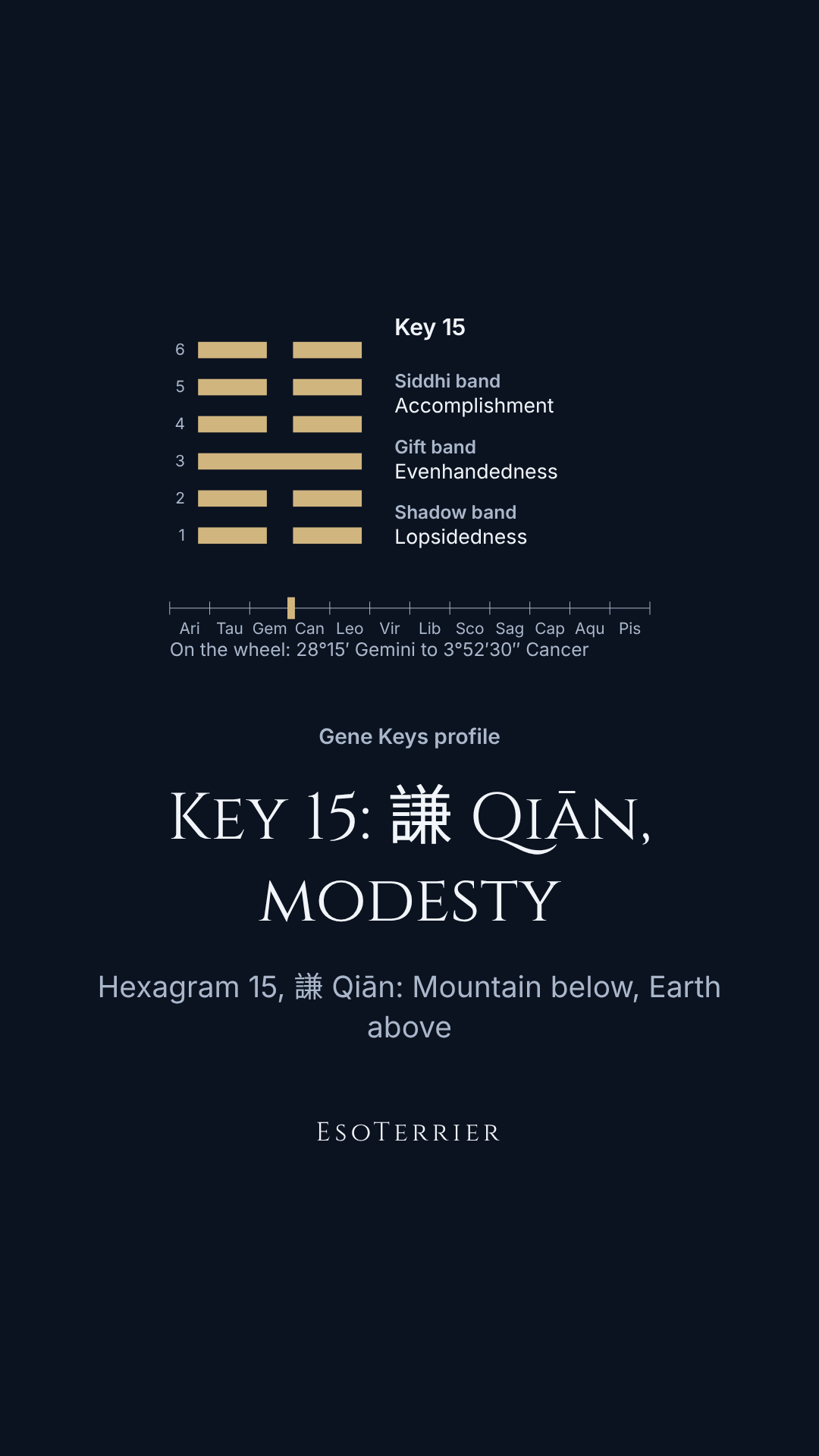
謙 is modesty, the character joining speech to a sign of joining or balance. The figure is a mountain, the highest of the land, set beneath the earth: what is tall has put itself low. Its single strong line, the third, is the only firm one, and it does not stand above the others. The Judgment says modesty brings success and that the noble person carries things through to the end. Our gloss is modesty. The text is on the hexagram 15 page.
It is one of the few hexagrams whose six line texts are all favourable or neutral, a point the tradition often makes about modesty. Key 15 pairs with key 16, the same figure turned over; its opposite on the wheel is key 10.
The three bands
The Shadow band, Lopsidedness, comes from the Image, 裒多益寡, 稱物平施: take from what is much and add to what is little, weigh things and distribute them evenly. Its failure is the reverse, piling more where there is plenty. The Gift band, Evenhandedness, is the same sentence done well: weighing and sharing out fairly. The Siddhi band, Accomplishment, is the Judgment's 君子有終: the noble person reaches the end, seeing a thing through and taking no credit for it.
So the key runs from imbalance to fairness to completion without claim.
In a profile
Key 15 belongs to no particular row. It stands in a profile wherever one of the thirteen bodies stood between 28°15′ Gemini and 3°52′30″ Cancer at birth or at the design moment, and so it can fill any of the thirteen rows or the three further tags.
The Sun passes through it each year from about 20 to 25 June. People born then have key 15 as their Life's Work and its opposite, key 10, as their Evolution, the Earth's place. For people born about three months later, from about 19 to 24 September, it is the Radiance, where the Sun stood at the design moment.
Each of its six lines is 56′15″ wide. A position from 28°15′ Gemini is in line 1, read by our theme Foundation; one from 2°56′15″ Cancer is in line 6, Overview. Every key's lines take the same six themes of ours, and the line of a fast body like the Moon depends on the birth time to the hour.
Correspondences
Each item with how it stands: “sourced” is in the work cited, “our construction” is EsoTerrier’s own, and “disputed” means the sources disagree.
- Hexagram and number
- 謙 Qiān, hexagram 15 in the received (King Wen) order of the Zhouyi; Legge (1882) writes the name Khien sourced
- Trigram images
- Mountain below, Earth above, as the Shuo Gua names them sourced
- Our gloss
- modesty: EsoTerrier's own, the same in our I Ching chart, not a translator's title our construction
- Our words for the three bands
- Lopsidedness, Evenhandedness and Accomplishment, written in October 2026 from the hexagram's own texts; none is one of Rudd's words our construction
- Opposite on the wheel
- Key 10, 180° round the wheel, with every line reversed; Rudd calls it the programming partner sourced
- Pair in the received order
- Key 16, 豫 Yù: the same six lines turned upside down, next to it in the received order sourced
- Within and upside down
- Lines 2 to 5 give 40 解 Xiè; the figure turned upside down gives 16 豫 Yù sourced
- Codon ring (Rudd)
- Rudd groups this key in his Ring of Seeking, which he ties to serine: his grouping and his choice of amino acid, not a finding of genetics sourced
- Place on the wheel
- Gate 15 of Ra Uru Hu's wheel (1987 to 1989), 28°15′ Gemini to 3°52′30″ Cancer (88.25° to 93.875° of tropical longitude): a modern placing, not the I Ching's sourced
How the schools read it
- The Zhouyi, after Legge (1882)
- Progress and success; the superior man, being humble, will carry his undertakings to a good end. The text in full is on the hexagram 15 page.
- Human Design (Ra Uru Hu, 1987 onward)
- Gate 15, in the G centre. The parent system gives the gate its own name and reading, which are Jovian Archive's and which we do not give here.
- Richard Rudd, The Gene Keys (2009)
- Key 15, read at three bands he calls the Shadow, the Gift and the Siddhi, each with a word of his own, under a chapter title of his own; we reproduce neither. He names key 10 its programming partner.
- EsoTerrier
- Modesty as balance: it heaps more where there is already plenty, weighs things and shares them out fairly, and at its peak sees a thing through to its end and claims nothing for it.
Claims about it
-
Key 15 is a code held in the genes, and contemplating it changes how they are expressed.
unverifiedWhat the record shows: The central metaphor of Rudd's system, given by its author, not a finding. The profile is the positions of thirteen bodies at two moments, read on a 64-part wheel; no gene, codon or measurement of the body enters it.
-
Key 15 belongs to the Ring of Seeking, a chemical family in the body tied to serine.
unverifiedWhat the record shows: Rudd's grouping. His ring sizes follow the real number of codons per amino acid in the genetic code, but which hexagram goes with which codon is his own choice, and nothing in genetics links a hexagram to an amino acid.
-
The place of key 15 on the zodiac, 28°15′ Gemini to 3°52′30″ Cancer, is an old I Ching teaching.
falseWhat the record shows: The wheel is Ra Uru Hu's, fixed between 1987 and 1989 by turning Shao Yong's 11th-century circle of the hexagrams so that hexagram 41 begins at 2° Aquarius. No Chinese source we know ties the hexagrams to degrees of the zodiac.
Elsewhere on EsoTerrier
- Hexagram 15: Modesty the I Ching text this key is read from
- Key 10: 履 Lǚ, treading, conduct its opposite on the wheel
- Key 16: 豫 Yù, readiness, delight its pair in the received order
- Key 40: 解 Xiè, release, the knot untied the hexagram within it, lines 2 to 5
- Human Design gate 15 the same place in the system the profile is calculated by