Meaning
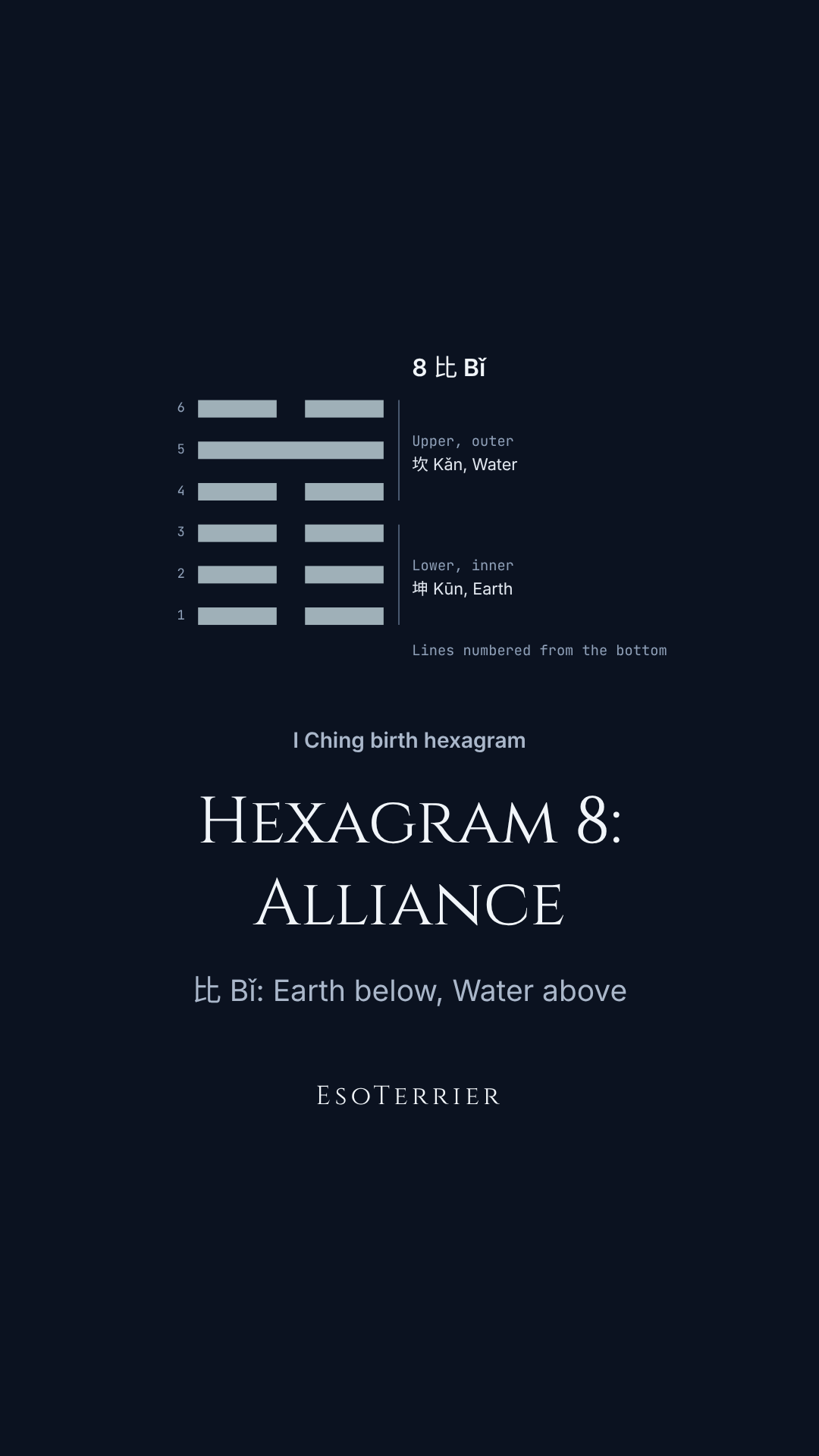
Water poured on the ground does not stay apart; it finds the low places and joins. That is the image of 比, and the character, two figures standing side by side, means to compare, to stand beside, to ally. One whole line sits in the fifth place, the ruler's seat, and the five broken lines gather round it; the tradition reads the figure as a union with a worthy centre.
The Judgment is favourable but turns the question back on the centre. Let the one people join, it says, examine himself as if by divination, to see whether his virtue is great, constant and firm; if it is, there is no error, the restless come to him, and those who come too late fare badly. The Image places the scene in the past: the early kings set up the states and kept close ties with their princes. In our reading the hexagram asks two things at once: whether the centre deserves to be joined, and whether one is joining for the right reasons and in time.
The lines
The lines grade the ways of joining. The first does it with sincerity, full "as an earthenware vessel is of its contents", in Legge's words; the second joins from within; the third seeks union with the wrong people; the fourth looks beyond itself to the centre. The fifth gives the hexagram's most famous picture, the king hunting on three sides only and letting the game that runs ahead escape: union offered, never forced. The top line seeks to join with no beginning to stand on, and the text marks it with ill fortune.
Its pair is 師, hexagram 7, the army; within 比 lies 剝, hexagram 23.
In the birth cast
The time cast arrives at 比 when the year, month and day leave 6 on eight, which puts 坎 water above, and the same total with the hour added leaves 0, counted as 8, which puts 坤 earth below. Which line moves depends on what the whole total leaves on six, and each line turns the figure into a different hexagram:
- Line 1 (初六) moving: becomes 3 屯 Zhūn, First Shoots
- Line 2 (六二) moving: becomes 29 坎 Kǎn, The Abyss
- Line 3 (六三) moving: becomes 39 蹇 Jiǎn, Obstruction
- Line 4 (六四) moving: becomes 45 萃 Cuì, Gathering
- Line 5 (九五) moving: becomes 2 坤 Kūn, Earth's Yielding
- Line 6 (上六) moving: becomes 20 觀 Guān, Looking Out
Lines 2 to 5 give the hexagram within, 23 剝 Bō, Stripping Away. Everyone born in the same lunar day and double hour has the same cast, so the figure describes a moment, not a person.
Correspondences
Each item with how it stands: “sourced” is in the work cited, “our construction” is EsoTerrier’s own, and “disputed” means the sources disagree.
- Trigram virtues (Shuogua, chapter 7)
- 坤 yielding, compliant below; 坎 sinking, perilous above, in our English sourced
- Trigram family places (Shuogua)
- mother below, middle son above sourced
- Trigram body and animal images (Shuogua)
- belly and ox below; ears and pig above sourced
- Trigram phases (a classical correspondence: the Plum Blossom text's table)
- Earth below, Water above. The Han assignment of 梅花易數, book 1, also used by Jing Fang; not stated as such in the Zhouyi sourced
- Inverse and opposite
- Upside down: 7 師 Shī, The Army; every line flipped: 14 大有 Dà Yǒu, Great Possession sourced
- Human Design gate
- Gate 8, from 54.5° to 60.125° of the tropical zodiac on Ra Uru Hu's wheel (1987): a modern placing, not the I Ching's sourced
- Our English title
- Alliance: EsoTerrier's own, from the sense of 比 our construction
How the schools read it
- The Zhouyi, in Legge's translation (1882)
- “Those who have not rest will then come to him; and with those who are (too) late in coming it will be ill.”
- The Image (大象), one of the Wings, in our paraphrase
- Water over the earth; the ancient kings set up the states and kept a close relation with their princes.
- The Plum Blossom method (Ming)
- A figure reached by numbers: 坎 above when the year, month and day leave 6 on eight, 坤 below when the same total with the hour leaves 0.
- Human Design (Ra Uru Hu, 1987)
- Takes the number for its gate 8 and puts it on the zodiac; its own reading, which we do not quote.
- EsoTerrier
- Water on the earth: people drawing together around a centre worth joining; deciding early is favoured, and those who hold back to the end find the circle closed.
Claims about it
-
Gate 8 of Human Design, at 54.5° to 60.125° of the zodiac, is where the I Ching itself places hexagram 8.
falseWhat the record shows: The wheel is Shao Yong's circle rotated by Ra Uru Hu in 1987 to 1989 so that hexagram 41 starts at 2° Aquarius. No Chinese source we found puts the hexagrams on degrees of the zodiac.
-
Being born under 比 Bǐ fixes a person's character.
unverifiedWhat the record shows: A modern reading with no source in the tradition. The Zhouyi has no birth hexagram; the cast reads a figure, not a person, and everyone born in the same lunar day and double hour shares it.