Meaning
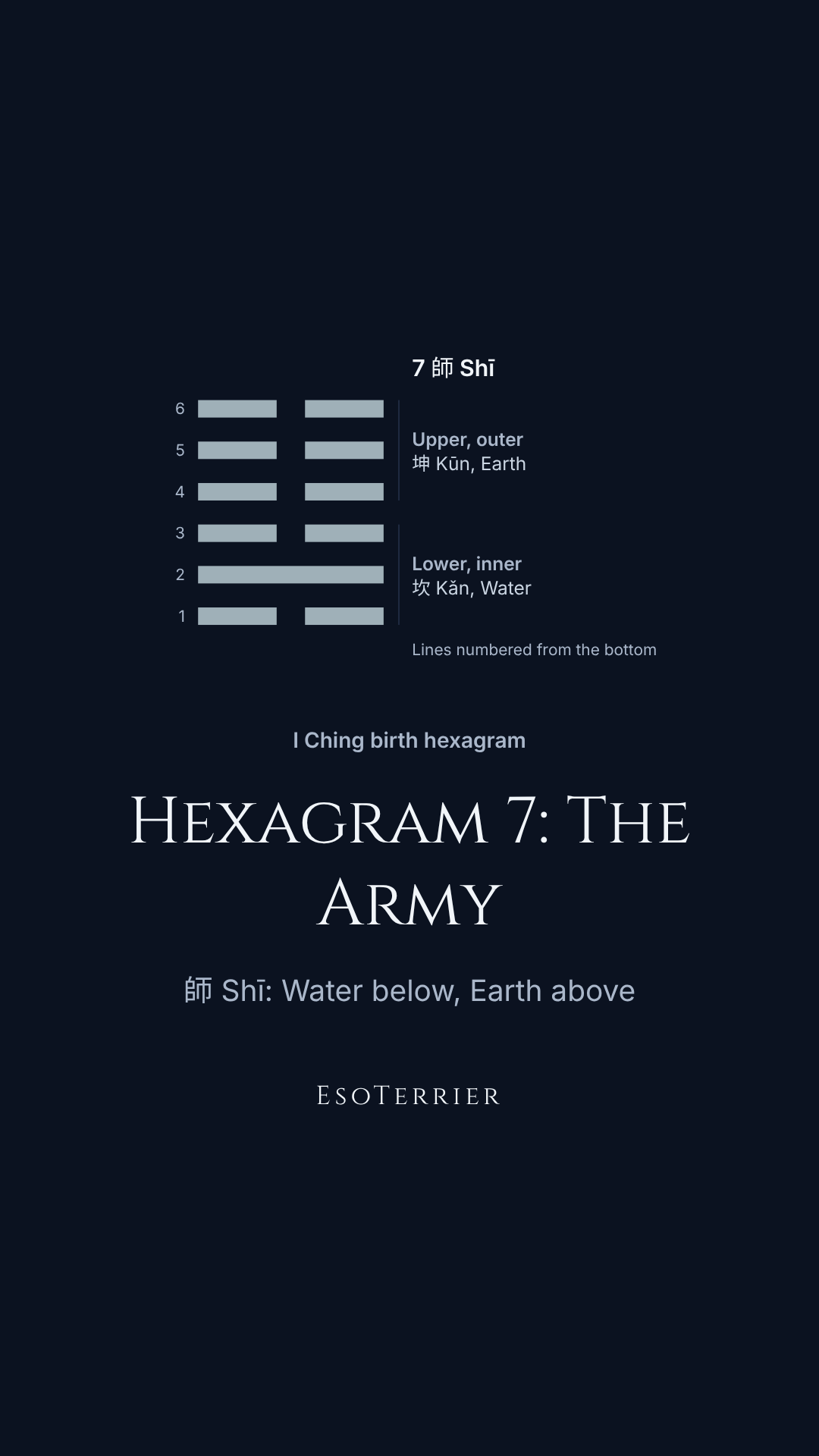
Under the earth there is water, unseen and there to be drawn. The hexagram reads the picture politically: within a people lies the army that can be raised from it, and the one yang line in the second place is its commander among the five yin lines. 師 means a troop or a multitude.
The Judgment is short and conditional. Good fortune and no error, it says, with firmness and correctness and a leader of age and experience; without those, a host is a danger to its own side. The Image draws the lesson from the hidden water: a ruler who feeds and teaches the people has a reserve to draw on when it is needed. Read in our own words, 師 is about how the many are organised: discipline from the first step, a lead whose authority is earned, and an aim that justifies the effort. It is a figure for order in a group, not a call to anything.
The lines
The lines follow a campaign. At the start the host goes out by its rules, and if the rules are bad there is trouble; in the second place the commander stands in the midst of the host and the king's favour reaches him three times. The third line warns of too many leaders, the fourth "shows the host in retreat", in Legge's words, and is not blamed for it, and the fifth sends the eldest to lead, warning against giving the work to the young and idle. At the top the campaign is over and the ruler hands out fiefs and offices, with the rule that small men are not to be given them.
Its pair is 比, hexagram 8, the same lines upside down; its opposite is 同人, hexagram 13.
In the birth cast
The time cast arrives at 師 when the year, month and day leave 0, counted as 8 on eight, which puts 坤 earth above, and the same total with the hour added leaves 6, which puts 坎 water below. Which line moves depends on what the whole total leaves on six, and each line turns the figure into a different hexagram:
- Line 1 (初六) moving: becomes 19 臨 Lín, Drawing Near
- Line 2 (九二) moving: becomes 2 坤 Kūn, Earth's Yielding
- Line 3 (六三) moving: becomes 46 升 Shēng, Ascent
- Line 4 (六四) moving: becomes 40 解 Xiè, Release
- Line 5 (六五) moving: becomes 29 坎 Kǎn, The Abyss
- Line 6 (上六) moving: becomes 4 蒙 Méng, The Untaught Mind
Lines 2 to 5 give the hexagram within, 24 復 Fù, Return. Everyone born in the same lunar day and double hour has the same cast, so the figure describes a moment, not a person.
Correspondences
Each item with how it stands: “sourced” is in the work cited, “our construction” is EsoTerrier’s own, and “disputed” means the sources disagree.
- Trigram virtues (Shuogua, chapter 7)
- 坎 sinking, perilous below; 坤 yielding, compliant above, in our English sourced
- Trigram family places (Shuogua)
- middle son below, mother above sourced
- Trigram body and animal images (Shuogua)
- ears and pig below; belly and ox above sourced
- Trigram phases (a classical correspondence: the Plum Blossom text's table)
- Water below, Earth above. The Han assignment of 梅花易數, book 1, also used by Jing Fang; not stated as such in the Zhouyi sourced
- Inverse and opposite
- Upside down: 8 比 Bǐ, Alliance; every line flipped: 13 同人 Tóng Rén, Fellowship sourced
- Human Design gate
- Gate 7, from 133.25° to 138.875° of the tropical zodiac on Ra Uru Hu's wheel (1987): a modern placing, not the I Ching's sourced
- Our English title
- The Army: EsoTerrier's own, from the sense of 師 our construction
How the schools read it
- The Zhouyi, in Legge's translation (1882)
- “Sze indicates how, in the case which it supposes, with firmness and correctness, and (a leader of) age and experience, there will be good fortune and no error.”
- The Image (大象), one of the Wings, in our paraphrase
- Water in the midst of the earth; the superior man nourishes and educates the people and gathers the multitude from among them.
- The Plum Blossom method (Ming)
- A figure reached by numbers: 坤 above when the year, month and day leave 0 on eight, 坎 below when the same total with the hour leaves 6.
- Human Design (Ra Uru Hu, 1987)
- Takes the number for its gate 7 and puts it on the zodiac; its own reading, which we do not quote.
- EsoTerrier
- Water held within the earth: the many organised under one experienced lead, kept from turning on itself by order from the first step and a just aim.
Claims about it
-
Gate 7 of Human Design, at 133.25° to 138.875° of the zodiac, is where the I Ching itself places hexagram 7.
falseWhat the record shows: The wheel is Shao Yong's circle rotated by Ra Uru Hu in 1987 to 1989 so that hexagram 41 starts at 2° Aquarius. No Chinese source we found puts the hexagrams on degrees of the zodiac.
-
Being born under 師 Shī fixes a person's character.
unverifiedWhat the record shows: A modern reading with no source in the tradition. The Zhouyi has no birth hexagram; the cast reads a figure, not a person, and everyone born in the same lunar day and double hour shares it.