Meaning
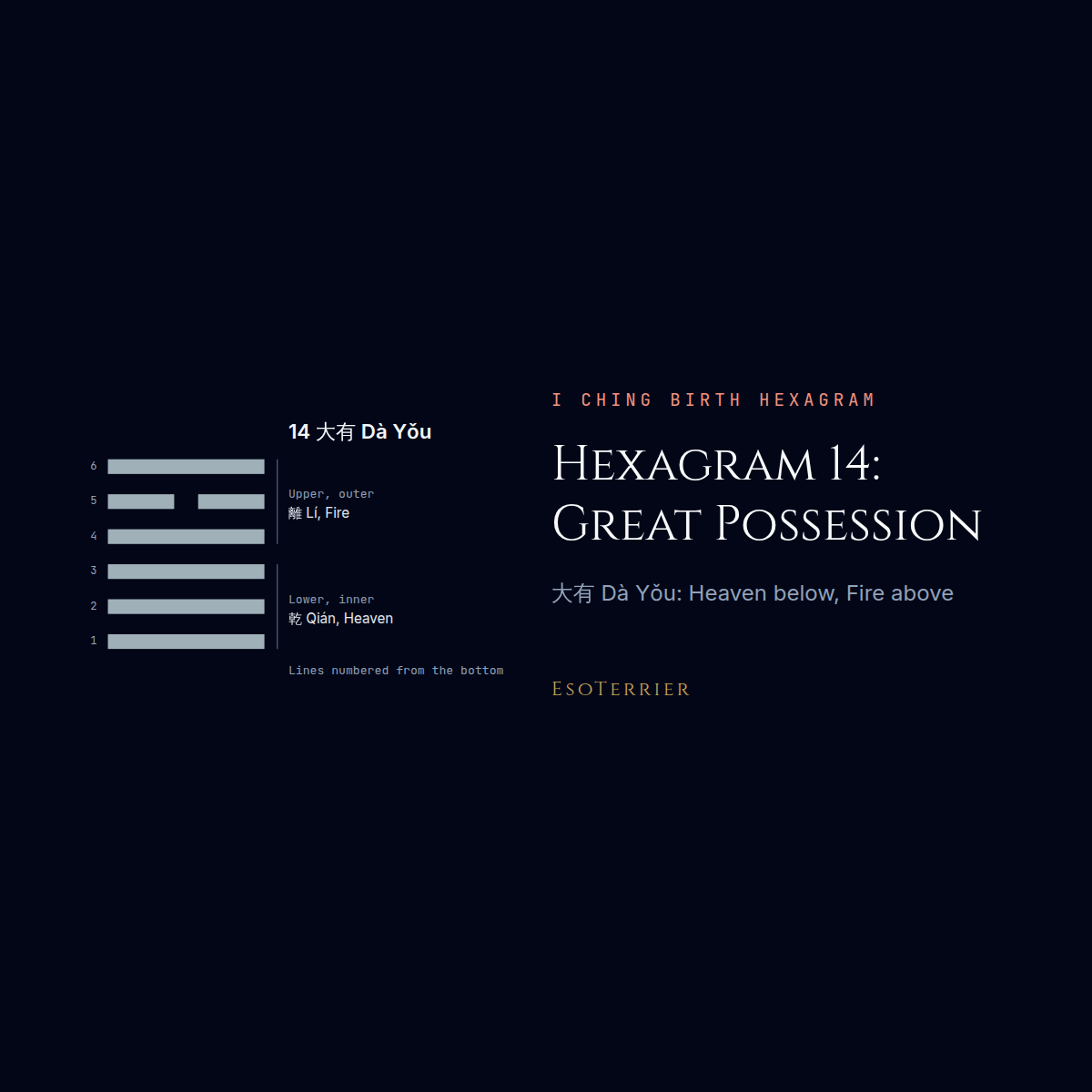
The sun stands high in the sky and everything under it is lit. That is the picture of the two trigrams, fire above heaven, and the name 大有, having much, follows from it. The one broken line sits in the fifth place, the ruler's seat, and the five strong lines are read as serving it willingly: a gentle centre holding a great deal of strength. The Judgment says almost nothing more than that the time brings great progress and success.
The Image asks what someone with much should do with it, and answers from the light overhead: check what is bad and bring forward what is good, in keeping with the nature heaven gave. In our own reading, 大有 is abundance with a duty attached. The line texts add the tradition's warning that what is held is kept by modesty and lost by display.
The lines
The first line keeps away from harm by remembering how hard its position is. The second is a large wagon with its load, able to go in any direction. The third is a prince offering what he has to the Son of Heaven, a duty a small man could not carry; the fourth keeps its great resources under restraint. The fifth, the broken line, is answered with sincerity by all the others and is told to show a proper dignity. The top line has help from heaven, and, in Legge's English, "advantage in every respect".
Its pair is 同人, hexagram 13, turned upside down; every line flipped gives 比, hexagram 8.
In the birth cast
The time cast arrives at 大有 when the year, month and day leave 3 on eight, which puts 離 fire above, and the same total with the hour added leaves 1, which puts 乾 heaven below. Which line moves depends on what the whole total leaves on six, and each line turns the figure into a different hexagram:
- Line 1 (初九) moving: becomes 50 鼎 Dǐng, The Cauldron
- Line 2 (九二) moving: becomes 30 離 Lí, Brightness
- Line 3 (九三) moving: becomes 38 睽 Kuí, Estrangement
- Line 4 (九四) moving: becomes 26 大畜 Dà Xù, Great Restraint
- Line 5 (六五) moving: becomes 1 乾 Qián, Heaven's Strength
- Line 6 (上九) moving: becomes 34 大壯 Dà Zhuàng, Great Power
Lines 2 to 5 give the hexagram within, 43 夬 Guài, Breakthrough. Everyone born in the same lunar day and double hour has the same cast, so the figure describes a moment, not a person.
Correspondences
Each item with how it stands: “sourced” is in the work cited, “our construction” is EsoTerrier’s own, and “disputed” means the sources disagree.
- Trigram virtues (Shuogua, chapter 7)
- 乾 strong, untiring below; 離 bright, attached above, in our English sourced
- Trigram family places (Shuogua)
- father below, middle daughter above sourced
- Trigram body and animal images (Shuogua)
- head and horse below; eyes and pheasant above sourced
- Trigram phases (a classical correspondence: the Plum Blossom text's table)
- Metal below, Fire above. The Han assignment of 梅花易數, book 1, also used by Jing Fang; not stated as such in the Zhouyi sourced
- Inverse and opposite
- Upside down: 13 同人 Tóng Rén, Fellowship; every line flipped: 8 比 Bǐ, Alliance sourced
- Human Design gate
- Gate 14, from 234.5° to 240.125° of the tropical zodiac on Ra Uru Hu's wheel (1987): a modern placing, not the I Ching's sourced
- Our English title
- Great Possession: EsoTerrier's own, from the sense of 大有 our construction
How the schools read it
- The Zhouyi, in Legge's translation (1882)
- “Tâ Yû indicates that, (under the circumstances which it implies), there will be great progress and success.”
- The Image (大象), one of the Wings, in our paraphrase
- Fire above the sky; the superior man represses what is evil and gives distinction to what is good, in sympathy with the Heaven-conferred nature.
- The Plum Blossom method (Ming)
- A figure reached by numbers: 離 above when the year, month and day leave 3 on eight, 乾 below when the same total with the hour leaves 1.
- Human Design (Ra Uru Hu, 1987)
- Takes the number for its gate 14 and puts it on the zodiac; its own reading, which we do not quote.
- EsoTerrier
- Fire high in heaven, shining on everything: much is held, and held in the open; the text counsels raising the good, checking the bad and making no show of what one has.
Claims about it
-
Gate 14 of Human Design, at 234.5° to 240.125° of the zodiac, is where the I Ching itself places hexagram 14.
falseWhat the record shows: The wheel is Shao Yong's circle rotated by Ra Uru Hu in 1987 to 1989 so that hexagram 41 starts at 2° Aquarius. No Chinese source we found puts the hexagrams on degrees of the zodiac.
-
Being born under 大有 Dà Yǒu fixes a person's character.
unverifiedWhat the record shows: A modern reading with no source in the tradition. The Zhouyi has no birth hexagram; the cast reads a figure, not a person, and everyone born in the same lunar day and double hour shares it.