Meaning
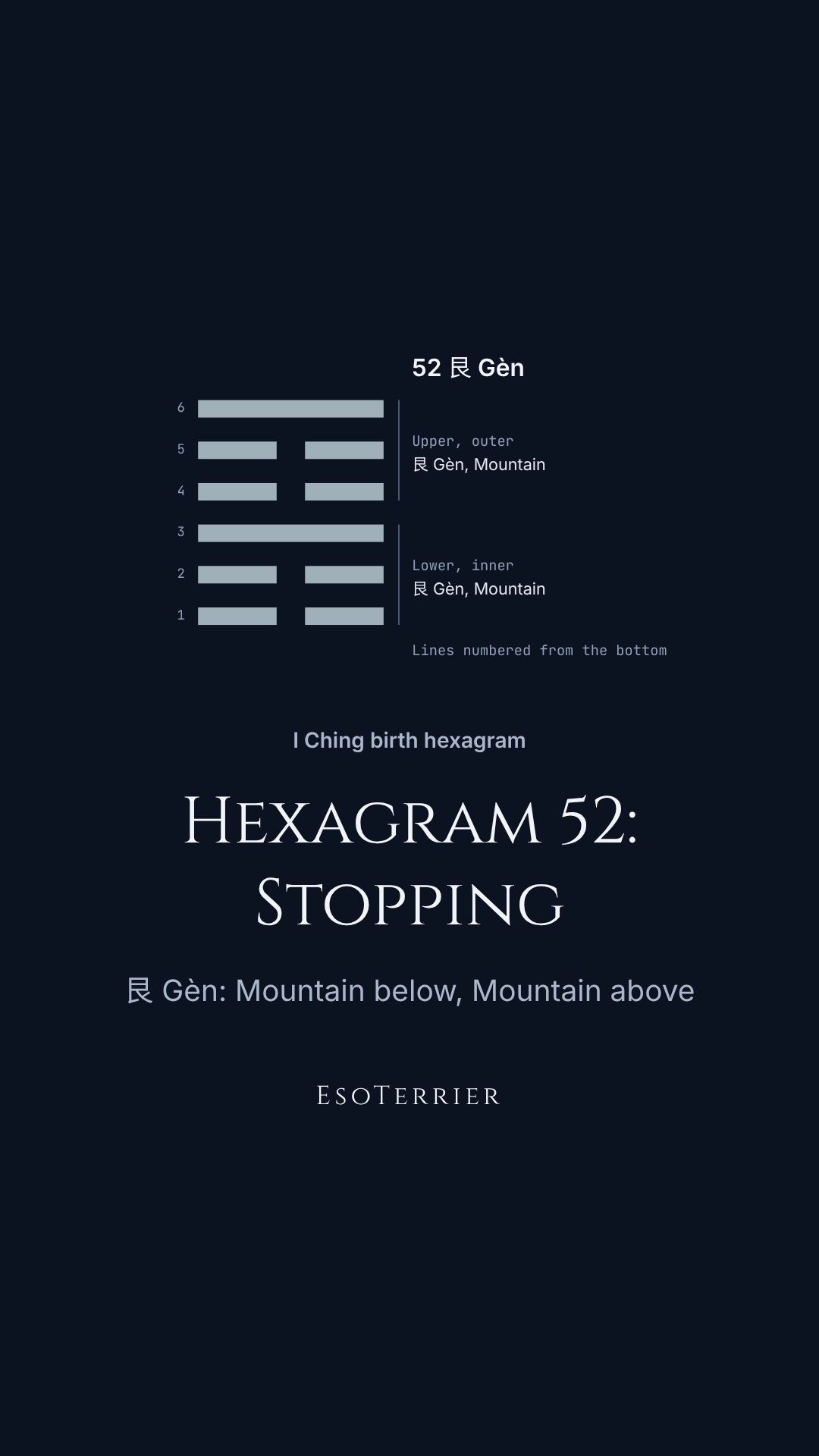
Two mountains, one on the other: the trigram of the youngest son doubled, stillness on stillness. 艮 means to stop, to stay still, and the tradition reads the hexagram as stopping well, at the right time and in the right place, not as mere inertia. The Judgment speaks through the body: resting like the back, which has no eyes, so that the self is forgotten, and walking through a courtyard without seeing the people in it, with no error.
The Image draws the lesson of the two mountains: the superior man keeps his thoughts within the bounds of his own position. The two halves do not answer each other: each line of the lower trigram meets a line of the same kind in the upper, which one of the Wings reads as the two sides not engaging, each keeping to itself. In our own reading, 艮 is quiet that is chosen, knowing when to stop moving, speaking or wanting. Its pair is 震, the shock, turned over, and its opposite, every line flipped, is 兌, hexagram 58, the open lake.
The lines
The lines follow stillness up the body. The toes come to rest first, and then the calves, which cannot help what they follow; then the loins, where stillness forced too hard leaves the heart burning. The fourth keeps the trunk at rest without error; the fifth keeps the jaws at rest, "so that his words are (all) orderly", in Legge's words. The top line is stillness that is wholehearted, and fortunate.
Within 艮 lies 解, hexagram 40; its pair is 震, hexagram 51.
In the birth cast
The time cast arrives at 艮 when the year, month and day leave 7 on eight, which puts 艮 mountain above, and the same total with the hour added leaves 7, which puts 艮 mountain below. Which line moves depends on what the whole total leaves on six, and each line turns the figure into a different hexagram:
- Line 1 (初六) moving: becomes 22 賁 Bì, Adornment
- Line 2 (六二) moving: becomes 18 蠱 Gǔ, Repairing Decay
- Line 3 (九三) moving: becomes 23 剝 Bō, Stripping Away
- Line 4 (六四) moving: becomes 56 旅 Lǚ, The Traveller
- Line 5 (六五) moving: becomes 53 漸 Jiàn, Step by Step
- Line 6 (上九) moving: becomes 15 謙 Qiān, Modesty
Lines 2 to 5 give the hexagram within, 40 解 Xiè, Release. Everyone born in the same lunar day and double hour has the same cast, so the figure describes a moment, not a person.
Correspondences
Each item with how it stands: “sourced” is in the work cited, “our construction” is EsoTerrier’s own, and “disputed” means the sources disagree.
- Trigram virtues (Shuogua, chapter 7)
- 艮 stopping, at rest, doubled, in our English sourced
- Trigram family places (Shuogua)
- youngest son, doubled sourced
- Trigram body and animal images (Shuogua)
- hands and dog, doubled sourced
- Trigram phases (a classical correspondence: the Plum Blossom text's table)
- Earth, doubled. The Han assignment of 梅花易數, book 1, also used by Jing Fang; not stated as such in the Zhouyi sourced
- Inverse and opposite
- Upside down: 51 震 Zhèn, Shock; every line flipped: 58 兌 Duì, Openness sourced
- Human Design gate
- Gate 52, from 93.875° to 99.5° of the tropical zodiac on Ra Uru Hu's wheel (1987): a modern placing, not the I Ching's sourced
- Our English title
- Stopping: EsoTerrier's own, from the sense of 艮 our construction
How the schools read it
- The Zhouyi, in Legge's translation (1882)
- “When one's resting is like that of the back, and he loses all consciousness of self …”
- The Image (大象), one of the Wings, in our paraphrase
- Two mountains, one over the other; the superior man does not let his thoughts go beyond the duties of his position.
- The Plum Blossom method (Ming)
- A figure reached by numbers: 艮 above when the year, month and day leave 7 on eight, 艮 below when the same total with the hour leaves 7.
- Human Design (Ra Uru Hu, 1987)
- Takes the number for its gate 52 and puts it on the zodiac; its own reading, which we do not quote.
- EsoTerrier
- Mountain upon mountain: stopping at the right time and in the right place, keeping the thoughts within what is one's own to do and letting the rest go by.
Claims about it
-
Gate 52 of Human Design, at 93.875° to 99.5° of the zodiac, is where the I Ching itself places hexagram 52.
falseWhat the record shows: The wheel is Shao Yong's circle rotated by Ra Uru Hu in 1987 to 1989 so that hexagram 41 starts at 2° Aquarius. No Chinese source we found puts the hexagrams on degrees of the zodiac.
-
Being born under 艮 Gèn fixes a person's character.
unverifiedWhat the record shows: A modern reading with no source in the tradition. The Zhouyi has no birth hexagram; the cast reads a figure, not a person, and everyone born in the same lunar day and double hour shares it.