How it works
Geomancy needs no birth date, no ephemeris and no tables. Everything comes from one casting, made by the person asking at the moment of asking, and from rules the old handbooks agree on. The Arabic name says how it began: marks made in sand.
The question. You may write a question and choose what it is about; the topic sets the question's house, from 1 to 12. As the casting screen says, geomancy does not answer medical, financial or legal questions, and questions about your health or about other people are best left out. The question stays in your account and never reaches the calculation.
The marks. By tradition the person asking makes sixteen lines of marks from right to left without counting them, keeping the question in mind. Only one thing is kept from each line: whether its count is odd or even. An odd line leaves one point, an even line two. In the app you tap out each line and then cross the marks off in pairs to see what is left, or let the computer cast at random, or enter four figures you cast yourself with sand, paper or dice.
The figures. Four lines make a figure: the head, the neck, the body and the feet, which Cattan gives to Fire, Air, Water and Earth from the top. With one or two points on each line there are exactly sixteen figures, and each has a Latin name, from Populus, the People, all double, to Via, the Way, all single. These four line elements are the only elements we show; the sources give a whole figure at least six different elements, so we give it none.
The shield. Lines 1 to 4 make the First Mother, read from the head down; lines 5 to 8 the Second, and so on. The four Daughters are read across the Mothers: the First Daughter is the four heads, the Second the four necks, the Third the bodies, the Fourth the feet. Two figures are added line by line, an odd sum giving one point and an even sum two, and the rest follows: Niece 1 is Mothers 1 and 2 added, Niece 2 is Mothers 3 and 4, Niece 3 Daughters 1 and 2, Niece 4 Daughters 3 and 4; the Right Witness adds Nieces 1 and 2, the Left Witness Nieces 3 and 4, and the Judge adds the two Witnesses. Because every point of the Mothers is counted twice on the way down, the Judge always has an even number of points. Cattan says a figure whose Judge comes out odd is false. Only eight figures are even, so only eight can be Judge, and each is Judge for exactly one in eight of the 65,536 possible sets of Mothers. A sixteenth figure, the Reconciler, adds the Judge to the First Mother; Hartmann calls it the Supreme Judge and Crowley the Reconciler, and we show it smaller, to be read only when the Judge is unclear.
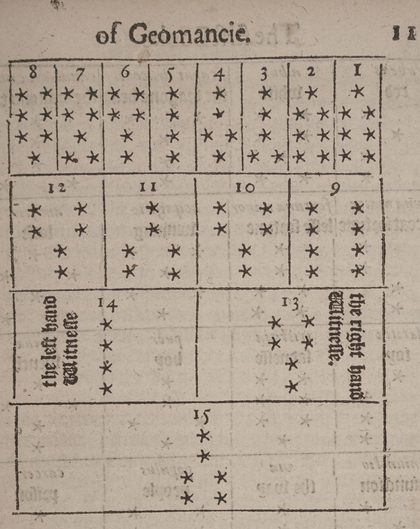
Figure 1 is a worked example. The first four counts, 3, 4, 5 and 5, are odd, even, odd, odd: one point, two, one, one, which is Puella, the First Mother. The others follow the same way, down to the Witnesses, Fortuna Major on the right and Fortuna Minor on the left, and the Judge, Via. The shield is drawn right to left, with the First Mother at the top right and the Right Witness on the right, as Cattan, Fludd, Crowley and the geomancy paper of the Hermetic Order of the Golden Dawn (founded in London in 1888) draw it; Hartmann's book of 1889 prints it the other way round.
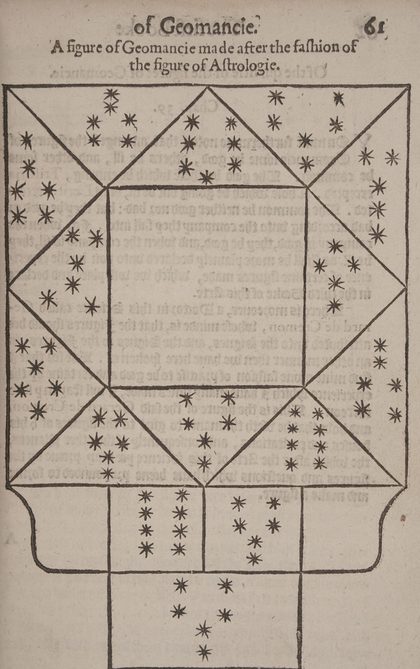
The house chart. The first twelve positions go into houses 1 to 12 in order, the “common manner” of the 1655 Of Geomancy and Hartmann's “usual way”, and the chart is the square chart of medieval astrology with the 1st house at the left, as Cattan drew it. We name the houses by their matter, in our own words: 1, life and self; 2, possessions and values; 3, siblings, news and short journeys; 4, home, land and roots; 5, children, pleasure and news; 6, work, routine and dependants; 7, partners and rivals; 8, endings and what is shared; 9, travel, beliefs and learning; 10, career and standing; 11, friends and hopes; 12, hidden matters and restraint. The old texts gave some houses harder matters, money to the second, sickness to the sixth, death and the goods of the dead to the eighth. We name these as theirs.
Reading the chart. The tradition reads the Judge as the general answer and the Witnesses as how it is reached: Hartmann takes the first as the beginning and the second as the outcome, and modern teachers the right as the asker's side and the left as the other side. The asker is always the 1st house and the matter asked about is in its own house; whether their two figures meet is called perfection, by occupation (the same figure in both), conjunction (side by side), mutation (side by side elsewhere) or translation (a third figure next to both). The modes are in Cattan's third book and come from horary astrology; they are not read when the question is about the asker. Our chart also shows company, the relation between the figures of paired houses, after the Golden Dawn paper; passing, where a house's figure appears again; and the Part of Fortune, found by adding the points of the twelve house figures and dividing by twelve, as Crowley's handbook and the Golden Dawn paper count it. The Way of the Point follows the Judge's head line back up through single points to the Mother or Daughter where the matter is rooted; this is the single-point rule of modern practice, and Cattan's older rule differs. With Rubeus or Cauda Draconis in the 1st house, the Golden Dawn paper says the figure is not to be judged; our chart says so, makes your next casting free and leaves the choice to you.
Planets and signs. Each figure's planet is the same in Cattan, Agrippa, the 1655 text, Hartmann and Crowley, except that Fludd swaps Puer and Puella; we give it with the 1655 text's note, such as Fortuna Major as the Sun by day. The two Dragon figures belong to the Moon's nodes, not to planets. Signs are another matter: the sources disagree, so we give the signs of the Astronomical Geomancy attributed to Gerard of Cremona, as printed in the English of 1655, and always say whose they are.
What a reading is. The texts in a reading are our own, written from the natures of the planets and from the 1655 text's judgements of each figure in each house, and checked against the Golden Dawn's. They describe tendencies, as the tradition reads them.
How we checked it. The sixteen figures were read against four public-domain books; the shield was compared with an independent program written from Cattan's wording for all 65,536 sets of Mothers in all sixteen positions, with no difference; and the worked examples printed by Cattan (p. 11), Hartmann (p. 38) and Crowley (pp. 142 to 143) come out exactly. Over 400,000 seeded and 60,000 random casts, each figure was equally likely in every position.
Origins and history
The word is Latin and old; the sixteen figures are Arabic and medieval; the revival is Victorian.
| When | Who | What happened |
|---|---|---|
| About 620 | Isidore of Seville | The Etymologies quote Varro's four kinds of divination, by earth, water, air and fire, which gives Latin the word geomantia. The word only: no figures, no sand. |
| 9th century | Sunan Abi Dawud 3909 | A hadith on men who divine by drawing lines: a prophet drew lines, and whoever does as he did is right. A count of marks, not the sixteen figures. |
| 10th to 12th centuries | Arabic-speaking authors | The sixteen-figure art is set down in Arabic. Manuals in Arabic and Judaeo-Arabic survive among the Cairo Genizah fragments, probably the oldest traces; Ibn al-Mahfuf presents himself as the first to standardise it. The exact origin is unknown. |
| About 1147 | Hugo of Santalla, at Tarazona in Aragon | Translates an Ars geomantiae from a lost Arabic text for Bishop Michael: the first Latin geomancy. |
| 12th century | An unknown translator, probably Gerard of Cremona at Toledo | The Estimaverunt Indi, “the Indians judged”, an anonymous Arabic text in Latin, which Burnett attributes to Gerard. |
| Mid-12th century | Bernardus Silvestris | The Experimentarius, a lot-book from the Arabic, related to geomancy. |
| 1241 to 1242 | Muhammad ibn Khutlukh al-Mawsili, probably at Damascus | A brass instrument with twenty dials for working out a casting, the oldest dated geomantic object. |
| 1266 | The monk Arsenius | Puts a treatise under al-Zanati's name into Greek verse; the Greek word rabolion is Arabic raml. Nothing reliable is known of al-Zanati himself. |
| 1277 | Étienne Tempier, Bishop of Paris | His condemnation names the Estimaverunt Indi, with a treatise on courtly love, as the only books condemned by title. |
| 1288 to 1297 | Bartholomew of Parma, at Bologna | Makes geomancy a teachable discipline tied to astrology. |
| 13th century | Thomas Aquinas | De sortibus counts geomancy among the superstitious arts. |
| About 1310 to 1320 | Dante | The opening of Purgatorio XIX: the geomancers see their Maggior Fortuna rise in the east before dawn. |
| 1377 | Ibn Khaldun | The Muqaddimah gives the best-known medieval Arabic account of the figures and rejects the art's claim to know the unseen. |
| About 1387 | Chaucer | The Knight's Tale sets two “figures of sterres”, Puella and Rubeus, over the statue of Mars. |
| March 1391 | A scribe for Richard II | MS Bodley 581, a book of advice for the young king that includes a geomancy. |
| 1533; English 1651 | Heinrich Cornelius Agrippa | Three Books of Occult Philosophy, II.48: the sixteen figures with names, planets and signs in one chapter. |
| 1558; English 1591 | Christopher Cattan; translated by Francis Sparry | The Geomancie: the whole method in print, with the square house chart and the rule that the Judge must be even. No sixteenth figure. |
| 1559; English 1655 | Attributed to Agrippa and to Gerard of Cremona | Of Geomancy and the Astronomical Geomancy in the Fourth Book of Occult Philosophy, which appeared long after Agrippa's death and which his pupil Weyer called spurious. |
| 1526 to 1586 | Elector August of Saxony | The one ruler documented using geomancy in the daily business of government. |
| 1601 to 1624 | Robert Fludd | Casts at Avignon in the winter of 1601 to 1602; prints the figures with their signs and planets in 1624, and his geomancy appears again in the Fasciculus geomanticus of 1687. |
| 1662 to 1664 | John Heydon | Theomagia, an English compilation with the figures of geomancy. |
| 18th century | Latin and vernacular handbooks | The texts are simplified and the art declines in Europe. |
| 1889 | Franz Hartmann | The Principles of Astrological Geomancy: the English revival, with a worked example and a “Supreme Judge”. |
| 1888 to 1900s | The Hermetic Order of the Golden Dawn | The order's geomancy paper: marks made while thinking of the question, its own house order, company, the Part of Fortune and the rule on Rubeus and Cauda Draconis. |
| 1909 | Aleister Crowley | A Handbook of Geomancy prints the Golden Dawn's tables and says it holds deliberate omissions. |
| 1920 | Paul Tannery | Le Rabolion, published after his death: the first modern study of the Arabic, Greek and Latin texts. |
| 1939 to 1969 | René Trautmann; Bernard Maupoil; William Bascom | Studies of Fa, sikidy and Ifá; Trautmann and Maupoil argue that Fa and sikidy come from Arabic geomancy. |
| 1980 | Thérèse Charmasson; Savage-Smith and Smith; Stephen Skinner | About 150 medieval Latin manuscripts surveyed; the 1241 instrument studied; the first modern English history and manual. |
| 1996 to 1997 | Wim van Binsbergen; Marcia Ascher; Ron Eglash | The astrological origin of the figures argued; sikidy and Bamana sand divination studied as mathematics. |
| 2005 and 2008 | UNESCO | The Ifá divination system of Nigeria proclaimed and then inscribed as intangible cultural heritage of humanity. |
| 2017 to 2025 | Palazzo, Zavattero, Villuendas Sabaté and others | Editions and studies of the earliest Latin texts, of the Genizah fragments and of Ibn al-Mahfuf. |
| 2026 | EsoTerrier | The system rebuilt as a casting tool: the old birth-date hash retired, the shield drawn right to left, the house chart, the techniques and our own texts. |
The two layouts in print. Cattan's English edition of 1591 is the fullest early account in English, and it shows both layouts the chart draws: the shield, numbered from the right, and the same casting set in the square house chart of the astrologers.
The sixteen figures
Each figure has its own page: its points and lines, its planet and its signs with their sources, how Cattan, Agrippa, the 1655 text, Hartmann and the Golden Dawn read it, its place in the shield and the houses, and the claims made about it. The eight figures with an even number of points, the only ones that can be Judge, come first, as our chart lists them.
The eight that can be Judge (an even number of points)
The eight that cannot (an odd number of points)
Variants and what we leave out
The sources disagree more than most traditions, and the differences change what a chart shows. We say what we chose and why.
- A birth chart. There is none. Every primary source casts for a question, and the nearest thing to a nativity is a fresh casting about a person's own life, which Gerard, Cattan and the 1655 text all allow. Your first casting, about your own path, stands in that place. Ifá gives a newborn a sign, but by casting, not from the date.
- Left-to-right shields. Hartmann prints the shield left to right and calls the Witnesses first and second. Our old chart was a mirror image; we now follow the right-to-left majority, which the names Right and Left Witness assume.
- The sixteenth figure. Not in Cattan or the 1655 text; the Judge plus the First Mother in Fludd, Hartmann and Crowley; formed from the Judge and the question's house in the Golden Dawn paper. One modern blog reads it as the matter's aftermath, which no older source does. We keep the first kind, as a secondary figure.
- The house placement. Besides ours there are Hartmann's angular method after Agrippa, the 1655 text's “true figure”, the Golden Dawn's order, which Crowley prints and some apps use, and Gerard's astronomical geomancy, which casts an ascendant instead of using the shield. The methods differ in eight to eleven houses for most castings. We chose the order of the 1655 text and Hartmann, the oldest in print and the simplest to explain.
- Signs. At least six schemes: the 1655 Astronomical Geomancy's, which Fludd shares and we use; Agrippa's and Cattan's own table, which differ from it for Puer and Amissio; Hartmann's, close to Agrippa's; the houses-and-exaltations scheme Cattan prints as “A figure of Gerard Cremon”; the 1655 Of Geomancy's own lists; and the Golden Dawn's, which gives the Dragons no sign. Wikipedia's signs for the Dragons are swapped.
- Elements of a figure. Six schemes again, from Cattan's to Greer's modern “inner” elements. None is shown, on the chart or on these pages.
- The Way of the Point. Cattan follows the Judge's head line whether it is single or double; the modern rule follows single points only. Our chart uses the modern rule and names it.
- The Part of Fortune. Hartmann and the 1655 text count the original marks of the sixteen lines, which the app does not keep; we use the Golden Dawn count of the twelve house figures.
- The not-judged rule. The Golden Dawn paper says to destroy the figure; Cattan judges such charts with warnings; we inform and do not enforce.
- What we do not compute. Letters and names drawn from the figures, the finding of lost things and thieves, “aspects” between houses, the Part of Spirit and reception are in Cattan, the 1655 text, Heydon and modern tools, but not in our chart.
- The Persian and Indian branch. Ramal, the Persianate geomancy surveyed by Melvin-Koushki, has its own developments, which we do not cover.
- The living African practices. Sikidy in Madagascar, the sand-divination geomancies of West Africa, the four-tablet divination of southern Africa, and the Yoruba Ifá and Fon Fa systems are described here as related traditions, whose relation to the Arabic art is debated by scholars. We do not compute or interpret them: their figures, names and readings are their own.
Myths and disputed claims
What is said about geomancy, who says it, and what the record shows. The label is ours. Several of these claims were on our own page before October 2026.
-
Geomancy has a traditional birth chart: a “birth shield” computed from a person's name and birth date.
falseWho says it: Our own app before 11 October 2026.
What the record shows: Every primary source, from Gerard and Cattan to the Golden Dawn paper, casts for a question; the nearest thing to a nativity is a fresh casting about a person's life, a 1st-house question. Our old hash of name and birth date had no source and was retired.
-
Geomancy is thousands of years old, practised by the Chaldeans or the Egyptians in the form we know.
unverifiedWho says it: Popular websites and some modern books.
What the record shows: The sixteen-figure art is first traceable in Arabic between the 10th and 12th centuries. Divination by drawn lines is older, but as a count of marks, not the sixteen figures.
-
Geomancy reached Europe in the Renaissance, through translators in Spain.
falseWho says it: Our own page before October 2026.
What the record shows: The Latin translations are twelfth-century: Hugo of Santalla at Tarazona about 1147, and the Estimaverunt Indi in the same century. The Renaissance is when the printed handbooks came.
-
Shakespeare mentions geomancy.
unverifiedWho says it: Our old page writer's notes and several websites.
What the record shows: No passage was found in a full-text search of the complete works. The literary mentions are Dante's and Chaucer's.
-
The Nieces are the intersection of the Mothers and the Daughters.
falseWho says it: Our own page before October 2026.
What the record shows: Nieces 1 and 2 come from the Mothers alone and Nieces 3 and 4 from the Daughters alone, in every primary source.
-
The Right Witness shows your inner psychology and the Left Witness what is outside your control.
disputedWho says it: Our own page before October 2026; looser versions on teaching sites.
What the record shows: Hartmann reads the first Witness as the beginning and the second as the outcome; modern pages read the right as the asker's side; the Golden Dawn paper gives the Witnesses no meaning of their own. The psychology has no source.
-
The Reconciler shows the long-term aftermath of the matter.
disputedWho says it: One modern blogger, and our own page before October 2026.
What the record shows: Cattan and the 1655 text have no sixteenth figure; Fludd, Hartmann and Crowley form it from the Judge and the First Mother; the Golden Dawn paper forms it differently. We read it only when the Judge is unclear.
-
Geomancy is a deterministic binary oracle that works like a computer's logic gate, and led to binary computing.
disputedWho says it: Our own page before October 2026; popular writing on African fractals.
What the record shows: Only the building of the shield is fixed; the Mothers are chance and the judgement the diviner's. Adding lines can be described as binary, a modern description. Leibniz credited binary to the Chinese hexagrams, not to geomancy.
-
The Yoruba Ifá and the Fon Fa systems derive from Arabic geomancy.
disputedWho says it: Trautmann (1939) and Maupoil (1943), and many writers after them.
What the record shows: They share sixteen four-line signs, and their ways of interpretation differ greatly. Eglash argues the opposite direction, and Dianteill (2025) sets out both views. Whether and how they are related is debated.
-
Madagascar's sikidy and the four-tablet divination of southern Africa are copies of Arabic geomancy.
disputedWho says it: Simplified accounts of the scholarship.
What the record shows: Most scholars hold that sikidy comes from Arabic geomancy, and van Binsbergen argues that the four-tablet system formed under its influence about 500 years ago; both are reconstructions, and neither practice is a copy.
-
Each figure has one zodiac sign.
disputedWho says it: Most handbooks and websites, each with its own table.
What the record shows: At least six schemes disagree, and two texts that name Gerard of Cremona give different signs. We show the 1655 Astronomical Geomancy's, always labelled as Gerard's.
-
Geomancy is the same thing as Chinese feng shui.
falseWho says it: Older English usage, and pages that mix the two.
What the record shows: A shared English word for two unrelated practices. The Latin geomantia was applied to the Arabic art in the 12th century and only much later to Chinese siting practice.
-
The Way of the Point follows only single points, and there is none when the Judge's head line is double.
disputedWho says it: Modern practice, and our chart, which labels it so.
What the record shows: Cattan's chapter takes the Judge's first line “be it even or odd” and follows whichever figure matches it, preferring a single point. Our chart uses the modern rule and names it.
-
A chart with Rubeus or Cauda Draconis in the 1st house must be destroyed.
disputedWho says it: The Golden Dawn paper.
What the record shows: A rule of the Golden Dawn, not of every source: Cattan judges such charts with warnings. We say the chart is not judged by that rule, make the next casting free, and leave the choice to you.
-
The Golden Dawn's order of the houses, the first figure in the 10th, is the traditional house chart.
disputedWho says it: Golden Dawn-derived books and some apps.
What the record shows: It is one of five placements in print. The 1655 text's “common manner” and Hartmann's “usual way” put positions 1 to 12 in houses 1 to 12, as we do.
-
Geomancy died out in the 17th century.
disputedWho says it: A 1990 study, as summarised in a bibliography.
What the record shows: It thinned in Europe in the 18th century, was revived in English in 1889, and the Arabic and African practices never stopped.
Stories and lore
These are told as their tellers told them.
Jibril and Idris. The manuals tell that the prophet Idris, whom Islamic lore identifies with Hermes and with Enoch, was tracing lines in the sand when the angel Jibril came and taught him the art; in another version the angel came in a dream and drew the first figure. The chain of teachers printed under al-Zanati's name runs from Jibril to Idris and on through named masters, and West African diviners told Maupoil the same story of their own art. It is the tradition's origin legend, not evidence that the art began with Hermes.
The prophet who drew lines. A hadith tells of a companion who asked about men who divine by drawing lines, and of the answer that a prophet drew lines, so whoever does as he did is right. The geomancers took it as their warrant, and their manuals name the prophet as Idris or Daniel, which the hadith does not.
“The Indians judged.” The Estimaverunt Indi opens by giving its teaching to the Indians, and the Arabic texts name a legendary Tumtum al-Hindi; the Latin texts also claim Hermes. Palazzo counts these origin stories among the ideas every geomantic text shares.
The daughter of astronomy. A Florentine manuscript calls geomancy “the daughter of astronomy”, founded on her; Hugo of Santalla's prologue says the art arose to make up for astrology's defects; Fludd called it terrestrial astrology, the name Skinner gave his history.
The condemned book. In 1277 the Bishop of Paris condemned the Estimaverunt Indi by name beside a treatise on courtly love. Scholars read the fear behind it as the art's claim to know past, present and future, and the prayers said before the lines were drawn.
Dante's Greater Fortune. At the start of Purgatorio XIX the geomancers see their Maggior Fortuna rise in the east before dawn, a group of stars in the figure's shape. It is Dante's only mention of the art, and his early commentators explained the method from it.
Chaucer's Mars. In the temple of Mars, Chaucer writes, “ther shynen two figures / Of sterres ... That oon Puella, that other Rubeus”: the two figures the old books give to Mars.
A book for a king. In March 1391 a handsome volume was made for Richard II with a geomancy in it; scholarship reads it as a book of advice for a young ruler, not an oracle of state. Charles V of France owned geomantic books too.
Fludd at Avignon. Robert Fludd cast geomantic figures at Avignon in the winter of 1601 to 1602, and later wrote up what happened; the episode is the subject of a study by Josten.
Crowley's omissions. The 1909 handbook says it holds deliberate omissions, so whether its house order is one of them cannot be known.
Hartmann's slip. Hartmann's worked example calls its Third Mother Fortuna Major while printing Fortuna Minor, and every figure he derives follows the printed one.
Evidence and criticism
The history. Palazzo, Charmasson and the SISMEL volume of 2017 are the current scholarship: geomancy appears in the Arabic world in the Middle Ages, enters Latin Europe in the twelfth century, survives in about 150 Latin manuscripts and declines in the eighteenth century. The Tübingen project on Ibn al-Mahfuf says the exact Arabic origin is unknown.
An astrological origin? Tannery and van Binsbergen argue that the sixteen figures come from astrology, by way of the Moon's mansions, and the 1241 instrument ties the figures to the mansions on its central dial. It is an argument, not a settled fact.
The African relatives. Trautmann and Maupoil argued that Fa and sikidy come from Arabic geomancy; Eglash argued for an African origin of the whole family; Dianteill sets out both and the differences between the ways of interpretation; van Binsbergen reconstructs the four-tablet system of southern Africa as a meeting of local divination and Arabic geomancy about five hundred years ago; Ascher and Chemillier analyse sikidy's rules as mathematics. The question is open.
The medieval critics. Tempier's condemnation, Aquinas' De sortibus and Ibn Khaldun's Muqaddimah all reject geomancy's claim to know hidden things.
The tradition argues with itself. The signs (at least six schemes), the elements (six), the planets of Puer and Puella (Fludd against the rest), the house placement (five methods), the sixteenth figure (three positions), the Way of the Point (two rules) and the phase of the Moon for Via and Populus (Cattan against the 1655 text) are all in dispute. Each figure's page gives the disagreement where it falls.
The binary story. Each line is single or double, so a figure can be written as four binary digits and the adding of lines as addition without carry, a modern description. The claim that geomancy led through Llull and Leibniz to the computer has been rebutted: Leibniz credited binary numbers to the Chinese hexagrams and thought little of geomancy.
Chance and judgement. Only the building of the shield is fixed. The Mothers come from chance, and every primary source makes the diviner's attention and judgement essential. Our own check found every figure equally likely in every position, and a hand-cast line's slight lean towards even counts washed out by the Judge.
No evidence of effect. We know of no study that tests whether a geomantic casting predicts anything, and van Binsbergen, an anthropologist who studied divination at first hand, stresses how much rests on the diviner, however exact the procedure looks.
Rights and names. We quote only works in the public domain: Cattan, the 1655 texts, Agrippa, Hartmann, Crowley's 1909 handbook, Dante and Chaucer. The Golden Dawn paper, Regardie, Greer, Skinner, Block and the modern scholars are used for facts only. “The Hermetic Order of the Golden Dawn” is a registered trade mark of a present-day group in the United States; we use it only for the historical order, and name nothing of ours after it.
Terms
- Geomancy
- Here only the Arabic and Latin art of the sixteen figures. The English word is also used for Chinese feng shui and for “earth mysteries”, which are unrelated and which we never mean.
- *'Ilm al-raml*, *khatt al-raml*, *ramal*
- Arabic for “the science of the sand” and “marking the sand”; ramal is the Persian and Indian branch. Greek rabolion is raml with a Greek ending.
- Figure
- Four lines, head to feet, each of one point or two: sixteen possible figures, each with a Latin name, such as Populus (the People) or Fortuna Major (the Greater Fortune).
- Lines and points
- The head, neck, body and feet of a figure, standing for Fire, Air, Water and Earth. A single point is odd and active, a double point even and passive.
- Marks
- The uncounted strokes made for each of the sixteen lines (“pricks” and “points” in Cattan). Only whether a line's count is odd or even is kept.
- Shield
- The stepped chart of sixteen positions: four Mothers, four Daughters, four Nieces, two Witnesses, the Judge and the Reconciler. Cattan calls it simply “the figure”.
- Mothers, Daughters, Nieces
- The four figures made from the marks; the four read across them line by line; and the four made by adding Mothers 1 and 2, Mothers 3 and 4, Daughters 1 and 2, Daughters 3 and 4.
- Right and Left Witness
- The sum of Nieces 1 and 2, standing on the right, and of Nieces 3 and 4, on the left. Traditionally read as how the answer comes about.
- Judge
- The sum of the two Witnesses, read as the general answer. It always has an even number of points, so only eight figures can be Judge.
- Reconciler
- A sixteenth figure, the Judge added to the First Mother: Hartmann's “Supreme Judge”, Crowley's “Reconciler”. Read only when the Judge is unclear. The Golden Dawn's own Reconciler is a different figure.
- House chart
- The square chart of twelve houses borrowed from medieval astrology, into which the first twelve figures are placed, the 1st house at the left.
- Querent and quesited
- The person asking, always the 1st house, and the thing asked about, in the house of its topic.
- Perfection
- Whether the querent's and the quesited's figures come together: by occupation, conjunction, mutation or translation. In Cattan's third book; the terms come from horary astrology.
- Company
- How the figures of paired houses (1 and 2, 3 and 4, and so on) relate: simple, demi-simple, compound or capitular, after the Golden Dawn paper.
- Part of Fortune
- A house found by adding the points of the twelve house figures and dividing by 12, as Crowley's handbook and the Golden Dawn paper count it.
- Way of the Point
- The Judge's head line followed back up the shield to the Mother or Daughter where the matter is rooted. We use the single-point rule of modern practice; Cattan's older rule differs.
- Entering, going out, “meane”
- Cattan's qualities: figures with more points above than below are entering and good, those with more below are going out and ill, the even ones “meane”, with Tristitia, Laetitia and Carcer as his named exceptions.
- Not judged
- The Golden Dawn paper's rule that a chart with Rubeus or Cauda Draconis in the 1st house is set aside. Our chart says so and does not enforce it.