Meaning
Puella is Venus in good condition: grace, pleasantness, attraction and peace. Cattan's translator renders it "wench", and Agrippa's table of 1651 glosses it "A Girle" and "Beautifull". Hartmann's verdict marks its limit: "pleasant but not very fortunate". The Hermetic Order of the Golden Dawn's handbook makes it good in all questions, especially those about women. In our own words, it favours love, friendship, the arts and anything that needs charm rather than force, and is weak where hard work or endurance is needed.
In the shield
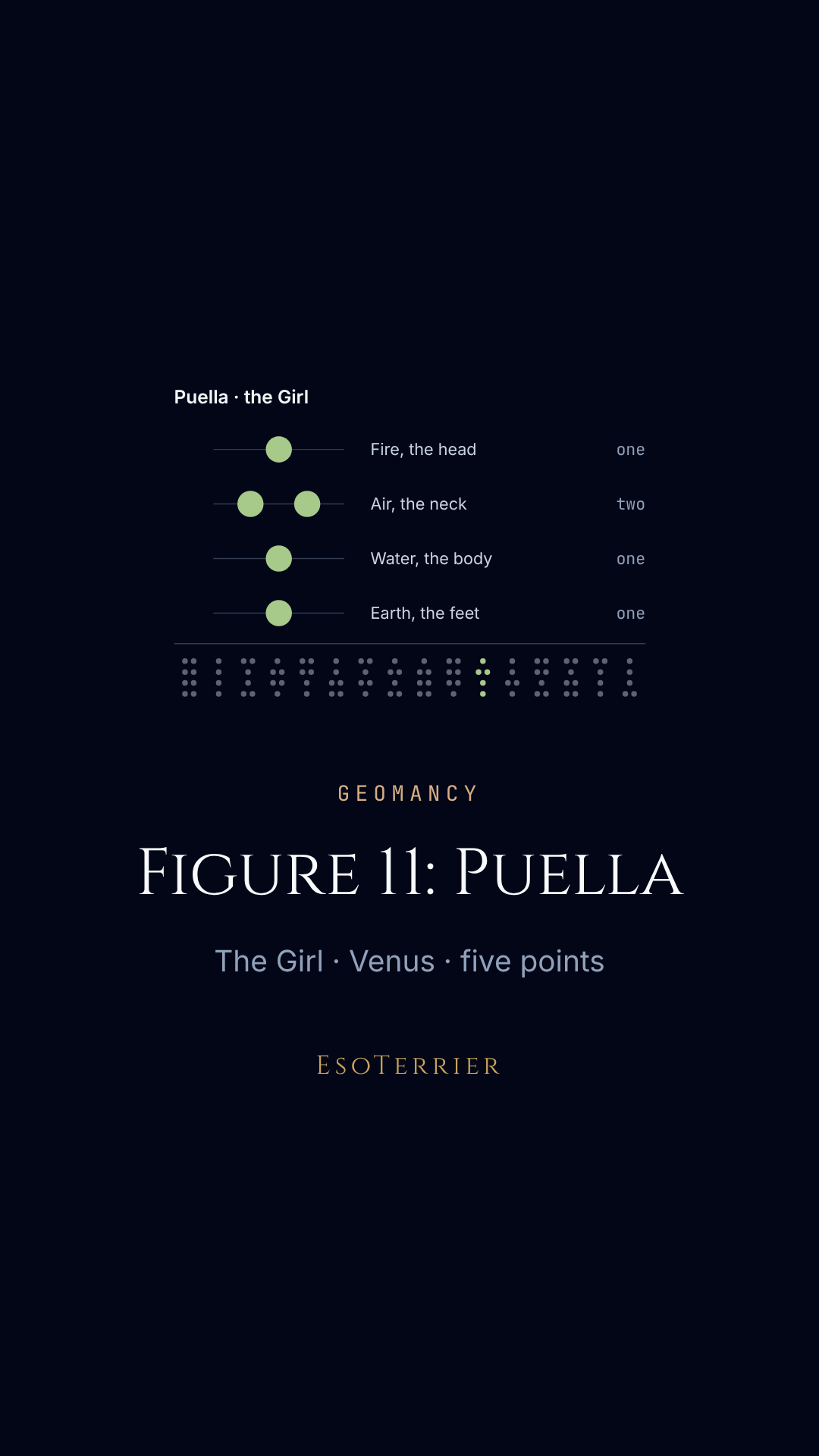
Puella has five points, so it can never be Judge. Its quality is disputed: read as head against feet, Cattan's rule makes it "meane", neither entering nor going out, while the modern table calls it entering. Its head line is single, so the Way of the Point can pass through it. Turned upside down it becomes Puer, the Boy, and the pair are the tradition's girl and boy; with every point swapped it becomes Rubeus. Its partner under Venus is Amissio. In the sample casting on the Geomancy page it is the First Mother, so it stands in the 1st house.
Chaucer's Mars, Fludd's swap, and the sign
In The Knight's Tale Chaucer sets two figures of stars over the statue of Mars, "That oon Puella, that other Rubeus". Rubeus is a figure of Mars in every handbook; Puella is Venus's in all but one. Cattan, Agrippa, the 1655 text, Hartmann and the Golden Dawn give Puella to Venus; Fludd alone, in 1624, gives it to Mars and Puer to Venus, which may be a printer's swap. Its sign is the rare one every scheme agrees on: Libra, a sign of Venus.
Correspondences
Each item with how it stands: “sourced” is in the work cited, “our construction” is EsoTerrier’s own, and “disputed” means the sources disagree.
- Planet
- Venus in Cattan, Agrippa, the 1655 text, Hartmann and Crowley; Mars in Fludd (1624) disputed
- Direct or retrograde (Cattan, p. 54)
- Venus direct sourced
- Sign, Gerard's scheme (ours)
- Libra sourced
- Sign, other schemes
- Libra in all of them: Agrippa (1651), Cattan's table (p. 56), his “Gerard Cremon” (p. 63) and the Golden Dawn (1909) sourced
- Quality (Cattan's rule)
- “meane” (common) if the head line is weighed against the feet; entering in the modern table disputed
- Lines
- Single, active: Fire (head), Water (body) and Earth (feet); double, passive: Air (neck) sourced
- In Chaucer
- Over the statue of Mars with Rubeus (The Knight's Tale, lines 2043 to 2045 in Skeat) sourced
- Our keywords
- Harmony, charm, receptiveness our construction
How the schools read it
- Cattan (1591)
- Calls it “wench”; “meane” (common) if the head line is weighed against the feet; entering in the modern table.
- Agrippa (1651)
- Glosses it “A Girle”, “Beautifull”.
- *Of Geomancy* (1655)
- Venus fortunate (Venus well placed).
- Hartmann (1889)
- “Puella, Girl, pretty face, is pleasant but not very fortunate.”
- The Golden Dawn (Crowley, 1909)
- “Good in all demands, especially those relating to women”
- Modern practice (Greer, as reported)
- Calls it stable, giving a direction even to a figure the old rule calls “meane”.
- EsoTerrier
- Harmony, charm, receptiveness (our one-line reading in the chart).
Claims about it
-
Puella is a figure a person is born under, worked out from a name and a birth date.
falseWhat the record shows: No source makes a geomantic figure from birth data; every casting is for a question. Our own app did this until October 2026, and the method was retired.
-
Puella has one zodiac sign.
disputedWhat the record shows: Every scheme we read gives it Libra, a rare agreement; elsewhere at least six schemes disagree, so we still say whose sign we show.
-
Puella has an element of its own.
disputedWhat the record shows: The sources give the figures at least six different sets of elements. We show only the four line elements, never an element for the whole figure.