Meaning
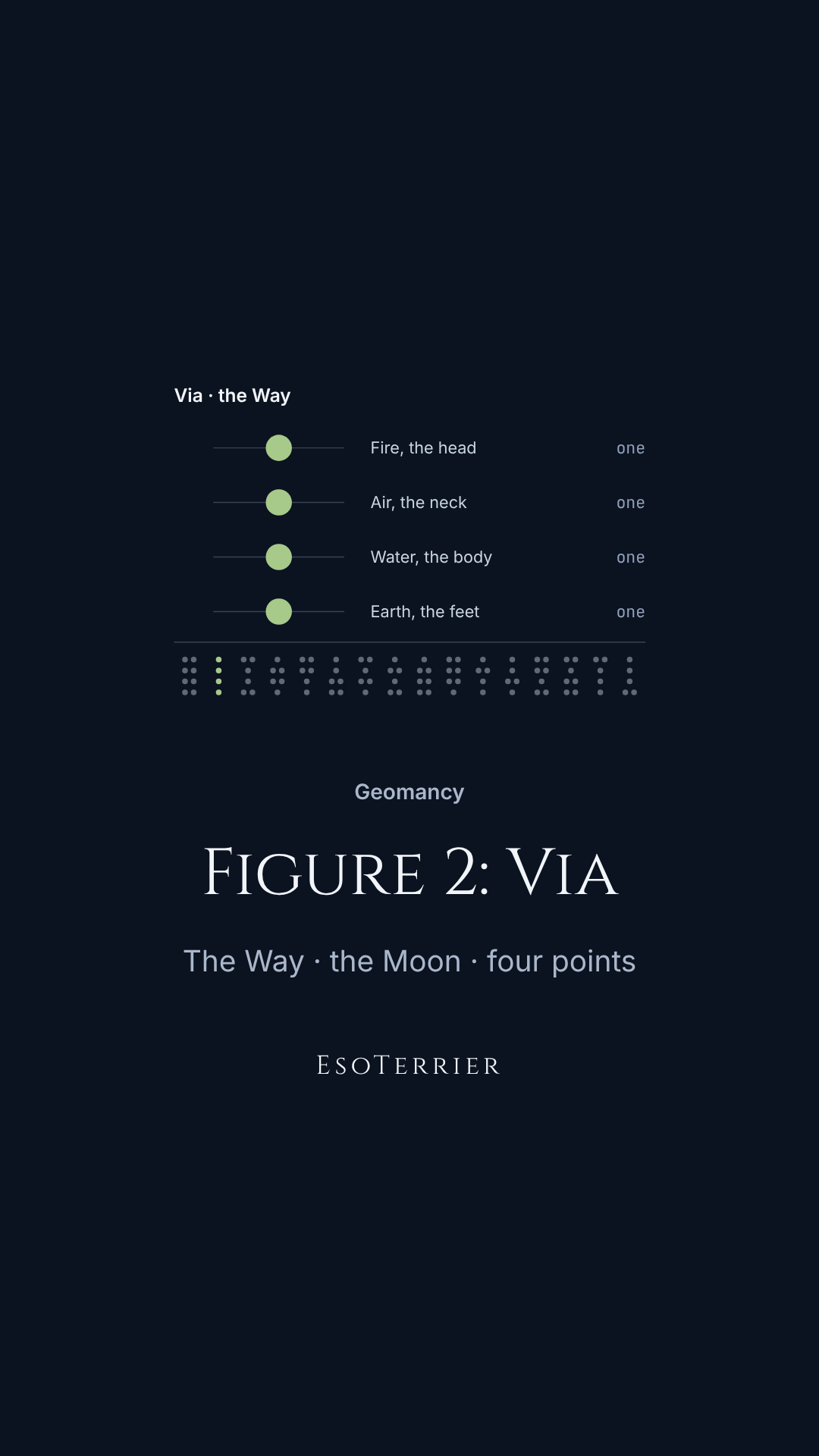
Via is a road drawn in points, every line single and active. The tradition reads it as change, departure and movement, and as a journey. Hartmann calls it "neither good nor bad", its quality set by the house it stands in, and the Hermetic Order of the Golden Dawn's handbook reads it as "injurious to the goodness of other figures generally, but good for journeys". In our own words, it favours whatever is already moving or looking for a way out, and goes against what the asker hopes to keep. As the Judge, the tradition's answer is change: the matter moves on.
In the shield
Via has four points, an even number, so it can be Judge, for one casting in eight; it is the Judge of the sample casting on the Geomancy page. Added to another figure, it turns over every line of that figure, single for double and double for single, which is why the tradition calls it the figure that changes whatever it touches. With every point swapped it becomes Populus, its partner under the Moon, and it reads the same upside down. Because its head line is single, a Judge Via always has a Way of the Point under the single-point rule we use. In the sample casting the Way runs from the Judge up through the Left Witness and the Third Niece to the First Daughter, which is Via again.
The Moon, and the signs
The sources disagree about Via's Moon as they do about Populus's. The 1655 text gives Via the Moon "from her beginning and increasing", the waxing Moon; Cattan gives it the Moon "in her decrease", and his table makes it the Moon retrograde, as Fludd does. Our chart follows the 1655 text and gives Cattan's phase beside it. In Gerard's scheme Via is Leo, as in Agrippa, Cattan's own table and Fludd; the Golden Dawn gives it Cancer, the Moon's own sign, and so does the scheme Cattan prints under Gerard's name.
Correspondences
Each item with how it stands: “sourced” is in the work cited, “our construction” is EsoTerrier’s own, and “disputed” means the sources disagree.
- Planet
- Moon, in every source checked (Cattan, Agrippa, the 1655 text, Hartmann, Crowley, Fludd) sourced
- Phase of the Moon
- waxing in the 1655 Of Geomancy; the Moon 'in her decrease' in Cattan (p. 72) disputed
- Direct or retrograde (Cattan, p. 54)
- Moon retrograde sourced
- Sign, Gerard's scheme (ours)
- Leo sourced
- Sign, other schemes
- Agrippa (1651): Leo; Cattan's table (p. 56): Leo; Cattan's “Gerard Cremon” (p. 63): Cancer; the Golden Dawn (1909): Cancer disputed
- Quality (Cattan's rule)
- “meane”: neither good nor bad, taking its quality from its company (pp. 62, 215) sourced
- Lines
- Single, active: Fire (head), Air (neck), Water (body) and Earth (feet) sourced
- Our keywords
- A road, change, movement away our construction
How the schools read it
- Cattan (1591)
- Calls it “the way”; “meane”: neither good nor bad, taking its quality from its company (pp. 62, 215).
- Agrippa (1651)
- Glosses it “Way”, “Journey”.
- *Of Geomancy* (1655)
- The Moon from her beginning and increasing (the waxing Moon).
- Hartmann (1889)
- “Via, Street or Way, is neither good nor bad; its quality, like those of all the rest, is determined by its position in the house of the astrological figure.”
- The Golden Dawn (Crowley, 1909)
- “Injurious to the goodness of other figures generally, but good for journeys”
- Modern practice (Greer, as reported)
- Calls it mobile, giving a direction even to a figure the old rule calls “meane”.
- EsoTerrier
- A road, change, movement away (our one-line reading in the chart).
Claims about it
-
Via is a figure a person is born under, worked out from a name and a birth date.
falseWhat the record shows: No source makes a geomantic figure from birth data; every casting is for a question. Our own app did this until October 2026, and the method was retired.
-
Via has one zodiac sign.
disputedWhat the record shows: Gerard's scheme gives Leo, the Golden Dawn Cancer, Cattan's page 63 Cancer. At least six schemes exist; we always name the one we use.
-
Via has an element of its own.
disputedWhat the record shows: The sources give the figures at least six different sets of elements. We show only the four line elements, never an element for the whole figure.
-
Via is the waning Moon and Populus the waxing Moon.
disputedWhat the record shows: The 1655 text has Via waxing and Populus waning; Cattan has Via “in her decrease” and Populus “in her full”. Wikipedia's waxing Populus matches neither.