Meaning
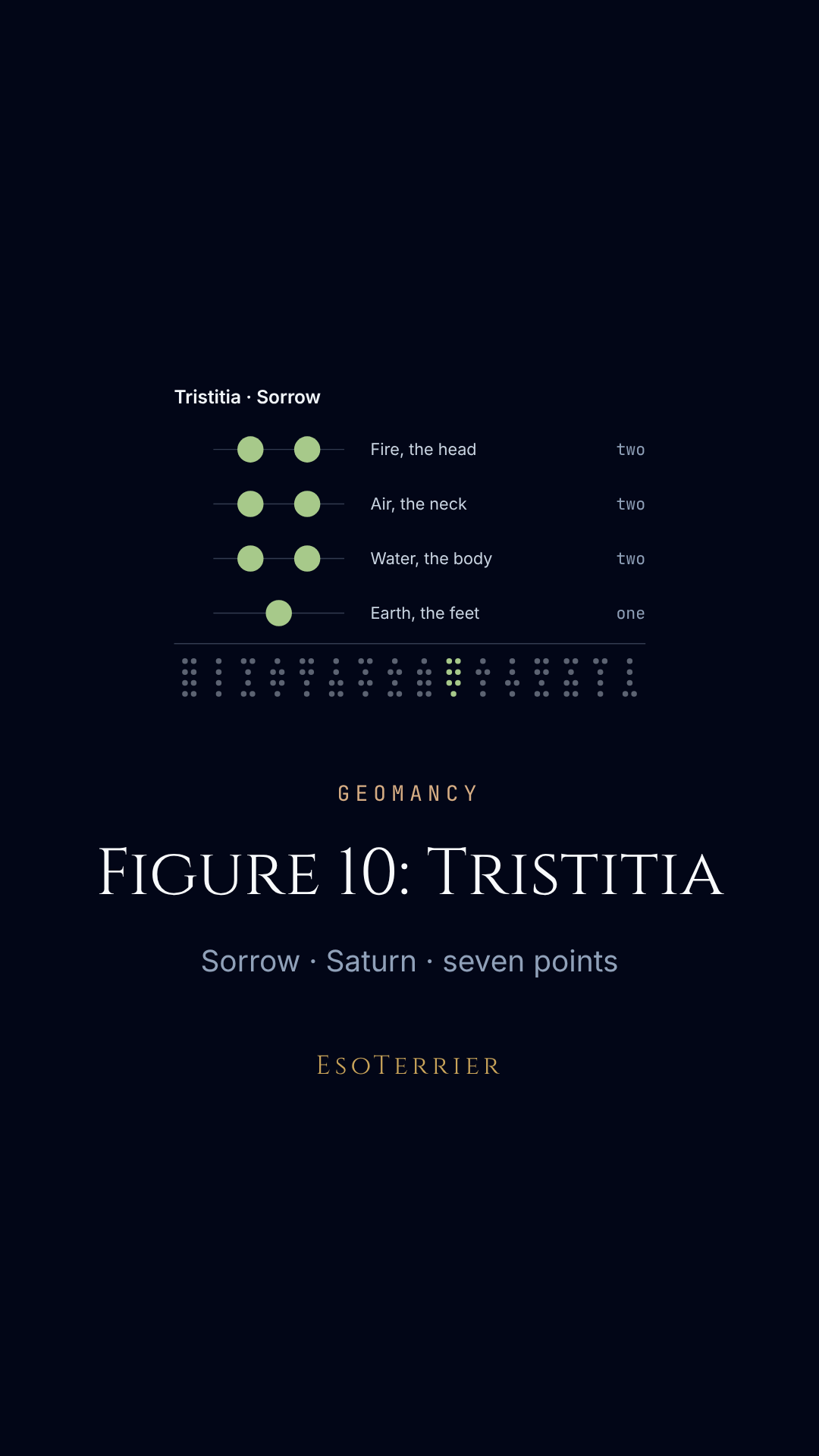
Tristitia is sorrow and sinking, and also depth: things that go down in order to stay. Cattan's translator writes "sadnesse"; Agrippa's glosses of 1651 are "Sadness", "Damned" and "Cross"; Hartmann calls it "sorrow, grief, perversion, condemnation" and "bad"; the Hermetic Order of the Golden Dawn's handbook, "evil in almost all things". Yet the tradition finds a use for it. In our own words, it is poor for most hopes and suits what needs patience and foundations: building, land, and things kept quiet. The Golden Dawn's tables allow it for working the land. Its shape gives the image: three rows of paired points weighing down on a single point at the feet, Laetitia's tower turned upside down.
In the shield
Tristitia has seven points, so it can never be Judge. More points above than below should make it an entering figure, and good, by Cattan's rule; he names it as the exception, entering and ill. Its head line is double, so the Way of the Point never runs through it under the modern rule. Turned upside down it becomes Laetitia, Joy; with every point swapped it becomes Cauda Draconis. Its partner under Saturn is Carcer, and the 1655 text calls Tristitia the lesser harm of the two.
Saturn, and the signs
Cattan's table makes Tristitia Saturn retrograde and Carcer Saturn direct, and Fludd agrees; Wikipedia's modern summary makes Carcer the retrograde one instead, and the 1655 text speaks only of greater and lesser harm. In Gerard's scheme Tristitia is Scorpio, as in Agrippa, Cattan's own table and Fludd; the Golden Dawn gives it Aquarius, a sign of Saturn, and Cattan's page 63 gives Capricorn, the other.
Correspondences
Each item with how it stands: “sourced” is in the work cited, “our construction” is EsoTerrier’s own, and “disputed” means the sources disagree.
- Planet
- Saturn, in every source checked (Cattan, Agrippa, the 1655 text, Hartmann, Crowley, Fludd) sourced
- Direct or retrograde (Cattan, p. 54)
- Saturn retrograde sourced
- Sign, Gerard's scheme (ours)
- Scorpio sourced
- Sign, other schemes
- Agrippa (1651): Scorpio; Cattan's table (p. 56): Scorpio; Cattan's “Gerard Cremon” (p. 63): Capricorn; the Golden Dawn (1909): Aquarius disputed
- Quality (Cattan's rule)
- Entering, yet ill: Cattan's one exception (pp. 62, 215) sourced
- Lines
- Single, active: Earth (feet); double, passive: Fire (head), Air (neck) and Water (body) sourced
- Our keywords
- Sorrow, going down, depth our construction
How the schools read it
- Cattan (1591)
- Calls it “sadnesse”; entering, yet ill: Cattan's one exception (pp. 62, 215).
- Agrippa (1651)
- Glosses it “Sadness”, “Damned”, “Cross”.
- *Of Geomancy* (1655)
- Saturn, the lighter of his two figures (both evil, Tristitia of the lesser detriment).
- Hartmann (1889)
- “Tristitia, Sorrow, grief, perversion, condemnation, is bad.”
- The Golden Dawn (Crowley, 1909)
- “Evil in almost all things”
- Modern practice (Greer, as reported)
- Calls it stable, the modern word for an entering figure.
- EsoTerrier
- Sorrow, going down, depth (our one-line reading in the chart).
Claims about it
-
Tristitia is a figure a person is born under, worked out from a name and a birth date.
falseWhat the record shows: No source makes a geomantic figure from birth data; every casting is for a question. Our own app did this until October 2026, and the method was retired.
-
Tristitia has one zodiac sign.
disputedWhat the record shows: Gerard's scheme gives Scorpio, the Golden Dawn Aquarius, Cattan's page 63 Capricorn. At least six schemes exist; we always name the one we use.
-
Tristitia has an element of its own.
disputedWhat the record shows: The sources give the figures at least six different sets of elements. We show only the four line elements, never an element for the whole figure.
-
Carcer is Saturn retrograde and Rubeus Mars retrograde.
disputedWhat the record shows: Cattan's table makes Carcer and Rubeus direct, Tristitia and Puer retrograde; the 1655 text speaks of greater and lesser harm, not of direction.